Organisational Behaviour
Lecture 1: Introduction 03/02/20
sosnowska20883
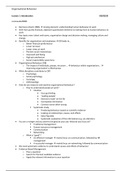
• Business schools 1980s à missing element: understanding human behaviour at work
• Shift from purely financial, objective quantitative elements to looking more at human behaviour at
work
• Key topics now: talent and teams, organisation design and decision making, managing culture and
change
• Benefits for organisation and employees à OB leads to…
o Better financial performance
o Lower turnover
o Lower stress at work
o Positive social relationships
o Improved well being
o High job satisfaction
o Social responsibility awareness
• Organisational Behaviour (OB)
o The impact of individuals, groups, structure … à behaviour within organisations… à
improving organisation’s effectiveness
• What disciplines contribute to OB?
o Psychology
o Social psychology
o Sociology
o Anthropology
• How do you measure and examine organisational behaviour?
o How to understand people at work?
§ Intuition
• Your gut feeling
• ‘reading people’
• Decisions made ‘on the fly’
• Incomplete information
• Common sense often wrong
§ Systematic study
• Predicting behaviour based on scientific evidence
• Looking at relationships, causes, and effects
• Data/ big data
• Systematic evaluation of the information (e.g. via statistics)
• You are a manger and you want to be good at your job. What do you focus on?
§ Traditional management
§ Human resources management
§ Communication
§ Networking
o What is “good”?
§ An effective manager à mainly focus on communication, followed by HR
management
§ A successful manager à mainly focus on networking, followed by communication
• We need systematic evidence to understand causes and effects of behaviour
• Evidence-Based Management
o Pose a question
o Search for the best available evidence
o Apply the relevant information to your question
Lecture 1: Introduction 03/02/20
sosnowska20883
• Business schools 1980s à missing element: understanding human behaviour at work
• Shift from purely financial, objective quantitative elements to looking more at human behaviour at
work
• Key topics now: talent and teams, organisation design and decision making, managing culture and
change
• Benefits for organisation and employees à OB leads to…
o Better financial performance
o Lower turnover
o Lower stress at work
o Positive social relationships
o Improved well being
o High job satisfaction
o Social responsibility awareness
• Organisational Behaviour (OB)
o The impact of individuals, groups, structure … à behaviour within organisations… à
improving organisation’s effectiveness
• What disciplines contribute to OB?
o Psychology
o Social psychology
o Sociology
o Anthropology
• How do you measure and examine organisational behaviour?
o How to understand people at work?
§ Intuition
• Your gut feeling
• ‘reading people’
• Decisions made ‘on the fly’
• Incomplete information
• Common sense often wrong
§ Systematic study
• Predicting behaviour based on scientific evidence
• Looking at relationships, causes, and effects
• Data/ big data
• Systematic evaluation of the information (e.g. via statistics)
• You are a manger and you want to be good at your job. What do you focus on?
§ Traditional management
§ Human resources management
§ Communication
§ Networking
o What is “good”?
§ An effective manager à mainly focus on communication, followed by HR
management
§ A successful manager à mainly focus on networking, followed by communication
• We need systematic evidence to understand causes and effects of behaviour
• Evidence-Based Management
o Pose a question
o Search for the best available evidence
o Apply the relevant information to your question