Table of Contents
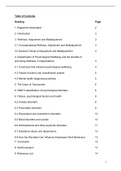
Heading Page
1. Plagiarism Declaration 2
2. Introduction 3
3. Wellness, Adjustment and Maladjustment 3
3.1 Conceptualising Wellness, Adjustment and Maladjustment 3
3.2 General Criteria of Adjustment and Maladjustment 4
4. Classification of Psychological Wellbeing and the benefits of
promoting Wellness in Organisations 4
4.1 Constructs that enhance psychological wellbeing 4
4.2 Values-in-action (via) classification system 5
4.3 Mental health diagnosed positively 5
5. The Value of Taxonomies 6
6. DSM 5 classification of psychological disorders 6
6.1 Stress, psychological factors and health 8
6.2 Anxiety disorders 8
6.3 Personality disorders 9
6.4 Dissociative and somatoform disorders 10
6.5 Mood disorders and suicide 10
6.6 Schizophrenia and other psychotic disorders 11
6.7 Substance abuse and dependence 12
6.8 How the Disorders Can Influence Employees Work Behaviour 12
7. Conclusion 12
8. Self-Evaluation 13
9. Reference List 14
1
, 2. Introduction
The content of this paper will focus around the of the classification of adjustment and
maladjustment in order to develop an overview of the different classification systems
that can be used in employee and organisational wellness. The main psychological
disorders will also be reviewed in order to create an understanding of the disorders
and how to handle these maladjustments in the workplace.
3. Wellness, Adjustment and Maladjustment
3.1 Conceptualising Wellness, Adjustment and Maladjustment
According to Hurley & Schlaadt (1992, as cited in Botha and Brand, 2009) wellness
can be defined as personal health that looks at the individual’s responsibility for
wellbeing through practicing healthy lifestyle behaviours.
It is also important to note that wellness is not only associated with psychological
satisfaction, but also with a person’s psychical health (Vazquez, Hervas, Rahona and
Gomez-Baya, 2009).
In this module, the focus is placed on the wellness of the employee. According to to
Wissing (2014, as cited in Research Report in Employee and Organisational Wellness
2020) the following three points are regarded as important to understand employee
wellness:
• leading a life of purpose – this refers to the experience of success in a person’s
work, as well as the works importance in the person's life
• deep and meaningful connections with others in all spheres of life – this also
refers to the work context.
• self-regard and mastery in a work context
To understand employee wellness, one must also understand adjustment and
maladjustment in the workplace (Research Report in Employee and Organisational
Wellness, 2020).
Work adjustment refers to the psychological adjustment of a individual at work, in order
for them to function effectively in the work place. The following are three areas that
needs to be identified for employee wellness in the workplace: intrapersonal,
3
Heading Page
1. Plagiarism Declaration 2
2. Introduction 3
3. Wellness, Adjustment and Maladjustment 3
3.1 Conceptualising Wellness, Adjustment and Maladjustment 3
3.2 General Criteria of Adjustment and Maladjustment 4
4. Classification of Psychological Wellbeing and the benefits of
promoting Wellness in Organisations 4
4.1 Constructs that enhance psychological wellbeing 4
4.2 Values-in-action (via) classification system 5
4.3 Mental health diagnosed positively 5
5. The Value of Taxonomies 6
6. DSM 5 classification of psychological disorders 6
6.1 Stress, psychological factors and health 8
6.2 Anxiety disorders 8
6.3 Personality disorders 9
6.4 Dissociative and somatoform disorders 10
6.5 Mood disorders and suicide 10
6.6 Schizophrenia and other psychotic disorders 11
6.7 Substance abuse and dependence 12
6.8 How the Disorders Can Influence Employees Work Behaviour 12
7. Conclusion 12
8. Self-Evaluation 13
9. Reference List 14
1
, 2. Introduction
The content of this paper will focus around the of the classification of adjustment and
maladjustment in order to develop an overview of the different classification systems
that can be used in employee and organisational wellness. The main psychological
disorders will also be reviewed in order to create an understanding of the disorders
and how to handle these maladjustments in the workplace.
3. Wellness, Adjustment and Maladjustment
3.1 Conceptualising Wellness, Adjustment and Maladjustment
According to Hurley & Schlaadt (1992, as cited in Botha and Brand, 2009) wellness
can be defined as personal health that looks at the individual’s responsibility for
wellbeing through practicing healthy lifestyle behaviours.
It is also important to note that wellness is not only associated with psychological
satisfaction, but also with a person’s psychical health (Vazquez, Hervas, Rahona and
Gomez-Baya, 2009).
In this module, the focus is placed on the wellness of the employee. According to to
Wissing (2014, as cited in Research Report in Employee and Organisational Wellness
2020) the following three points are regarded as important to understand employee
wellness:
• leading a life of purpose – this refers to the experience of success in a person’s
work, as well as the works importance in the person's life
• deep and meaningful connections with others in all spheres of life – this also
refers to the work context.
• self-regard and mastery in a work context
To understand employee wellness, one must also understand adjustment and
maladjustment in the workplace (Research Report in Employee and Organisational
Wellness, 2020).
Work adjustment refers to the psychological adjustment of a individual at work, in order
for them to function effectively in the work place. The following are three areas that
needs to be identified for employee wellness in the workplace: intrapersonal,
3