EC210 LT Week 1-2 - Money and Interest
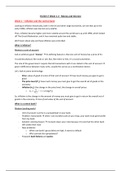
Week 1 – Inflation and the central bank
Looking at inflation historically, both in the UK and other large economies, we see that up to the
early 1900s, inflation was low but very volatile.
Then, inflation became higher and more volatile around the world wars up until 1994, which kicked
off The Great Moderation, and it has remained quite low and stable.
We’ll learn about why and how inflation was controlled.
What is inflation?
Money is a unit of account
Call an arbitrary good “money” → its defining feature is that one unit of money has a price of £1.
It could be physical, like rocks or salt. But, like metre or kilo, it’s a social convention.
The role of the government: require that all transactions with it are stated in this unit of account →
given indifference between many units, usually this serves as a coordination device.
Let’s look at some terminology:
- Price: value of good in terms of that unit of account → how much money you give to get a
good
- The price level (𝑷𝒕 ): how much money you must give to get the overall set of goods in the
economy
- Inflation (𝝅𝒕 ): the change in the price level, the change in overall prices
𝑃𝑡
o 𝜋𝑡 = − 1 ≈ Δ log(𝑃𝑡 )
𝑃𝑡−1
So, inflation is the change in the amount of money you must give to get in return the overall set of
goods in the economy → loss of real value of the unit of account.
What is a central bank?
Modern banking world
- Unit of account is entry in a spreadsheet in your bank
- Problem: many banks → when I use my debit card at your shop, your bank must get transfer
from my bank
- Solution: clearing houses → my bank clears your note because it trusts that the other bank
will satisfy their note
- New problems:
o When one bank’s gross debts are high, it wants to default
o Who controls the spreadsheet?
- Frequent bank failures and panics
,Central bank and reserves
- Solution: central bank, owned by banks and gvt, to serve as a clearing house for banks
o i.e. bank of the banks
- Advantage: has regulatory power over members
- Deposits of banks at CB are reserves
o Properties:
▪ Can only be held by banks recognized by the CB
▪ Can only be issued by the CB
▪ Short-term, as they’re used to settle claims
▪ Free of default, as the CB always issue more
The demand for reserves
- Interbank credit is an imperfect substitute for reserves, pays 𝑖
- Interbank rate (𝑖) minus rate on reserves (𝑖 𝑣 ) is the opportunity cost of
reserves
- Demand for reserves falls with 𝑖 − 𝑖 𝑣
o The larger this gap, the more attractive it is to lend to another bank
- Friedman rule: 𝑖 − 𝑖 𝑣 = 0
o There’s an indifference of lending to another bank or to the CB
o Optimal point for CB: 𝑖 𝑣 = 𝑖 → i.e. no cost of depositing with the CB
o Why? The MC of issuing reserves is zero, and economic efficiency
dictates goods that have zero cost of production should have zero opportunity cost
Setting interest rates
Interbank markets
- Banks can lend to and borrow from each other
- Let 𝑖 be the interbank rate (bank rate, Federal Funds rate, EONIA) at which this market clears
- Assume overnight, safe, nominal rates
- The higher 𝑖 is, the less deposits a bank wants to have at the CB, since it can lend them out
instead at a profit
In practice, CB chooses the two rates & the quantity of reserves, given banks’ demand for reserves:
- The demand curve is downward sloping → lower 𝑖 means more
demand for reserves
- There are two horizontal parts of the demand curve
o Cannot have interbank rate below the deposit rate, so it
becomes horizontal at the deposit rate
▪ Wouldn’t make sense to lend to other banks at a
lower rate than the safer (and more profitable)
option of the CB
o Cannot have interbank rate above the lending rate, so it
becomes horizontal at the lending rate
▪ Sometimes, CBs lend to banks too (see later)
▪ Wouldn’t make sense to borrow from other banks at a higher rate than the
CB is lending at
- The CB can choose how many reserves to have → supply curve is vertical
,Floor systems
How do CBs control interest rates? Today, how they do it is known as a floor system:
- The supply of reserves is very high
- Given that amount, we’re at 𝑖0 = deposit rate0 → where the
supply curve intersects the horizontal part of the demand curve
o Reserve satiation: 𝑖 = 𝑖 𝑣
o Deposit rate is policy rate
- If the CB decides to increase the deposit rate, there’s no change
in the supply curve, but the demand curve shifts up (but note,
not at the lending rate, which is unchanged → remember,
interbank rate cannot be above the lending rate)
- Now, we’re at 𝑖1 = deposit rate1 → the interbank rate has instantaneously risen
- So, CBs choose their official price, and because of the high supply of reserves, immediately
the markets adjust
Corridor systems
Before 2009, this was done differently, using a corridor system → used to do what is known as open
market operations: shift supply of reserves to hit 𝑖 target
- Instead, the supply of reserves was initially low
- Then, when the CB wanted to lower the interest rate from 𝑖0 to
𝑖1 , they’d announce that their “target” for the rate is lowered
- Immediately after announcing this, they’d go and buy stuff
from banks using reserves → by doing this, they’d increase the
amount of reserves in the economy
- Hence, supply curve shifts to the right → intersection with the
demand curve is now at a lower rate
Arbitrage and Fisher
Now, we want to link interest rates to inflation. To do this, we need to look at a condition, but first
let’s abstract from that for a moment and look at nominal vs real returns.
- Nominal return: Give 𝑥 today, get 𝑦 back next year
o The nominal net return on the investment is the same as promised rate today, equal
𝑦
to: 𝑖 = − 1
𝑥
o Simple bond has 𝑥 = 1, so 𝑦 = 1 + 𝑖
𝑥 𝑦
- Real return: in units of goods → today gave 𝑝 , next year get 𝑝𝑡+1
𝑡
𝑦
⁄𝑝𝑡+1
o So, the real return is: ret = 𝑥⁄ −1
𝑝𝑡
, No arbitrage
𝑦
⁄𝑝𝑡+1
Let’s rearrange ret = 𝑥⁄ − 1 and write it in a more intuitive way:
𝑝𝑡
𝑦 𝑝𝑡
1 + ret = (𝑥 ) (𝑝 )
𝑡+1
𝑝𝑡
= (1 + 𝑖) (𝑝 ) (for a simple bond: 𝑥 = 1, 𝑦 = 1 + 𝑖)
𝑡+1
1 𝑝𝑡+1 𝑝𝑡+1 𝑝𝑡 1
= (1 + 𝑖) (1+𝜋) (remember, 𝜋 = 𝑝𝑡
−1⇒ 𝑝𝑡
= 1 + 𝜋, and so 𝑝 = 1+𝜋 )
𝑡+1
1
So, (1 + 𝑖) (1+𝜋) is the return on a nominal bond → if you lend a pound, you get 𝑖 in pounds, but in
1
real terms, you get (1 + 𝑖) (1+𝜋).
Suppose that there’s also an option of a real bond → call the return on this bond 𝑟 (no mention of
pounds whatsoever).
So, to be indifferent between the two, they should earn you the same return → if there’s a
discrepancy between the two, this is known as an arbitrage opportunity.
However, the thing with the return on the nominal bond is that, even though you’re told what the
nominal interest rate is, you don’t know what inflation will be. Hence, the best you can do is figure
out the expected return (e means expected).
So, the no arbitrage condition taking into account that you don’t know what the price level will be is
equating the real return on the real bond to the expected return on the nominal bond:
1
1 + 𝑟 = 1 + ret 𝑒 ⇒ 1 + 𝑟 = (1 + 𝑖) ( )
1+𝜋𝑒
Fisher equation
1+𝑖
From no arbitrage condition, 1 + 𝑟 = (1+𝜋𝑒 ), we can get a measure of expected inflation:
- Whenever we see 1 + 𝑥 in this course, take logs: log(1 + 𝑟) = log(1 + 𝑖) − log(1 + 𝜋 𝑒 )
- Then, use the approximation that log(1 + 𝑥) ≈ 𝑥 for small 𝑥: 𝑟 = 𝑖 − 𝜋 𝑒
- Rearrange to make 𝜋 𝑒 the subject: 𝜋 𝑒 = 𝑖 − 𝑟
o Expected inflation = nominal rate − real rate
So, Fisher equation: nominal rate = real rate + expected inflation
From interest rates to inflation
Policy in long-run
What does this imply for the long-run? First, let’s define it:
- LR variables: bar over them, so 𝜋̅
- Define LR as the point when all the expectations have adjusted → expectation is equal to
actual → in other words, can’t fool people all the time: 𝜋 𝑒 = 𝜋̅
- Remember from MT: 𝑟̅ = 𝑀𝑃𝐾
So, what is long-run inflation?
- LR inflation is determined by the LR nominal interest rate set by CB: 𝜋̅ = 𝑖̅ − 𝑟̅
- Given historical 𝑟 = 2%, set 𝑖 = 4% → get 𝜋 = 4 − 2 = 2%
Week 1 – Inflation and the central bank
Looking at inflation historically, both in the UK and other large economies, we see that up to the
early 1900s, inflation was low but very volatile.
Then, inflation became higher and more volatile around the world wars up until 1994, which kicked
off The Great Moderation, and it has remained quite low and stable.
We’ll learn about why and how inflation was controlled.
What is inflation?
Money is a unit of account
Call an arbitrary good “money” → its defining feature is that one unit of money has a price of £1.
It could be physical, like rocks or salt. But, like metre or kilo, it’s a social convention.
The role of the government: require that all transactions with it are stated in this unit of account →
given indifference between many units, usually this serves as a coordination device.
Let’s look at some terminology:
- Price: value of good in terms of that unit of account → how much money you give to get a
good
- The price level (𝑷𝒕 ): how much money you must give to get the overall set of goods in the
economy
- Inflation (𝝅𝒕 ): the change in the price level, the change in overall prices
𝑃𝑡
o 𝜋𝑡 = − 1 ≈ Δ log(𝑃𝑡 )
𝑃𝑡−1
So, inflation is the change in the amount of money you must give to get in return the overall set of
goods in the economy → loss of real value of the unit of account.
What is a central bank?
Modern banking world
- Unit of account is entry in a spreadsheet in your bank
- Problem: many banks → when I use my debit card at your shop, your bank must get transfer
from my bank
- Solution: clearing houses → my bank clears your note because it trusts that the other bank
will satisfy their note
- New problems:
o When one bank’s gross debts are high, it wants to default
o Who controls the spreadsheet?
- Frequent bank failures and panics
,Central bank and reserves
- Solution: central bank, owned by banks and gvt, to serve as a clearing house for banks
o i.e. bank of the banks
- Advantage: has regulatory power over members
- Deposits of banks at CB are reserves
o Properties:
▪ Can only be held by banks recognized by the CB
▪ Can only be issued by the CB
▪ Short-term, as they’re used to settle claims
▪ Free of default, as the CB always issue more
The demand for reserves
- Interbank credit is an imperfect substitute for reserves, pays 𝑖
- Interbank rate (𝑖) minus rate on reserves (𝑖 𝑣 ) is the opportunity cost of
reserves
- Demand for reserves falls with 𝑖 − 𝑖 𝑣
o The larger this gap, the more attractive it is to lend to another bank
- Friedman rule: 𝑖 − 𝑖 𝑣 = 0
o There’s an indifference of lending to another bank or to the CB
o Optimal point for CB: 𝑖 𝑣 = 𝑖 → i.e. no cost of depositing with the CB
o Why? The MC of issuing reserves is zero, and economic efficiency
dictates goods that have zero cost of production should have zero opportunity cost
Setting interest rates
Interbank markets
- Banks can lend to and borrow from each other
- Let 𝑖 be the interbank rate (bank rate, Federal Funds rate, EONIA) at which this market clears
- Assume overnight, safe, nominal rates
- The higher 𝑖 is, the less deposits a bank wants to have at the CB, since it can lend them out
instead at a profit
In practice, CB chooses the two rates & the quantity of reserves, given banks’ demand for reserves:
- The demand curve is downward sloping → lower 𝑖 means more
demand for reserves
- There are two horizontal parts of the demand curve
o Cannot have interbank rate below the deposit rate, so it
becomes horizontal at the deposit rate
▪ Wouldn’t make sense to lend to other banks at a
lower rate than the safer (and more profitable)
option of the CB
o Cannot have interbank rate above the lending rate, so it
becomes horizontal at the lending rate
▪ Sometimes, CBs lend to banks too (see later)
▪ Wouldn’t make sense to borrow from other banks at a higher rate than the
CB is lending at
- The CB can choose how many reserves to have → supply curve is vertical
,Floor systems
How do CBs control interest rates? Today, how they do it is known as a floor system:
- The supply of reserves is very high
- Given that amount, we’re at 𝑖0 = deposit rate0 → where the
supply curve intersects the horizontal part of the demand curve
o Reserve satiation: 𝑖 = 𝑖 𝑣
o Deposit rate is policy rate
- If the CB decides to increase the deposit rate, there’s no change
in the supply curve, but the demand curve shifts up (but note,
not at the lending rate, which is unchanged → remember,
interbank rate cannot be above the lending rate)
- Now, we’re at 𝑖1 = deposit rate1 → the interbank rate has instantaneously risen
- So, CBs choose their official price, and because of the high supply of reserves, immediately
the markets adjust
Corridor systems
Before 2009, this was done differently, using a corridor system → used to do what is known as open
market operations: shift supply of reserves to hit 𝑖 target
- Instead, the supply of reserves was initially low
- Then, when the CB wanted to lower the interest rate from 𝑖0 to
𝑖1 , they’d announce that their “target” for the rate is lowered
- Immediately after announcing this, they’d go and buy stuff
from banks using reserves → by doing this, they’d increase the
amount of reserves in the economy
- Hence, supply curve shifts to the right → intersection with the
demand curve is now at a lower rate
Arbitrage and Fisher
Now, we want to link interest rates to inflation. To do this, we need to look at a condition, but first
let’s abstract from that for a moment and look at nominal vs real returns.
- Nominal return: Give 𝑥 today, get 𝑦 back next year
o The nominal net return on the investment is the same as promised rate today, equal
𝑦
to: 𝑖 = − 1
𝑥
o Simple bond has 𝑥 = 1, so 𝑦 = 1 + 𝑖
𝑥 𝑦
- Real return: in units of goods → today gave 𝑝 , next year get 𝑝𝑡+1
𝑡
𝑦
⁄𝑝𝑡+1
o So, the real return is: ret = 𝑥⁄ −1
𝑝𝑡
, No arbitrage
𝑦
⁄𝑝𝑡+1
Let’s rearrange ret = 𝑥⁄ − 1 and write it in a more intuitive way:
𝑝𝑡
𝑦 𝑝𝑡
1 + ret = (𝑥 ) (𝑝 )
𝑡+1
𝑝𝑡
= (1 + 𝑖) (𝑝 ) (for a simple bond: 𝑥 = 1, 𝑦 = 1 + 𝑖)
𝑡+1
1 𝑝𝑡+1 𝑝𝑡+1 𝑝𝑡 1
= (1 + 𝑖) (1+𝜋) (remember, 𝜋 = 𝑝𝑡
−1⇒ 𝑝𝑡
= 1 + 𝜋, and so 𝑝 = 1+𝜋 )
𝑡+1
1
So, (1 + 𝑖) (1+𝜋) is the return on a nominal bond → if you lend a pound, you get 𝑖 in pounds, but in
1
real terms, you get (1 + 𝑖) (1+𝜋).
Suppose that there’s also an option of a real bond → call the return on this bond 𝑟 (no mention of
pounds whatsoever).
So, to be indifferent between the two, they should earn you the same return → if there’s a
discrepancy between the two, this is known as an arbitrage opportunity.
However, the thing with the return on the nominal bond is that, even though you’re told what the
nominal interest rate is, you don’t know what inflation will be. Hence, the best you can do is figure
out the expected return (e means expected).
So, the no arbitrage condition taking into account that you don’t know what the price level will be is
equating the real return on the real bond to the expected return on the nominal bond:
1
1 + 𝑟 = 1 + ret 𝑒 ⇒ 1 + 𝑟 = (1 + 𝑖) ( )
1+𝜋𝑒
Fisher equation
1+𝑖
From no arbitrage condition, 1 + 𝑟 = (1+𝜋𝑒 ), we can get a measure of expected inflation:
- Whenever we see 1 + 𝑥 in this course, take logs: log(1 + 𝑟) = log(1 + 𝑖) − log(1 + 𝜋 𝑒 )
- Then, use the approximation that log(1 + 𝑥) ≈ 𝑥 for small 𝑥: 𝑟 = 𝑖 − 𝜋 𝑒
- Rearrange to make 𝜋 𝑒 the subject: 𝜋 𝑒 = 𝑖 − 𝑟
o Expected inflation = nominal rate − real rate
So, Fisher equation: nominal rate = real rate + expected inflation
From interest rates to inflation
Policy in long-run
What does this imply for the long-run? First, let’s define it:
- LR variables: bar over them, so 𝜋̅
- Define LR as the point when all the expectations have adjusted → expectation is equal to
actual → in other words, can’t fool people all the time: 𝜋 𝑒 = 𝜋̅
- Remember from MT: 𝑟̅ = 𝑀𝑃𝐾
So, what is long-run inflation?
- LR inflation is determined by the LR nominal interest rate set by CB: 𝜋̅ = 𝑖̅ − 𝑟̅
- Given historical 𝑟 = 2%, set 𝑖 = 4% → get 𝜋 = 4 − 2 = 2%