3/17/25, 7:45 AQA A Level Chemistry- Organic Chemistry Flashcards |
AM
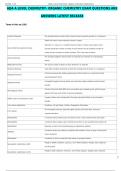
AQA A LEVEL CHEMISTRY- ORGANIC CHEMISTRY EXAM QUESTIONS ANS
ANSWERS LATEST RELEASE
Terms in this set (161)
Empirical formula The simplest whole number ratio of atoms of each element present in a compound
Obtain the mass of each element present in grams
(Element % = mass in g = m) Determine the number of moles of each type of atom
How to find the empirical formula present Divide the number of moles of each element by the smallest number of
moles Convert numbers to whole numbers. This is the ratio of atoms
The simplest algebraic formula that can describe any member of a homologous
General formula
series
Molecular formula The actual number of atoms of each element in a molecule
Structural formula Uses letter symbols and bonds to show the arrangement of atoms in a compound
A formula showing the relative positioning of all the atoms in a molecule and the
Displayed formula
bonds between them
A simplified organic formula which only shows the carbon skeleton and functional
Skeletal formula
groups
Family of chemical that differ from one another by a repeating unit, with the same
Homologous series
general formula and similar chemical properties
Longest carbon chain Unsaturation Functional groups Position of any functional
IUPAC rules of nomenclature order
groups
Free radical substitution Conditions: UV light Steps: Initiation Propagation Termination
An uncharged molecule, typically highly reactive and short-lived, having an
Free radical
unpaired electron
Nucleophile A reactant that provides a pair of electrons form a new covalent bond Lewis base
Electrophile A reactant that accepts a pair of electrons top form a new covalent bond Lewis acid
Substitution Reaction in which one functional group is replaced by another
A reaction where one molecule combines with another to form a larger molecule No
Addition
other products
Elimination A reaction in which a molecule loses atoms or groups of atoms
Reagent: NaOH Conditions: aqueous, warm What happens: Halogen atom replaced
Nucleophilic substitution w/OH-
by OH group
Reagent: KCN Conditions: ethanolic, warm What happens: Halogen atom replaced
Nucleophilic substitution w/ CN-
1/
6
, 3/17/25, 7:45 AQA A Level Chemistry- Organic Chemistry Flashcards |
AM
by CN group
Reagent: NH3 Conditions: excess conc. ammonia dissolved in ethanol at pressure in
Nucleophilic substitution w/NH3 a sealed container What happens: first molecule of NH3 -halogen atom replaced by
NH2 group, second molecule of NH3 -leads to formation of NH4X
Reagent: KOH Conditions: ethanolic, hot What
happens: the halogen atom and one H atom from
Elimination of halogenoalkanes an adjacent C is removed to form an alkene
Reagent: Br2 Conditions: aqueous (like bromine
water) What happens: double bond on alkene
Electrophilic addition w/Br2 opens and alkane is produced
Reagent: H2SO4 Conditions: conc H2SO4, cold
(room temp)
Electrophilic addition w/H2SO4 What happens: double bond on alkene opens and
alkane is produced
Reagent: HBr Conditions: - What happens: double
bond on alkene opens and alkane is produced
Electrophilic addition w/HBr
Reagent: H2O and strong acid Conditions: ACID
CATALYST (e.g. H2SO4, H3PO4) What happens:
Formation of alcohol:
double bond opens up, H and OH are added
Hydration of alkenes
onto the molecule
Reagent: excess of conc. H2SO4 or H3PO4
Conditions: heat (150-200C) What happens: lone
pair of electrons on the O of the alcohol picks up a
H from the acid. Water molecule removed
Elimination (of water from alcohols) leaving a carbocation. Negative acid ion
removes a H
leaving a C=C double bond and acid molecule is
regenerated
Structural isomerism Same molecular formula but different structural formula
Stereoisomerism Same structural formula, different arrangement of atoms in space
STRUCTURAL The same molecular formula but a different arrangement of carbon
Chain isomerism
atoms in the chain
Position isomerism STRUCTURAL Same molecular formula but functional groups in different places
Functional group isomerism STRUCTURAL Same molecular formula but different functional groups
E-Z isomerism STEREO Occurs when there is restricted rotation about the planar C=C bond
2/
6
AM
AQA A LEVEL CHEMISTRY- ORGANIC CHEMISTRY EXAM QUESTIONS ANS
ANSWERS LATEST RELEASE
Terms in this set (161)
Empirical formula The simplest whole number ratio of atoms of each element present in a compound
Obtain the mass of each element present in grams
(Element % = mass in g = m) Determine the number of moles of each type of atom
How to find the empirical formula present Divide the number of moles of each element by the smallest number of
moles Convert numbers to whole numbers. This is the ratio of atoms
The simplest algebraic formula that can describe any member of a homologous
General formula
series
Molecular formula The actual number of atoms of each element in a molecule
Structural formula Uses letter symbols and bonds to show the arrangement of atoms in a compound
A formula showing the relative positioning of all the atoms in a molecule and the
Displayed formula
bonds between them
A simplified organic formula which only shows the carbon skeleton and functional
Skeletal formula
groups
Family of chemical that differ from one another by a repeating unit, with the same
Homologous series
general formula and similar chemical properties
Longest carbon chain Unsaturation Functional groups Position of any functional
IUPAC rules of nomenclature order
groups
Free radical substitution Conditions: UV light Steps: Initiation Propagation Termination
An uncharged molecule, typically highly reactive and short-lived, having an
Free radical
unpaired electron
Nucleophile A reactant that provides a pair of electrons form a new covalent bond Lewis base
Electrophile A reactant that accepts a pair of electrons top form a new covalent bond Lewis acid
Substitution Reaction in which one functional group is replaced by another
A reaction where one molecule combines with another to form a larger molecule No
Addition
other products
Elimination A reaction in which a molecule loses atoms or groups of atoms
Reagent: NaOH Conditions: aqueous, warm What happens: Halogen atom replaced
Nucleophilic substitution w/OH-
by OH group
Reagent: KCN Conditions: ethanolic, warm What happens: Halogen atom replaced
Nucleophilic substitution w/ CN-
1/
6
, 3/17/25, 7:45 AQA A Level Chemistry- Organic Chemistry Flashcards |
AM
by CN group
Reagent: NH3 Conditions: excess conc. ammonia dissolved in ethanol at pressure in
Nucleophilic substitution w/NH3 a sealed container What happens: first molecule of NH3 -halogen atom replaced by
NH2 group, second molecule of NH3 -leads to formation of NH4X
Reagent: KOH Conditions: ethanolic, hot What
happens: the halogen atom and one H atom from
Elimination of halogenoalkanes an adjacent C is removed to form an alkene
Reagent: Br2 Conditions: aqueous (like bromine
water) What happens: double bond on alkene
Electrophilic addition w/Br2 opens and alkane is produced
Reagent: H2SO4 Conditions: conc H2SO4, cold
(room temp)
Electrophilic addition w/H2SO4 What happens: double bond on alkene opens and
alkane is produced
Reagent: HBr Conditions: - What happens: double
bond on alkene opens and alkane is produced
Electrophilic addition w/HBr
Reagent: H2O and strong acid Conditions: ACID
CATALYST (e.g. H2SO4, H3PO4) What happens:
Formation of alcohol:
double bond opens up, H and OH are added
Hydration of alkenes
onto the molecule
Reagent: excess of conc. H2SO4 or H3PO4
Conditions: heat (150-200C) What happens: lone
pair of electrons on the O of the alcohol picks up a
H from the acid. Water molecule removed
Elimination (of water from alcohols) leaving a carbocation. Negative acid ion
removes a H
leaving a C=C double bond and acid molecule is
regenerated
Structural isomerism Same molecular formula but different structural formula
Stereoisomerism Same structural formula, different arrangement of atoms in space
STRUCTURAL The same molecular formula but a different arrangement of carbon
Chain isomerism
atoms in the chain
Position isomerism STRUCTURAL Same molecular formula but functional groups in different places
Functional group isomerism STRUCTURAL Same molecular formula but different functional groups
E-Z isomerism STEREO Occurs when there is restricted rotation about the planar C=C bond
2/
6