Intro to Business Management - 1.1
Types of Inputs:
1) Physical Resources (raw & semi-finished materials)
2) Financial Resources (funds & finance)
3) Human Resources (manager & employees & enterprise)
Types of Outputs:
1) Goods = tangible (cupcakes, houses)
2) Services = intangible but provide value (education, health care)
Economic Sectors
Primary Sector - Extracting raw material from earth (agriculture, fishing, forestry
& mining)
- Often in undeveloped economies
Secondary Sector - Transforming raw materials into finished & semi-finished
products (construction, processing & manufacturing)
- Developing economies
Tertiary Sector - Delivery of services (education, health care, travel & tourism)
- Developed economies
Quaternary Sector - Services related to development & use of technology (subset of
tertiary sector)
- Developed economies
● Integrated companies = activities span two or more sectors (e.g. oil industry)
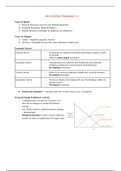
Sectoral Change in Business Activity
- Companies move in and out of sectors over
time due to changes in market & business
strategy
- It is closely linked to global/economic changes
+ development
- Deindustrialization = when a sector surpasses
another in terms of employment & output value
,Entrepreneurs = individuals with talent and perseverance that lead the process of setting up a new
business
● Risk-takers (invest their own funds)
● Self-motivated + commitment
● Confident
● Persevering
● Innovative
Intrapreneurs = those who are encouraged by their employees to take risks & new develop new
products, processes and services while retaining their status as employees
- Establishes entrepreneurship in organizations
- Promotes innovation, creativity, staff motivation & creates competitive advantages
Reasons for Starting a Business
● Earning a living
● Financial reward
● Control over work & future career
● Work-life balance
● New technology/business idea
Business Startup Steps
1) Refine the idea
2) Prepare a business plan
a) Business plan = a written document that describes all the aspects of a new enterprise
(product idea, marketing, finance, operations & HR)
3) Decide on legal structure
4) Business registration
5) Finding location
6) Hiring employees
7) Seeking finance
However, possible issues are: lack of management skills, recruiting qualified personnel, strong
competitors, lack of funds
, Types of Organizations - 1.2
Public Sector = organizations owned & operated by
either the central or local governments (dedicated to
providing public services rather than earning profit)
Private Sector = organizations owned by individuals
or groups of individuals (earning profits to
compensate for the owner's investment in
organization)
Unlimited liability = all owners personal assets &
investment can be seized to pay for firm debts
Limited liability = a corporation’s owners cannot lose more than the funds they invested in the firm &
creates a separate entity between owner’s assets & ownership interest in business
For-profit Organizations
Type Description Pros Cons
Sole Trader For-profit business owned by a - Easy to set up - Unlimited liability
single individual. It has little - Owner has full control & - No help with
legal distinction between all profits decisions
business & owner - Finances are confidential - Owner assumes all
losses & limited
access to finance
Partnership For-profit business owned by - Confidential finances - Unlimited liability
two or more individuals who - Partners can both - Shared profits
are each personally responsible contribute finance & have - Conflict
for firm debts. shared management - Limited sources of
- Set up with a responsibility finance
partnership agreement
for how major decisions
will be made
Corporation For-profit business owned by - Limited liability - Difficult &
numerous shareholders who - Independent legal entity expensive to create
enjoy limited liability - Large amounts of funds via - Potential conflict
shares - Exposure of finance
- Change of ownership in public limited
doesn’t affect firm - Selling shares dilutes
ownership
Types of Inputs:
1) Physical Resources (raw & semi-finished materials)
2) Financial Resources (funds & finance)
3) Human Resources (manager & employees & enterprise)
Types of Outputs:
1) Goods = tangible (cupcakes, houses)
2) Services = intangible but provide value (education, health care)
Economic Sectors
Primary Sector - Extracting raw material from earth (agriculture, fishing, forestry
& mining)
- Often in undeveloped economies
Secondary Sector - Transforming raw materials into finished & semi-finished
products (construction, processing & manufacturing)
- Developing economies
Tertiary Sector - Delivery of services (education, health care, travel & tourism)
- Developed economies
Quaternary Sector - Services related to development & use of technology (subset of
tertiary sector)
- Developed economies
● Integrated companies = activities span two or more sectors (e.g. oil industry)
Sectoral Change in Business Activity
- Companies move in and out of sectors over
time due to changes in market & business
strategy
- It is closely linked to global/economic changes
+ development
- Deindustrialization = when a sector surpasses
another in terms of employment & output value
,Entrepreneurs = individuals with talent and perseverance that lead the process of setting up a new
business
● Risk-takers (invest their own funds)
● Self-motivated + commitment
● Confident
● Persevering
● Innovative
Intrapreneurs = those who are encouraged by their employees to take risks & new develop new
products, processes and services while retaining their status as employees
- Establishes entrepreneurship in organizations
- Promotes innovation, creativity, staff motivation & creates competitive advantages
Reasons for Starting a Business
● Earning a living
● Financial reward
● Control over work & future career
● Work-life balance
● New technology/business idea
Business Startup Steps
1) Refine the idea
2) Prepare a business plan
a) Business plan = a written document that describes all the aspects of a new enterprise
(product idea, marketing, finance, operations & HR)
3) Decide on legal structure
4) Business registration
5) Finding location
6) Hiring employees
7) Seeking finance
However, possible issues are: lack of management skills, recruiting qualified personnel, strong
competitors, lack of funds
, Types of Organizations - 1.2
Public Sector = organizations owned & operated by
either the central or local governments (dedicated to
providing public services rather than earning profit)
Private Sector = organizations owned by individuals
or groups of individuals (earning profits to
compensate for the owner's investment in
organization)
Unlimited liability = all owners personal assets &
investment can be seized to pay for firm debts
Limited liability = a corporation’s owners cannot lose more than the funds they invested in the firm &
creates a separate entity between owner’s assets & ownership interest in business
For-profit Organizations
Type Description Pros Cons
Sole Trader For-profit business owned by a - Easy to set up - Unlimited liability
single individual. It has little - Owner has full control & - No help with
legal distinction between all profits decisions
business & owner - Finances are confidential - Owner assumes all
losses & limited
access to finance
Partnership For-profit business owned by - Confidential finances - Unlimited liability
two or more individuals who - Partners can both - Shared profits
are each personally responsible contribute finance & have - Conflict
for firm debts. shared management - Limited sources of
- Set up with a responsibility finance
partnership agreement
for how major decisions
will be made
Corporation For-profit business owned by - Limited liability - Difficult &
numerous shareholders who - Independent legal entity expensive to create
enjoy limited liability - Large amounts of funds via - Potential conflict
shares - Exposure of finance
- Change of ownership in public limited
doesn’t affect firm - Selling shares dilutes
ownership