Language-Specific Implementation of Linked
Lists
Implementing linked lists varies from one programming language to another due
to differences in syntax, memory management, and available data structures.
Below, we’ll discuss how to implement linked lists in some popular programming
languages: Python, Java, C, and C++.
1. Linked List Implementation in Python
Python is a high-level language, which makes it easy to implement linked lists
without worrying about low-level memory management. Here's a basic
implementation of a singly linked list in Python:
Node Class:
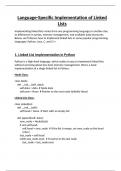
class Node:
def __init__(self, data):
self.data = data # Node data
self.next = None # Pointer to the next node (initially None)
Linked List Class:
class LinkedList:
def __init__(self):
self.head = None # Start with an empty list
def append(self, data):
new_node = Node(data)
if not self.head:
self.head = new_node # If the list is empty, set new_node as the head
return
last_node = self.head
while last_node.next: # Traverse to the last node
last_node = last_node.next
, last_node.next = new_node # Set the next of the last node to the new node
def display(self):
current = self.head
while current: # Traverse the list and print each node's data
print(current.data, end=" -> ")
current = current.next
print("None")
Usage:
ll = LinkedList()
ll.append(10)
ll.append(20)
ll.append(30)
ll.display() # Output: 10 -> 20 -> 30 -> None
Key Points:
Node Class: Contains the data and a reference (next) to the next node.
LinkedList Class: Manages the linked list, with methods for appending
nodes and displaying the list.
2. Linked List Implementation in Java
Java is an object-oriented language, so the linked list implementation involves
creating classes for both the nodes and the linked list itself.
Node Class:
class Node {
int data;
Node next;
// Constructor
public Node(int data) {
this.data = data;
Lists
Implementing linked lists varies from one programming language to another due
to differences in syntax, memory management, and available data structures.
Below, we’ll discuss how to implement linked lists in some popular programming
languages: Python, Java, C, and C++.
1. Linked List Implementation in Python
Python is a high-level language, which makes it easy to implement linked lists
without worrying about low-level memory management. Here's a basic
implementation of a singly linked list in Python:
Node Class:
class Node:
def __init__(self, data):
self.data = data # Node data
self.next = None # Pointer to the next node (initially None)
Linked List Class:
class LinkedList:
def __init__(self):
self.head = None # Start with an empty list
def append(self, data):
new_node = Node(data)
if not self.head:
self.head = new_node # If the list is empty, set new_node as the head
return
last_node = self.head
while last_node.next: # Traverse to the last node
last_node = last_node.next
, last_node.next = new_node # Set the next of the last node to the new node
def display(self):
current = self.head
while current: # Traverse the list and print each node's data
print(current.data, end=" -> ")
current = current.next
print("None")
Usage:
ll = LinkedList()
ll.append(10)
ll.append(20)
ll.append(30)
ll.display() # Output: 10 -> 20 -> 30 -> None
Key Points:
Node Class: Contains the data and a reference (next) to the next node.
LinkedList Class: Manages the linked list, with methods for appending
nodes and displaying the list.
2. Linked List Implementation in Java
Java is an object-oriented language, so the linked list implementation involves
creating classes for both the nodes and the linked list itself.
Node Class:
class Node {
int data;
Node next;
// Constructor
public Node(int data) {
this.data = data;