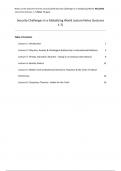
Notes on the lectures from the course (2024) Security Challenges in a Globalizing World. INCLUDES
notes from lectures 1-7 (Total: 19 ages).
Security Challenges in a Globalizing World Lecture Notes (Lectures
1-7)
Table of Contents
Lecture 1: Introduction 1
Lecture 2: Polycrisis, Anxiety & Ontological (In)Security in International Relations 4
Lecture 3: Threats, Narrative, Routines - Acting in an Anxious International 8
Lecture 4: Identity Politics 12
Lecture 5: Modern Anti-Institutional Extremism, Populism & the Crisis of Liberal
Democracy 14
Lecture 6: Conspiracy Theories - Battle for the Truth 16
, 1
Lecture 1: Introduction
Introduction: The Concept of Ontological (In)Security
Ontological Security: A lens or protected bubble of unreality, that helps us focus on the big picture.
We share confidence & trust in the world, with a sense of continuity that this will carry on.
➔ It does NOT refer to ‘classic’ security (e.g., physical danger, survival, war).
◆ Mitzen = “security NOT of the body but of the Self, the subjective sense of who one is,
which enables and motivates action and choice.”
◆ Giddens = people’s ability to give meaning (associated with positive/stable
emotions) to their lives, while avoiding chaos & anxiety.
➔ This concept is a lens/perspective (NOT an all-explaining theory).
◆ Relates to individual perceptions as influenced by major societal transformations &
political narratives.
➔ Necessary factors to feel ontologically secure:
1. Stable sense of home.
2. Feeling that nature is benign (NOT out to get us).
3. Sense that our contract with society, institutions & the government are NOT harmful
(preferably positive).
➔ Catastrophes can threaten our ontological security & ‘pierce’ our bubble. This can further
undermine the foundational degree of security of the ongoing control & predictability within
our daily lives.
➔ Important conditions = stable sense of:
◆ Stability: Freedom of anxiety about what may happen next.
● Security as a low probability of damage to acquired values.
● Most people want tomorrow to be more or less the same as today.
◆ Continuity & order = gives meaning to our lives, that the world is a stable & safe
place, predictable & generally positive.
◆ Trust & continuity = if we have to check everything for possible risk & danger all the
time, we will be anxious all the time
◆ Stable sense of home = community, nationhood, national identity or the notion that
society is a safe place for everyone.
◆ Sense of contract with society = among our fellow citizens, leaders & institutions.
➔ Dialectical approach = the concept of ontological security enables the analysis of the impact
of major social transformations on communities & individuals.
◆ Focuses on dynamic & developing moments (why & how things happen).
Ontological Insecurity: Disorienting & destabilising Other of ontological security (i.e., distrust,
anxieties, risk, danger, fear).
➔ When faced with this, people attempt to restore ontological security (from mode to more
extreme attempts).
➔ Mechanisms can include boundary-making & othering (difference between ‘us’ & ‘them’)
that create a sense of home.
Why is ontological (in)security a focus of this course?
, 2
● Enable a multilevel perspective (e.g., individual, community nation, states, international
system).
Perspectives on ontological security:
I. Laing’s The Divided Self (1960): Psychoanalytical approach examining existential anxieties.
Connecting the individual’s mental well being to society.
➔ Critical approach = the patient’s behaviour does NOT reflect a mental disease, BUT is
expressive of their existence.
II. Giddens’ Sociological Approach: Examined how societal structures impact ontological
security. Highlights the importance of people’s embedded:
➔ Social Narratives: People need a story about the society they are living in, how they
relate to it, expectations of them & others.
➔ Routines: Enabling people to live their life in a stable & more or less predictable way.
III. Kinnvall = religion & nationalism are powerful responses to insecurity & existential
anxieties. They work as identity-signifiers promising security & stability.
➔ Identity = anxiety-controlling mechanism (grants a consistent structure).
➔ Nationalism & nostalgia = mechanisms going back to an imagined past in response
to globalisation’s disruptive patterns (recreates a lost sense of security).
➔ Globalisation = migratory patterns lead to a breakdown of people’s identities.
IV. Browning = Brexit through the lens of ontological security (“take back control”).
➔ Mirrored feeling of crisis & instability = an existential anxiety.
➔ Key enemies:
◆ Brussels (the threatening Other) = threatening sovereignty, national identity
& the very essence of the UK
◆ Migration = taking back control over the borders.
The Precariat (Guy Standing): Disruptions in economic continuity & a lack of work-based identity has
created a new class of people with justified anger. This class is defined by 3 dimensions:
1. NO ‘shadow of the future’ (a sense that what you do will have a long-term effect). Highlights
the importance of routines.
2. NO occupational narrative, constantly faced with uncertainty (unsure what to do with your
time) & unsustainable debt.
3. NO political representation = loss of civil, economic & political rights.
Resistance Identities (Castells): 1990s prediction of the rise in justified anger & anxieties associated
with globalisation. Types:
1. Nationalist Movements: 1990s celebrated the idea of a Global Village (1990s), where nation
states were deemed to be dead & buried. HOWEVER, the age of globalisation has led to a
resurgence in nationalism & the reconstruction of identity based on nationality.
2. Fundamentalist Movements: Push to restore older ‘fundamental’ values, truths & practices.
Switching themselves off the global networks (splendid isolation).
3. Alternative Movements: Oppose the current codes/logic of globalised late modernity,
sometimes fighting/escaping the system or building alternative/parallel societies.
➔ Includes ecological, feminist & human rights movements.
notes from lectures 1-7 (Total: 19 ages).
Security Challenges in a Globalizing World Lecture Notes (Lectures
1-7)
Table of Contents
Lecture 1: Introduction 1
Lecture 2: Polycrisis, Anxiety & Ontological (In)Security in International Relations 4
Lecture 3: Threats, Narrative, Routines - Acting in an Anxious International 8
Lecture 4: Identity Politics 12
Lecture 5: Modern Anti-Institutional Extremism, Populism & the Crisis of Liberal
Democracy 14
Lecture 6: Conspiracy Theories - Battle for the Truth 16
, 1
Lecture 1: Introduction
Introduction: The Concept of Ontological (In)Security
Ontological Security: A lens or protected bubble of unreality, that helps us focus on the big picture.
We share confidence & trust in the world, with a sense of continuity that this will carry on.
➔ It does NOT refer to ‘classic’ security (e.g., physical danger, survival, war).
◆ Mitzen = “security NOT of the body but of the Self, the subjective sense of who one is,
which enables and motivates action and choice.”
◆ Giddens = people’s ability to give meaning (associated with positive/stable
emotions) to their lives, while avoiding chaos & anxiety.
➔ This concept is a lens/perspective (NOT an all-explaining theory).
◆ Relates to individual perceptions as influenced by major societal transformations &
political narratives.
➔ Necessary factors to feel ontologically secure:
1. Stable sense of home.
2. Feeling that nature is benign (NOT out to get us).
3. Sense that our contract with society, institutions & the government are NOT harmful
(preferably positive).
➔ Catastrophes can threaten our ontological security & ‘pierce’ our bubble. This can further
undermine the foundational degree of security of the ongoing control & predictability within
our daily lives.
➔ Important conditions = stable sense of:
◆ Stability: Freedom of anxiety about what may happen next.
● Security as a low probability of damage to acquired values.
● Most people want tomorrow to be more or less the same as today.
◆ Continuity & order = gives meaning to our lives, that the world is a stable & safe
place, predictable & generally positive.
◆ Trust & continuity = if we have to check everything for possible risk & danger all the
time, we will be anxious all the time
◆ Stable sense of home = community, nationhood, national identity or the notion that
society is a safe place for everyone.
◆ Sense of contract with society = among our fellow citizens, leaders & institutions.
➔ Dialectical approach = the concept of ontological security enables the analysis of the impact
of major social transformations on communities & individuals.
◆ Focuses on dynamic & developing moments (why & how things happen).
Ontological Insecurity: Disorienting & destabilising Other of ontological security (i.e., distrust,
anxieties, risk, danger, fear).
➔ When faced with this, people attempt to restore ontological security (from mode to more
extreme attempts).
➔ Mechanisms can include boundary-making & othering (difference between ‘us’ & ‘them’)
that create a sense of home.
Why is ontological (in)security a focus of this course?
, 2
● Enable a multilevel perspective (e.g., individual, community nation, states, international
system).
Perspectives on ontological security:
I. Laing’s The Divided Self (1960): Psychoanalytical approach examining existential anxieties.
Connecting the individual’s mental well being to society.
➔ Critical approach = the patient’s behaviour does NOT reflect a mental disease, BUT is
expressive of their existence.
II. Giddens’ Sociological Approach: Examined how societal structures impact ontological
security. Highlights the importance of people’s embedded:
➔ Social Narratives: People need a story about the society they are living in, how they
relate to it, expectations of them & others.
➔ Routines: Enabling people to live their life in a stable & more or less predictable way.
III. Kinnvall = religion & nationalism are powerful responses to insecurity & existential
anxieties. They work as identity-signifiers promising security & stability.
➔ Identity = anxiety-controlling mechanism (grants a consistent structure).
➔ Nationalism & nostalgia = mechanisms going back to an imagined past in response
to globalisation’s disruptive patterns (recreates a lost sense of security).
➔ Globalisation = migratory patterns lead to a breakdown of people’s identities.
IV. Browning = Brexit through the lens of ontological security (“take back control”).
➔ Mirrored feeling of crisis & instability = an existential anxiety.
➔ Key enemies:
◆ Brussels (the threatening Other) = threatening sovereignty, national identity
& the very essence of the UK
◆ Migration = taking back control over the borders.
The Precariat (Guy Standing): Disruptions in economic continuity & a lack of work-based identity has
created a new class of people with justified anger. This class is defined by 3 dimensions:
1. NO ‘shadow of the future’ (a sense that what you do will have a long-term effect). Highlights
the importance of routines.
2. NO occupational narrative, constantly faced with uncertainty (unsure what to do with your
time) & unsustainable debt.
3. NO political representation = loss of civil, economic & political rights.
Resistance Identities (Castells): 1990s prediction of the rise in justified anger & anxieties associated
with globalisation. Types:
1. Nationalist Movements: 1990s celebrated the idea of a Global Village (1990s), where nation
states were deemed to be dead & buried. HOWEVER, the age of globalisation has led to a
resurgence in nationalism & the reconstruction of identity based on nationality.
2. Fundamentalist Movements: Push to restore older ‘fundamental’ values, truths & practices.
Switching themselves off the global networks (splendid isolation).
3. Alternative Movements: Oppose the current codes/logic of globalised late modernity,
sometimes fighting/escaping the system or building alternative/parallel societies.
➔ Includes ecological, feminist & human rights movements.