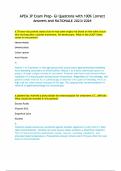
APEA 3P Exam Prep- GI Questions Answers and RATIONALE
APEA 3P Exam Prep- GI Questions Answers test bank is not a book but rather exam practice questions and answers. The APEA 3P GI section study material is available for download immediately after purchase. The APEA 3P Exam Prep- GI Questions Answers and RATIONALE is a crucial resource for nursing students aiming to excel in their examinations. This study aid provides comprehensive GI questions and answers, along with detailed rationale to deepen your understanding. With the APEA 3P GI study guide and practice questions, you can effectively prepare for the GI section of the exam. Utilize these exam preparation resources to enhance your knowledge and confidence, employing GI test preparation strategies that ensure success in mastering the APEA 3P Exam. A 70-year-old patient states that he had some bright red blood on the toilet tissue this morning after a bowel movement. He denies pain. What is the LEAST likely cause in this patient? Hemorrhoids Diverticulitis Colon cancer Anal fissure D. Nearly 1 in 3 patients in this age group with acute lower gastrointestinal bleeding have bleeding secondary to diverticulitis. Nearly 1 in 5 have colorectal cancer or polyps, though, polyps usually do not bleed. Patients who have anal fissures often complain of a tearing pain during bowel movements. Regardless of the etiology, this patient needs referral for a colonoscopy to identify the cause of bleeding. He is at high risk for colon cancer because of his age. The appropriate recommendation is referral to gastroenterology for colonoscopy. A patient has received a prescription for metronidazole for treatment of C. difficile. What should be avoided in this patient? Excess fluids Vitamin B12 Grapefruit juice Alcohol D. Patients should always be cautioned against alcohol ingestion (in any form) if they take metronidazole. Alcohol can (and usually does) produce a disulfiram reaction. This is characterized by abdominal cramps, nausea, vomiting, headache, and elevated body temperature. Precautions should remain until 72 hours after the last dose of metronidazole. The relationship between colon polyps and colon cancer is those polyps: eventually, all become malignant. have a slow progression to colon cancer. have a rapid progression to colon cancer. have no relationship to colon cancer. B. Colon polyps are usually slow-growing and take a long time to progress to cancer. This is the reason that a colonoscopy does not need to be repeated annually. While not all polyps grow slowly, this is the usual progression. An 82-year-old adult has constipation. A supplement known to cause constipation is: vitamin A. calcium. magnesium. vitamin B12. B. Calcium does produce constipation in many patients. If this is taken as a supplement for osteoporosis or osteopenia, the patient should be encouraged to increase fluids and fiber. A 5-year-old has been diagnosed with pinworms. He lives with his mother. There are no other members of the household. How should his mother be managed? Reassure the mother that if she develops symptoms, she will need to be treated. Visually assess the mother’s rectum for redness or presence of worms. Have the mother collect a stool specimen and send it to the laboratory. Perform the “scotch tape” test and look at the collection under the microscope. D. The diagnosis of pinworms (Enterobiasis) is made by using a piece of scotch tape on a tongue depressor. It is touched against the patient’s rectum. The greatest yield of eggs will occur during the nighttime or early AM. Eggs will be found here if they are present. Worms and eggs are rarely found in stool specimens, so this is not a good plan. When the scotch tape is examined under a low power microscope, the eggs will be easily visualized since they are large and bean shaped. The finding of an adult worm would confirm the diagnosis. These are large enough to be seen with the naked eye. If the mother is symptomatic, she should be treated with or without a rectal exam. It is very likely she is infected. A patient has been diagnosed with hepatitis B. The most commonly reported risk factor is: drinking contaminated water. eating contaminated food. exposure to blood. sexual exposure. D. Hepatitis B is transmitted by blood and body fluids. While exposure to infected blood or blood products would significantly increase the risk of infection in unvaccinated people, this is much less likely than becoming infected via sexual exposure or IV drug use. Hepatitis A is transmitted via fecal-oral routes. Drinking contaminated water and eating contaminated food implicate hepatitis A as the etiologic agent. The three most common causes of bacterial diarrhea in the US are Salmonella, Campylobacter, and: E. coli. Enterovirus. Yersinia. Shigella. D. Shigella will be shed continuously in the stool and should be easily identified on stool culture. When bacterial gastroenteritis is suspected, a stool specimen could be ordered for confirmation. Generally, these three pathogens are easily identified if they are present. Enterovirus produces a viral form of diarrhea. Yersinia produces the deadly disease called bubonic plague. E. coli is a typical colonic pathogen. An 83-year-old patient is diagnosed with diverticulitis. The most common complaint is: rectal bleeding. bloating and cramping. left lower quadrant pain. frequent belching and flatulence. C. Diverticular disease is more common in older adults. About 70% of patients diagnosed with diverticulitis have left lower quadrant pain. Rectal bleeding may have varied etiologies, such as rectal carcinoma or hemorrhoids. Bloating and cramping are often found in patients with diverticular disease (diverticulosis) but not specifically diverticulitis. Belching and flatulence are not specifically associated with diverticulosis.
Escuela, estudio y materia
- Institución
- APEA 3P Prep- GI
- Grado
- APEA 3P Prep- GI
Información del documento
- Subido en
- 19 de septiembre de 2024
- Número de páginas
- 34
- Escrito en
- 2024/2025
- Tipo
- Examen
- Contiene
- Preguntas y respuestas
Temas
-
apea 3p exam gi rationale
-
apea 3p gi study guide
-
apea 3p gi exam prepa
-
apea 3p gi questions and answers
-
apea 3p gi practice questions
-
gi questions for apea 3p exam
-
gi answers and rationale for apea 3p

Documento también disponible en un lote