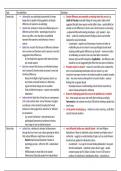
Topic Key definitions Evaluation
Gender bias Universality: any underlying characteristic of human o Gender differences are presented as enduring when they are not e.g.
beings that is capable of being applied to all despite Jacklin & Maccoby presented findings of many gender studies which
differences of experience & upbringing suggested that girls have superior verbal ability & boys – spatial ability but
Gender bias: tendency to treat one individual group in a actually no such differences in brain scans in brain structure or processing
different way from others - psychological research or – popularised fitted with existing stereotypes – girls ‘speakers’ , boys –
theory may offer a view that does not justifiably ‘doers’ – careful of accepting research findings as facts may be better
represent the experience and behaviour of men or explained by social stereotypes
women - Counterpoint – popular social stereotype of women are better at
Alpha bias: research that focuses of differences between multitasking may be true doesn’t mean psychologists should avoid
men & women and therefore tends to present a view that studying possible gender differences eg. Research – women are better
exaggerates these differences at multitasking as woman’s brain may have better connections
- Eg. Psychodynamic approach which states that boys between right and left hemispheres (Ingalhalikar) – bio differences but
are morally superior should be wary of exaggerating the effect they may have on behaviour
Beta bias: research that focuses on similarities between o Promotes sexism in research – research is more likely to be conducted by
men & women & therefore tends to present a view that men so may disadvantage participants who are women e.g. male
minimises differences researcher may expect women to be irrational unable to complete complex
- Research into flight or fight responses doesn’t use tasks - may mean women underperform in research studies – produce
any females as female behaviour is affected by findings that are gender biased
regular hormonal changes due to ovulation - Nowadays because of understanding male & female researchers &
- Tend and befriend response – oxytocin more plentiful male & female participants & reflexivity
- Attachment o Research challenging gender bias may not be published as are funded
Androcentrism (alpha bias & beta bias are consequences less – fewer people are aware and rectify their methods accordingly
of A): male-centred; when 'normal' behaviour is judged Formanowicz et al analysed more than 1000 articles relating to gender bias
according to a male standard (meaning that female over 8 years
behaviour is often judged to be 'abnormal' or 'deficient' o Led to gender stereotyping eg. – mothers are more nurturing , could affect
by comparison). social & financial situations
- E.g. women’s behaviour is misunderstood and
pathologized (premenstrual syndrome) whereas
men’s anger is seen as rational response
Culture bias culture bias: a tendency to interpret all phenomena o most influential studies are culturally biased – Asch and Milgram.
through the lens of one's own culture ignoring the effects Replications of these in collectivist cultures showed much higher rates of
that cultural differences might have on behaviour conformity – suggests are understanding of topics such as social influence
- Henrich et al reviewed hundreds of studies in should only be applied to individualist culture
psychology journals – 68% US & 96% - industrialised - counterpoint – in an age of increased media globalisation it is argued
nations that the individualist – collectivist culture doesn’t apply – studies
- WEIRD people are most likely to be studied comparing Japan and US Takano & Osaka (14 out of 15) found no
(Westernised, Educated people from Industrialised, evidence of collectivism & individualism divide – cultural bias in
, Rich Democracies) research may be less of an issue in more recent psychological research
- Findings suffer from culture bias & behaviour from o emergence of cultural psych – study of how people are shaped by their
non WEIRD are seen as abnormal cultural experiences – avoiding ethnocentric assumptions by taking an
Ethnocentrism: judging other cultures by the standards emic approach and conducting research within a culture & local
and values of ones own culture - belief that superiority of researchers using culturally – based techniques and can combat ethnic
one's own culture which may lead to prejudice & stereotypes
discrimination towards other cultures o ethnic stereotyping led to prejudice against groups of people eg. First
- e.g. Strange situation – reflects only the norms of intelligence tests led to eugenic social policies – used WW1 to pilot first IQ
‘western culture’ & led to misinterpretation of child tests. Many items on test were ethnocentric (US presidents) African
rearing practices in other countries (Japan) Americans got lower scores – promoted racism – denied educational
cultural relativism: idea that norms & values as well as opportunities – CB can be used to justify prejudice & discrimination toward
ethics & moral standards can only be meaningful and certain groups
understood within specific social & cultural contexts
- etic: looks at behaviour from outside of a given
culture & attempts to describe those behaviours as
universal
- eg. Strange situation – imposed etic – studied
behaviour in one culture (US) and assumed ideal
attachment type
etic looks at behaviours outside a given culture and
attempts to describe those behaviours as universal
- psychology been guilty of imposed etic suggesting
theories, models are universal but actually came
about through emic research
- emic: functions from inside a culture and identifies
behaviour that are specific to that culture
Free will free will: notion that humans can make choices and their o free will has a more positive effect in terms of mental health (Roberts et
determinism behaviour/thoughts are not determined external forces al) – teenagers who believed in fatalism more likely to develop depression.
determinism: view that individual's behaviour is shaped This suggests that even if free will is not a reality, believing we do could
or controlled by internal or external forces potentially have a positive impact on mind & behaviour.
hard determinism: all behaviour is caused by something o research evidence supporting determinism (Libet et al) – instructed
(internal or external) - free will is an illusion participants to choose a random movement to flick their wrist when they
soft determinism: behaviour may be predictable but felt the conscious will to move. Libet found the unconscious brain activity
there is also room for personal choice from a limited leading up to the conscious decision to move came around half a second
range of possibilities before the participant felt they had decided to move, this suggests that
biological determinism: belief that behaviour is caused even our basic experiences of free will are actually predetermined
by biological (genetic, hormonal, evolutionary) influences o determinism has formed treatments e.g. biological explanation of OCD –
that we cannot control SSRI’s. Biological determinism suggests that illnesses such as OCD &
Gender bias Universality: any underlying characteristic of human o Gender differences are presented as enduring when they are not e.g.
beings that is capable of being applied to all despite Jacklin & Maccoby presented findings of many gender studies which
differences of experience & upbringing suggested that girls have superior verbal ability & boys – spatial ability but
Gender bias: tendency to treat one individual group in a actually no such differences in brain scans in brain structure or processing
different way from others - psychological research or – popularised fitted with existing stereotypes – girls ‘speakers’ , boys –
theory may offer a view that does not justifiably ‘doers’ – careful of accepting research findings as facts may be better
represent the experience and behaviour of men or explained by social stereotypes
women - Counterpoint – popular social stereotype of women are better at
Alpha bias: research that focuses of differences between multitasking may be true doesn’t mean psychologists should avoid
men & women and therefore tends to present a view that studying possible gender differences eg. Research – women are better
exaggerates these differences at multitasking as woman’s brain may have better connections
- Eg. Psychodynamic approach which states that boys between right and left hemispheres (Ingalhalikar) – bio differences but
are morally superior should be wary of exaggerating the effect they may have on behaviour
Beta bias: research that focuses on similarities between o Promotes sexism in research – research is more likely to be conducted by
men & women & therefore tends to present a view that men so may disadvantage participants who are women e.g. male
minimises differences researcher may expect women to be irrational unable to complete complex
- Research into flight or fight responses doesn’t use tasks - may mean women underperform in research studies – produce
any females as female behaviour is affected by findings that are gender biased
regular hormonal changes due to ovulation - Nowadays because of understanding male & female researchers &
- Tend and befriend response – oxytocin more plentiful male & female participants & reflexivity
- Attachment o Research challenging gender bias may not be published as are funded
Androcentrism (alpha bias & beta bias are consequences less – fewer people are aware and rectify their methods accordingly
of A): male-centred; when 'normal' behaviour is judged Formanowicz et al analysed more than 1000 articles relating to gender bias
according to a male standard (meaning that female over 8 years
behaviour is often judged to be 'abnormal' or 'deficient' o Led to gender stereotyping eg. – mothers are more nurturing , could affect
by comparison). social & financial situations
- E.g. women’s behaviour is misunderstood and
pathologized (premenstrual syndrome) whereas
men’s anger is seen as rational response
Culture bias culture bias: a tendency to interpret all phenomena o most influential studies are culturally biased – Asch and Milgram.
through the lens of one's own culture ignoring the effects Replications of these in collectivist cultures showed much higher rates of
that cultural differences might have on behaviour conformity – suggests are understanding of topics such as social influence
- Henrich et al reviewed hundreds of studies in should only be applied to individualist culture
psychology journals – 68% US & 96% - industrialised - counterpoint – in an age of increased media globalisation it is argued
nations that the individualist – collectivist culture doesn’t apply – studies
- WEIRD people are most likely to be studied comparing Japan and US Takano & Osaka (14 out of 15) found no
(Westernised, Educated people from Industrialised, evidence of collectivism & individualism divide – cultural bias in
, Rich Democracies) research may be less of an issue in more recent psychological research
- Findings suffer from culture bias & behaviour from o emergence of cultural psych – study of how people are shaped by their
non WEIRD are seen as abnormal cultural experiences – avoiding ethnocentric assumptions by taking an
Ethnocentrism: judging other cultures by the standards emic approach and conducting research within a culture & local
and values of ones own culture - belief that superiority of researchers using culturally – based techniques and can combat ethnic
one's own culture which may lead to prejudice & stereotypes
discrimination towards other cultures o ethnic stereotyping led to prejudice against groups of people eg. First
- e.g. Strange situation – reflects only the norms of intelligence tests led to eugenic social policies – used WW1 to pilot first IQ
‘western culture’ & led to misinterpretation of child tests. Many items on test were ethnocentric (US presidents) African
rearing practices in other countries (Japan) Americans got lower scores – promoted racism – denied educational
cultural relativism: idea that norms & values as well as opportunities – CB can be used to justify prejudice & discrimination toward
ethics & moral standards can only be meaningful and certain groups
understood within specific social & cultural contexts
- etic: looks at behaviour from outside of a given
culture & attempts to describe those behaviours as
universal
- eg. Strange situation – imposed etic – studied
behaviour in one culture (US) and assumed ideal
attachment type
etic looks at behaviours outside a given culture and
attempts to describe those behaviours as universal
- psychology been guilty of imposed etic suggesting
theories, models are universal but actually came
about through emic research
- emic: functions from inside a culture and identifies
behaviour that are specific to that culture
Free will free will: notion that humans can make choices and their o free will has a more positive effect in terms of mental health (Roberts et
determinism behaviour/thoughts are not determined external forces al) – teenagers who believed in fatalism more likely to develop depression.
determinism: view that individual's behaviour is shaped This suggests that even if free will is not a reality, believing we do could
or controlled by internal or external forces potentially have a positive impact on mind & behaviour.
hard determinism: all behaviour is caused by something o research evidence supporting determinism (Libet et al) – instructed
(internal or external) - free will is an illusion participants to choose a random movement to flick their wrist when they
soft determinism: behaviour may be predictable but felt the conscious will to move. Libet found the unconscious brain activity
there is also room for personal choice from a limited leading up to the conscious decision to move came around half a second
range of possibilities before the participant felt they had decided to move, this suggests that
biological determinism: belief that behaviour is caused even our basic experiences of free will are actually predetermined
by biological (genetic, hormonal, evolutionary) influences o determinism has formed treatments e.g. biological explanation of OCD –
that we cannot control SSRI’s. Biological determinism suggests that illnesses such as OCD &