1
Understanding Psychopatholgy | The Literature
Week 1
Article 1 | A cognitive approach to panic | David M. Clark
The phenomenology of panic attacks
A panic attack consists of an intense feeling of apprehension or impending doom
which is of sudden onset and which is associated with a wide range of distressing physical
sensations. These sensations include breathlessness, palpitations, chest pain, choking,
dizziness, tingling in the hands and feet, hot and cold flushes, sweating, faintness, trembling
and feelings of unreality.
A cognitive model of panic attacks
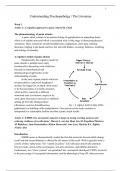
Paradoxically, the cognitive model of
panic attacks is perhaps most easily
introduced by discussing work which has
focused on neurochemical and
pharmacological approaches to the
understanding of panic.
In the case of panic attacks which are
not preceded by a period of heightened
anxiety, the trigger for an attack often seems
to be the perception of a bodily sensation
which itself is caused by a different
emotional state (excitement, anger) or by
some quite innocuous event such as suddenly
getting up from the sitting position
(dizziness), exercise (breathlessness,
palpitations) or drinking coffee (palpitations). Once perceived the body sensation is
interpreted in a catastrophic fashion and then a panic attack results.
Article 2 | EMDR: Eye movements superior to beeps in taxing working memory and
reducing vividness of recollections | Marcel A. van den Hout, Iris M. Engelhard Marleen
M. Rijkeboer, Jutte Koekebakker, Hellen Hornsveld, Arne Leer, Marieke B.J. Toffolo,
Nienke Akse
Introduction
EMDR seems to therapeutically exploit the fact that memories become labile during
recall and that reconsolidation is affected by the nature of the recall. WM is typically held to
consist of three subsystems. The “central executive” (CE) allocates and divides attention
between tasks, selects retrieval strategies, activates memories, and inhibits distracters.
Furthermore, two “slave systems” are postulated: the visuospatial sketchpad (VSSP), involved
in the processing of visuospatial information, and the phonological loop (PL) that processes
, 2
verbal information. The question then ensues what component(s) of WM is (are) affected by
the tasks mentioned above. It has been found that eye movements strongly interfere with WM
for (sequences of) locations and much more than equivalent limb movement or covert
attention shifts without eye movements. In sum then, laboratory data suggest that EMDR and
related procedures derive their effects from the taxing of WM during recall of aversive
memories.
General discussion
Controlled clinical trials showed the eye movement procedure yields good effects,
which are as good as various types of Cognitive Behavior Therapy. An explanation for the
EMDR effects in terms of WM taxing by eye movements emerged and has been supported by
a series of critical experimental studies from various laboratories.
Article 3 | Psychiatric symptoms as pathogens | Marcel van den Hout
Symptoms and disorders
The very fact that a sound neurological diagnosis can be made in the absence of
symptoms while this would be ridiculous in the case of mental disorders, points to an
important feature of psychiatric diagnosis. it has implications for our understanding of mental
disorders and for the nature of research in psychopathology.
Symptoms are causes of other symptoms: network theory
We argued that in the present context, an explanatory model should explain, first, that
symptoms of mental disorders do not cluster randomly but come in reliable combinations,
that, second, co-morbidity is widespread and that, third, there are no biological markers for
specific disorders. The second issue that needs to be covered by a credible model is co-
morbidity. Finally, the fact that no robust biological markers for Dsm disorders were found is
explained by the simple hypothesis that there are no such markers and that their existence
does not have to be assumed to begin with.
Network theory, CBT, EPP and OCD research
CBT refers to psychological treatments that are typically not focusing on hypothetical
distal origins or underlying causes of mental problems, but on processes that are held to
maintain the problems. The findings corroborate the notion that responsibility, in OCD
patients, causally contributes to the occurrence of new compulsive compulsive acts.
D’Olimpio and Mancini (2014) reasoned that compulsions like checking or washing are not
due to responsibility as such, but to a feeling of “deontological” guilt that is related, but not
identical to responsibility. Deontological guilt refers to feelings after violating a general moral
rule and has to be differentiated from “altruistic” guilt that relates to feelings after for having,
willfully or not, inflicted suffering on others.
Concluding remarks
Psychopathology comes in clusters of complaints. We have come to call the
complaints “symptoms” and call the clusters “disorders”. this may foster the idea that
, 3
somehow, the disorders explain the symptoms. they do not. efforts to avoid tautology by
explaining the various disorders by specific underlying pathophys- iologies have not yielded
biological markers that differ- entiate patients with different disorders. network theo- ry
provides a fresh perspective on these issues. clusters of symptoms do exist and this is
explained by symp- tom-to-symptom causality that may or may not be re- ciprocal. Co-
morbidity is high in psychopathology and network theory explains this and specifies that
“bridge symptoms” are responsible for co-morbidity. Biological markers have not been
identified because they may not exist to begin with and there is no need to assume their
existence. network theory uses powerful and advanced mathematical techniques and it opens
new vistas on the phenomenology and explanation of psychopathology. it has the potential to
create a Kuhnian paradigm shift in the field.
the notion that symptoms affect other symptoms is not new. it is part and parcel of particular
traditions in the treatment and study of mental disorders: CBT and EPP. examples of EPP
studies on OCD research were given above. What, then, has network theory to offer to EPP?
First, network theory provides a solid conceptual rationale for experimental dissection of
symptom à symptom processes. Second, it gives powerful and empirically derived clues
about what symptom à symptom associations are central and likely to be involved in the
maintenance of specific disorders. What has experimental psychopathology has to offer to
network theory? First, network theory suggests causality, but the royal road to testing and
establishing causality is experimental research. this is what EPP does. Second, the examples
of symptoma à symptom effects, giving in the emerging network literature, are explained by
referring to common sense: yes, sleeplessness is likely to result in fatigue and yes, fatigue can
safely be assumed to create concentration problems. However, many symptom à symptom
effects are counterintuitive and need more than common sense to be understood. The studies
on OCD, discussed above illustrate this. It is one thing to suggest that, e.g. compulsive
perseveration reinforces obsessive uncertainty, but the question ensues how this takes place.
EPP answers precisely such questions. Finally, the emerging network theory concentrates on
symptom à symptom associations where symptoms are derived from diagnostic
nomenclatures like Dsm. clinical experience and systematic descriptive phenomenology may
enrich and refine DSM like nomenclatures by identifying descriptive features that are not
included in the Diagnostic System, like, in the case of OCD, (de-ontological guilt, uncertainty
about internal states et cetera). Here, CBT, with its tradition on objective assessment of
symptom-patterns has a role to play. It seems, in conclusion, that network theory and CBT/
EPP start from comparable premises, use different methods and may mutually reinforce one
another, much like psychiatric symptoms do.
, 4
Week 2
Article 1 | Classical Conditioning and the acquisition on human fears and phobias: a
review and synthesis of the literature | Graham C. L. Davey
Conditioning process in humans
Two lines of evidence suggest that humans also learn CS-UCS associations in first-
order Pavlovian conditioning. First, a large number of studies have suggested that human
subjects only exhibit a differential CR when they are able to verbalize the CS-UCS
contingency. Only subjects who can verbalize the correct CS-UCS relationship in
postexperimental interviews exhibit differential conditioning; when awareness of
contingencies is measured on a trial-by-trial basis, differential conditioning appears only after
the appearance of contingency awareness.
Secondly, those studies which have used the postconditioning UCS devaluation
method with human subjects have all demonstrated that postconditioning revaluation of the
UCS affects the strength of the CR in both first- and second-order aversive conditioning.
Concluding remarks
This paper has been an attempt to familiarize those clinicians concerned with fears and
phobias with recent developments in conditioning theory and, in particular, to discuss the
relevance of these developments to an understanding of fears and phobias. Many of the
associative and nonassociative processes discussed above may be new to the clinician dealing
with phobic disorders, and they may help to throw new light on the etiology of such fears,
either collectively or in individual cases. There is clearly a body of evidence that needs to be
collected here during the course of normal clinical practise, and it is hoped that this review
has identified some of the variables that should be given consideration during the collection of
this evidence.
Finally, this paper has not been an attempt to resuscitate traditional conditioning
models of phobias nor has it been an attempt to construct a self-contained contemporary
conditioning model of phobias. The theme throughout has been to identify conditioning
processes relevant to humans, indicate how they might have relevance to fears and phobias,
and - most importantly - how these conditioning processes might be integrated with other
psychological processes to provide a comprehensive model of fears and phobias. It is only
with such an eclectic theoretical approach that a full understanding of most psychological
disorders will be achieved.
Article 2 | Expectancy-learning and evaluative learning in human classical conditioning:
affective priming as an indirect and unobtrusive measure of conditioned stimulus valence |
Dirk Hermans, Debora Vansteenwegen, Geert Crombez, Frank Baeyens, Paul Eelen
Discussion
As predicted, the experience of repeated contingent presen- tations of a previously
neutral face (CS+) and an aversive electrical stimulus (US) altered the meaning of the CS+ in
two different ways. First of all, the CS+ became a valid predictor for the US. On the other
Understanding Psychopatholgy | The Literature
Week 1
Article 1 | A cognitive approach to panic | David M. Clark
The phenomenology of panic attacks
A panic attack consists of an intense feeling of apprehension or impending doom
which is of sudden onset and which is associated with a wide range of distressing physical
sensations. These sensations include breathlessness, palpitations, chest pain, choking,
dizziness, tingling in the hands and feet, hot and cold flushes, sweating, faintness, trembling
and feelings of unreality.
A cognitive model of panic attacks
Paradoxically, the cognitive model of
panic attacks is perhaps most easily
introduced by discussing work which has
focused on neurochemical and
pharmacological approaches to the
understanding of panic.
In the case of panic attacks which are
not preceded by a period of heightened
anxiety, the trigger for an attack often seems
to be the perception of a bodily sensation
which itself is caused by a different
emotional state (excitement, anger) or by
some quite innocuous event such as suddenly
getting up from the sitting position
(dizziness), exercise (breathlessness,
palpitations) or drinking coffee (palpitations). Once perceived the body sensation is
interpreted in a catastrophic fashion and then a panic attack results.
Article 2 | EMDR: Eye movements superior to beeps in taxing working memory and
reducing vividness of recollections | Marcel A. van den Hout, Iris M. Engelhard Marleen
M. Rijkeboer, Jutte Koekebakker, Hellen Hornsveld, Arne Leer, Marieke B.J. Toffolo,
Nienke Akse
Introduction
EMDR seems to therapeutically exploit the fact that memories become labile during
recall and that reconsolidation is affected by the nature of the recall. WM is typically held to
consist of three subsystems. The “central executive” (CE) allocates and divides attention
between tasks, selects retrieval strategies, activates memories, and inhibits distracters.
Furthermore, two “slave systems” are postulated: the visuospatial sketchpad (VSSP), involved
in the processing of visuospatial information, and the phonological loop (PL) that processes
, 2
verbal information. The question then ensues what component(s) of WM is (are) affected by
the tasks mentioned above. It has been found that eye movements strongly interfere with WM
for (sequences of) locations and much more than equivalent limb movement or covert
attention shifts without eye movements. In sum then, laboratory data suggest that EMDR and
related procedures derive their effects from the taxing of WM during recall of aversive
memories.
General discussion
Controlled clinical trials showed the eye movement procedure yields good effects,
which are as good as various types of Cognitive Behavior Therapy. An explanation for the
EMDR effects in terms of WM taxing by eye movements emerged and has been supported by
a series of critical experimental studies from various laboratories.
Article 3 | Psychiatric symptoms as pathogens | Marcel van den Hout
Symptoms and disorders
The very fact that a sound neurological diagnosis can be made in the absence of
symptoms while this would be ridiculous in the case of mental disorders, points to an
important feature of psychiatric diagnosis. it has implications for our understanding of mental
disorders and for the nature of research in psychopathology.
Symptoms are causes of other symptoms: network theory
We argued that in the present context, an explanatory model should explain, first, that
symptoms of mental disorders do not cluster randomly but come in reliable combinations,
that, second, co-morbidity is widespread and that, third, there are no biological markers for
specific disorders. The second issue that needs to be covered by a credible model is co-
morbidity. Finally, the fact that no robust biological markers for Dsm disorders were found is
explained by the simple hypothesis that there are no such markers and that their existence
does not have to be assumed to begin with.
Network theory, CBT, EPP and OCD research
CBT refers to psychological treatments that are typically not focusing on hypothetical
distal origins or underlying causes of mental problems, but on processes that are held to
maintain the problems. The findings corroborate the notion that responsibility, in OCD
patients, causally contributes to the occurrence of new compulsive compulsive acts.
D’Olimpio and Mancini (2014) reasoned that compulsions like checking or washing are not
due to responsibility as such, but to a feeling of “deontological” guilt that is related, but not
identical to responsibility. Deontological guilt refers to feelings after violating a general moral
rule and has to be differentiated from “altruistic” guilt that relates to feelings after for having,
willfully or not, inflicted suffering on others.
Concluding remarks
Psychopathology comes in clusters of complaints. We have come to call the
complaints “symptoms” and call the clusters “disorders”. this may foster the idea that
, 3
somehow, the disorders explain the symptoms. they do not. efforts to avoid tautology by
explaining the various disorders by specific underlying pathophys- iologies have not yielded
biological markers that differ- entiate patients with different disorders. network theo- ry
provides a fresh perspective on these issues. clusters of symptoms do exist and this is
explained by symp- tom-to-symptom causality that may or may not be re- ciprocal. Co-
morbidity is high in psychopathology and network theory explains this and specifies that
“bridge symptoms” are responsible for co-morbidity. Biological markers have not been
identified because they may not exist to begin with and there is no need to assume their
existence. network theory uses powerful and advanced mathematical techniques and it opens
new vistas on the phenomenology and explanation of psychopathology. it has the potential to
create a Kuhnian paradigm shift in the field.
the notion that symptoms affect other symptoms is not new. it is part and parcel of particular
traditions in the treatment and study of mental disorders: CBT and EPP. examples of EPP
studies on OCD research were given above. What, then, has network theory to offer to EPP?
First, network theory provides a solid conceptual rationale for experimental dissection of
symptom à symptom processes. Second, it gives powerful and empirically derived clues
about what symptom à symptom associations are central and likely to be involved in the
maintenance of specific disorders. What has experimental psychopathology has to offer to
network theory? First, network theory suggests causality, but the royal road to testing and
establishing causality is experimental research. this is what EPP does. Second, the examples
of symptoma à symptom effects, giving in the emerging network literature, are explained by
referring to common sense: yes, sleeplessness is likely to result in fatigue and yes, fatigue can
safely be assumed to create concentration problems. However, many symptom à symptom
effects are counterintuitive and need more than common sense to be understood. The studies
on OCD, discussed above illustrate this. It is one thing to suggest that, e.g. compulsive
perseveration reinforces obsessive uncertainty, but the question ensues how this takes place.
EPP answers precisely such questions. Finally, the emerging network theory concentrates on
symptom à symptom associations where symptoms are derived from diagnostic
nomenclatures like Dsm. clinical experience and systematic descriptive phenomenology may
enrich and refine DSM like nomenclatures by identifying descriptive features that are not
included in the Diagnostic System, like, in the case of OCD, (de-ontological guilt, uncertainty
about internal states et cetera). Here, CBT, with its tradition on objective assessment of
symptom-patterns has a role to play. It seems, in conclusion, that network theory and CBT/
EPP start from comparable premises, use different methods and may mutually reinforce one
another, much like psychiatric symptoms do.
, 4
Week 2
Article 1 | Classical Conditioning and the acquisition on human fears and phobias: a
review and synthesis of the literature | Graham C. L. Davey
Conditioning process in humans
Two lines of evidence suggest that humans also learn CS-UCS associations in first-
order Pavlovian conditioning. First, a large number of studies have suggested that human
subjects only exhibit a differential CR when they are able to verbalize the CS-UCS
contingency. Only subjects who can verbalize the correct CS-UCS relationship in
postexperimental interviews exhibit differential conditioning; when awareness of
contingencies is measured on a trial-by-trial basis, differential conditioning appears only after
the appearance of contingency awareness.
Secondly, those studies which have used the postconditioning UCS devaluation
method with human subjects have all demonstrated that postconditioning revaluation of the
UCS affects the strength of the CR in both first- and second-order aversive conditioning.
Concluding remarks
This paper has been an attempt to familiarize those clinicians concerned with fears and
phobias with recent developments in conditioning theory and, in particular, to discuss the
relevance of these developments to an understanding of fears and phobias. Many of the
associative and nonassociative processes discussed above may be new to the clinician dealing
with phobic disorders, and they may help to throw new light on the etiology of such fears,
either collectively or in individual cases. There is clearly a body of evidence that needs to be
collected here during the course of normal clinical practise, and it is hoped that this review
has identified some of the variables that should be given consideration during the collection of
this evidence.
Finally, this paper has not been an attempt to resuscitate traditional conditioning
models of phobias nor has it been an attempt to construct a self-contained contemporary
conditioning model of phobias. The theme throughout has been to identify conditioning
processes relevant to humans, indicate how they might have relevance to fears and phobias,
and - most importantly - how these conditioning processes might be integrated with other
psychological processes to provide a comprehensive model of fears and phobias. It is only
with such an eclectic theoretical approach that a full understanding of most psychological
disorders will be achieved.
Article 2 | Expectancy-learning and evaluative learning in human classical conditioning:
affective priming as an indirect and unobtrusive measure of conditioned stimulus valence |
Dirk Hermans, Debora Vansteenwegen, Geert Crombez, Frank Baeyens, Paul Eelen
Discussion
As predicted, the experience of repeated contingent presen- tations of a previously
neutral face (CS+) and an aversive electrical stimulus (US) altered the meaning of the CS+ in
two different ways. First of all, the CS+ became a valid predictor for the US. On the other