Atonement – Critical Reading
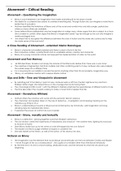
Atonement – Questioning the Imagination
• Briony is only interested in an imagination that makes everything fit to her sense of order
• Her desire for a coherent story seems to override everything else. Through fiction she can imagine a world that is
better than it actually is
• McEwan identifies the limitations of Briony and of the novel and novelist who only tells a single, partial story
where so many others are available
• Some believe Briony deliberately uses her imagination in malign ways; others argue that she is subject to a force
she is unable to control; other argue that Briony’s imagination doesn’t go far enough as she can only imagine a
neatly packaged story
• ‘she simply fails to recognise the difference between the story in fiction and the stories she constructed to help
her make sense of the real world’
A Close Reading of Atonement – extended Interior Monologue
• Briony’s character is incredibly isolated and there is a lack of love in her live
• She is impulsive, restless, a perfectionist and an unreliable witness, narrator and character
• Briony as a young character notices and enjoyed the implementation of order on the world
Atonement and Post-Memory
• ’65 000 died there. Dunkirk is not simply the miracle of the little boats. Before that, there was a war crime.’
• The narrative is fragmented, told from multiple and often conflicting points of view. McEwen also uses prolepsis,
the sudden leap into a different time
• It is a mourning for our inability to access the past in anything other than this incomplete, imaginative way
• ‘Briony, an unreliable narrator with a serious ulterior motive’
Slips and Shifts – Time and Viewpoint in Atonement
• By narrating part 3 from Briony’s point of view, McEwan seals us off from Cecilia’s righteous fury and from
Robbie’s bitter anger. We instead focus on the courage she has for facing them
• The chronological shifts in part 1 with the different chapters emphasis the separateness of different points of vies
• The time slips reflect the novelists working to make a novel that is happier than life
Atonement – Revelations Withheld
• McEwan litters the narrative with words with the semantic field of violence
• The characters and readers taken on the role of detective – investigation and imposing meaning on the
narrative e.g. Emily in Ch.6
• Briony’s understanding of events is influenced and informed by her immaturity, wild imagination and long
standing taste for melodramatic fiction
• It explored the power an author has over a reader
Atonement – Briony, morality and textuality
• Briony is a detective – piecing together clues from Robbie’s behaviour
• The war section carries the trademarks of melodrama and romance – the wartime hero, fighting his way back
to his lover at home
• Does Briony really face up to her crime or is she still trapped by her own fiction?
• The reader is invited to judge whether to forgive or condemn her
• She sees herself as the heroin, as well of the author, of her drama, her story
McEwan on Briony
• Her imagination was the element that would disrupt and eventually ruin the love between Cecilia and Robbie
• ‘I never thought of her as a wicked person’, she is guilty of a mistake rather than intentional mendacity
• By the time she is 18, she Is a hard-working, dedicated nurse, and her remorse for what she ahs done is just
beginning
Atonement – Questioning the Imagination
• Briony is only interested in an imagination that makes everything fit to her sense of order
• Her desire for a coherent story seems to override everything else. Through fiction she can imagine a world that is
better than it actually is
• McEwan identifies the limitations of Briony and of the novel and novelist who only tells a single, partial story
where so many others are available
• Some believe Briony deliberately uses her imagination in malign ways; others argue that she is subject to a force
she is unable to control; other argue that Briony’s imagination doesn’t go far enough as she can only imagine a
neatly packaged story
• ‘she simply fails to recognise the difference between the story in fiction and the stories she constructed to help
her make sense of the real world’
A Close Reading of Atonement – extended Interior Monologue
• Briony’s character is incredibly isolated and there is a lack of love in her live
• She is impulsive, restless, a perfectionist and an unreliable witness, narrator and character
• Briony as a young character notices and enjoyed the implementation of order on the world
Atonement and Post-Memory
• ’65 000 died there. Dunkirk is not simply the miracle of the little boats. Before that, there was a war crime.’
• The narrative is fragmented, told from multiple and often conflicting points of view. McEwen also uses prolepsis,
the sudden leap into a different time
• It is a mourning for our inability to access the past in anything other than this incomplete, imaginative way
• ‘Briony, an unreliable narrator with a serious ulterior motive’
Slips and Shifts – Time and Viewpoint in Atonement
• By narrating part 3 from Briony’s point of view, McEwan seals us off from Cecilia’s righteous fury and from
Robbie’s bitter anger. We instead focus on the courage she has for facing them
• The chronological shifts in part 1 with the different chapters emphasis the separateness of different points of vies
• The time slips reflect the novelists working to make a novel that is happier than life
Atonement – Revelations Withheld
• McEwan litters the narrative with words with the semantic field of violence
• The characters and readers taken on the role of detective – investigation and imposing meaning on the
narrative e.g. Emily in Ch.6
• Briony’s understanding of events is influenced and informed by her immaturity, wild imagination and long
standing taste for melodramatic fiction
• It explored the power an author has over a reader
Atonement – Briony, morality and textuality
• Briony is a detective – piecing together clues from Robbie’s behaviour
• The war section carries the trademarks of melodrama and romance – the wartime hero, fighting his way back
to his lover at home
• Does Briony really face up to her crime or is she still trapped by her own fiction?
• The reader is invited to judge whether to forgive or condemn her
• She sees herself as the heroin, as well of the author, of her drama, her story
McEwan on Briony
• Her imagination was the element that would disrupt and eventually ruin the love between Cecilia and Robbie
• ‘I never thought of her as a wicked person’, she is guilty of a mistake rather than intentional mendacity
• By the time she is 18, she Is a hard-working, dedicated nurse, and her remorse for what she ahs done is just
beginning