KANTIAN DEONTOLOGY
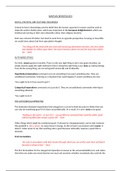
SOCIAL, POLITICAL AND CULTURAL INFLUENCES
Central to Kant’s deontology was the belief that the human capacity for reason could be used to
make the world a better place, which was important to the European Enlightenment, which saw
intellectuals turning to their own rationality rather than religious doctrine.
Kant was a devout Christian, but tried to work from an agnostic perspective, focusing on how little
we could know about God from speculative thought.
‘Two things fill the mind with ever new and increasing admiration and awe, the more often
and steadily we reflect upon them: the starry heavens above me and the moral law within
me’ – Kant
DUTY-BASED ETHICS
For Kant, reason governs morality. There is only one right thing to do in any given situation, we
simply need to apply the right method to find it. Doing the right thing is our duty as rational beings.
If we do the wrong thing, we are acting both immorally and irrationally.
Hypothetical Imperatives command us to do something if we want something else. They are
conditional commands, referring to a situation that could happen if certain conditions are met.
‘You ought to do X if you want to get Y’
Categorical Imperatives command us to just do it. They are unconditional commands referring to
something absolute.
‘You ought to do X’
THE CATAGORICAL IMPERATIVE
The distinction between hypothetical and categorical is crucial to Kant because he thinks that one
can only do something good if it is done unconditionally. As a result, it is one’s duty to do good.
‘Nothing in the world – or out of it! – can possibly be conceived that could be called ‘good’
without qualification except a good will’ – Kant
Other things which might be considered good, if misused or misappropriated, can be bad, however
this goodwill is ‘Like a jewel’, its value doesn’t change, its life is lived in accordance with reason. It
doesn’t make sense to say that anything else is good because rationality requires a good that is
absolute.
First Formulation:
‘Act only in accordance with that maxim through which you can at the same time will that it
become a universal law’ – Kant
The first formulation for the categorical imperative is known as the universalizability test, and states
that when we make any moral decision we must ask ourselves whether everybody else could do the
SOCIAL, POLITICAL AND CULTURAL INFLUENCES
Central to Kant’s deontology was the belief that the human capacity for reason could be used to
make the world a better place, which was important to the European Enlightenment, which saw
intellectuals turning to their own rationality rather than religious doctrine.
Kant was a devout Christian, but tried to work from an agnostic perspective, focusing on how little
we could know about God from speculative thought.
‘Two things fill the mind with ever new and increasing admiration and awe, the more often
and steadily we reflect upon them: the starry heavens above me and the moral law within
me’ – Kant
DUTY-BASED ETHICS
For Kant, reason governs morality. There is only one right thing to do in any given situation, we
simply need to apply the right method to find it. Doing the right thing is our duty as rational beings.
If we do the wrong thing, we are acting both immorally and irrationally.
Hypothetical Imperatives command us to do something if we want something else. They are
conditional commands, referring to a situation that could happen if certain conditions are met.
‘You ought to do X if you want to get Y’
Categorical Imperatives command us to just do it. They are unconditional commands referring to
something absolute.
‘You ought to do X’
THE CATAGORICAL IMPERATIVE
The distinction between hypothetical and categorical is crucial to Kant because he thinks that one
can only do something good if it is done unconditionally. As a result, it is one’s duty to do good.
‘Nothing in the world – or out of it! – can possibly be conceived that could be called ‘good’
without qualification except a good will’ – Kant
Other things which might be considered good, if misused or misappropriated, can be bad, however
this goodwill is ‘Like a jewel’, its value doesn’t change, its life is lived in accordance with reason. It
doesn’t make sense to say that anything else is good because rationality requires a good that is
absolute.
First Formulation:
‘Act only in accordance with that maxim through which you can at the same time will that it
become a universal law’ – Kant
The first formulation for the categorical imperative is known as the universalizability test, and states
that when we make any moral decision we must ask ourselves whether everybody else could do the