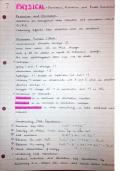
3. Biodiversity and Conservation
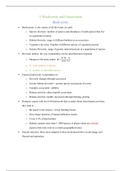
Biodiversity
Biodiversity: is the variety of all life forms on earth
o Species diversity: number of species and abundance of earth species that live
in a particular location
o Habitat diversity: range of different habitats in an ecosystem
o Vegetative diversity: Number of different species of vegetation present
o Genetic Diversity: range of genetic material present in a population of species
Diversity indices: the way communities can be described and compared
N (N −1)
o Simpson’s Diversity Index: D=
n(n−1)
o N= total number of species
o n= number of individual species
Factors biodiversity is dependent on:
o Diversity changes through succession
o Greater habitat diversity-> greater species and genetic diversity
o Complex ecosystem= stability
o Human activities often simplify ecosystems
o Human activities modify succession through burning, grazing
Hotspots: region with level of biodiversity that is under threat from human activities,
they tend to…:
o Be nearer to the tropics-> fewer limiting factors
o Have larger densities of human habitation nearby
o Cover 2.3% of land surface
o Habitat contains more than 1 5000 species of plants which are endemic
(species that only exist in a certain geographical area)
Natural selection: those more adapted to their environment have an advantage and
flourish and reproduce
, Speciation: change of a species over a long time
o When a population of a species separate and cannot interbreed
o Environment they inhabit changes and new species form (geographical or
reproductive causes)
> Physical barriers: species can develop into new ones is separated by
mountain range or oceans- it will split the gene pool (large flightless
birds only exist in continents once part of Gondwana)
> Land bridges: allow species to invade other areas (e.g. North and South
America) for example: bears from N to S America- Bridge: Central
America
> Continental drift: continents moved to new climate zones
o Changing climatic conditions- food supply changes: forces
species to adapt and results in increase of biodiversity
o Diverge: create physical separation
o Converge:
-move together, thus creates mountains: physical Barriers
-collide and one plate id under the other: subduction zone,
volcanic chains formed, land bridges
Similar groups of animals: llamas and camels are distant cousins; African and Indian
elephants suggest continents used to be connected in the past
Mass extinction: 5 major ones due to: rapid change of climate, natural disaster
(volcanic eruption, meteorite impact) now: Holocene extinction
Mass extinction MYA (million Geological period Est. of losses
years ago)
th
6 Now Holocene Unknown
5th 65 Cretaceous 17% families and
all large animals
th
4 199-214 End Triassic 23% animals,
some vertebrates
rd
3 251 Permian Triassic 95% of all species,
54% families
2nd 364 Devonian 19% of all families
st
1 440 Ordovician 25% of all families
Current mass extinction caused by humans over few decades
> Cities, roads, industries
Biodiversity
Biodiversity: is the variety of all life forms on earth
o Species diversity: number of species and abundance of earth species that live
in a particular location
o Habitat diversity: range of different habitats in an ecosystem
o Vegetative diversity: Number of different species of vegetation present
o Genetic Diversity: range of genetic material present in a population of species
Diversity indices: the way communities can be described and compared
N (N −1)
o Simpson’s Diversity Index: D=
n(n−1)
o N= total number of species
o n= number of individual species
Factors biodiversity is dependent on:
o Diversity changes through succession
o Greater habitat diversity-> greater species and genetic diversity
o Complex ecosystem= stability
o Human activities often simplify ecosystems
o Human activities modify succession through burning, grazing
Hotspots: region with level of biodiversity that is under threat from human activities,
they tend to…:
o Be nearer to the tropics-> fewer limiting factors
o Have larger densities of human habitation nearby
o Cover 2.3% of land surface
o Habitat contains more than 1 5000 species of plants which are endemic
(species that only exist in a certain geographical area)
Natural selection: those more adapted to their environment have an advantage and
flourish and reproduce
, Speciation: change of a species over a long time
o When a population of a species separate and cannot interbreed
o Environment they inhabit changes and new species form (geographical or
reproductive causes)
> Physical barriers: species can develop into new ones is separated by
mountain range or oceans- it will split the gene pool (large flightless
birds only exist in continents once part of Gondwana)
> Land bridges: allow species to invade other areas (e.g. North and South
America) for example: bears from N to S America- Bridge: Central
America
> Continental drift: continents moved to new climate zones
o Changing climatic conditions- food supply changes: forces
species to adapt and results in increase of biodiversity
o Diverge: create physical separation
o Converge:
-move together, thus creates mountains: physical Barriers
-collide and one plate id under the other: subduction zone,
volcanic chains formed, land bridges
Similar groups of animals: llamas and camels are distant cousins; African and Indian
elephants suggest continents used to be connected in the past
Mass extinction: 5 major ones due to: rapid change of climate, natural disaster
(volcanic eruption, meteorite impact) now: Holocene extinction
Mass extinction MYA (million Geological period Est. of losses
years ago)
th
6 Now Holocene Unknown
5th 65 Cretaceous 17% families and
all large animals
th
4 199-214 End Triassic 23% animals,
some vertebrates
rd
3 251 Permian Triassic 95% of all species,
54% families
2nd 364 Devonian 19% of all families
st
1 440 Ordovician 25% of all families
Current mass extinction caused by humans over few decades
> Cities, roads, industries