Political Economic Welfare Industrial Healthcare Education Society Culture
Landscap Landscap Reforms Relations Reforms Reforms & Sport
e e
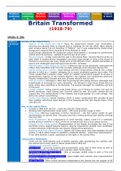
Britain Transformed
(1918-79)
1910s & 20s
Political Decline of the Liberal Party
Landscap - Defence of the Realm Act (1914): Gave the government powers over conscription,
e rationing and allowed them to request land or buildings for the war effort. Many liberals
were anxious about the Act branding it “illiberal”, but it was supported by David Lloyd
George who replaced Henry Asquith as Prime Minister in 1916.
- Lloyd George abandoned his traditional Laissez Faire beliefs in exchange for government
control over the economy – wanted to win the war at all costs.
- Maurice Debate – further cemented the split in the Liberal Party. General Maurice wrote an
open letter in several British newspapers accusing Lloyd George of lying to the House of
Commons concerning how many troops were on the Western Front – Asquith demanded an
inquiry and challenged Lloyd George to become PM – he failed.
- Representation of the People Act (1918): tripled the size of the electorate; estimated the
Labour Party benefited most from this increase, although some historians dispute this.
- Liberal-Conservative coalition: Lloyd George and the Conservatives entered into a khaki
election in 1918 as a “coupon” pledging not to stand candidates against each other. The
Tories needed DLG’s popular image, whilst he needed conservative support to achieve a
parliamentary majority. In the ‘Coupon Election’, the coalition won handsomely whilst the
Asquith (independent) Liberals won only 28 seats (Asquith lost his own).
- Cash for honours: Emerged in 1922 that Lloyd George was selling honours (peerages and
knighthoods) in exchange for “party donations”. He refused to share these funds with the
party unless they submitted to his demands. The scandal damaged his credibility and that
of the party.
- Chanak Incident: Turkey tried to push Greek forces out of Turkey to restore rule over its
former territories. Lloyd George and Churchill called for war, but public opinion did not
support this. The conservatives in the coalition saw Lloyd George as a war monger- this
led to the Carlton Club Meeting.
- Carlton Club Meeting: Formal meeting (1922) in which conservative MPs decided to end
their coalition with David Lloyd George. In the following election the Liberals share of the
vote fell 12%.
Rise of the Labour Party
Formed in 1900 from the TUC – close ties with the Trade Unions
Working class representation made easier – MPs were granted a wage in 1911
- Party Unity: Effective leadership of Arthur Henderson – the first Labour leader to gain
representation at cabinet level. The party also had a strong working-class identity (formed
from the TUC)
- Party Organisation: As a consequence of union backing, Labour could run a nationally
funded political machine. In 1924, all but 19 constituencies had a local Labour branch.
- Changes to the Voting system: Representation of the People Act tripled the size of the
electorate (many swayed towards Labour). Internal organisation allowed more candidates
to stand whilst the 1918 election was heavily influenced by patriotism.
- Breaking away from Liberal Influence: Before 1914 there were close links between the two
parties. In 1914 Labour began to establish a separate identity – supporting nationalisation.
In the 1923 Election, Labour capitalised on the splits in the Liberal Party.
Conservative Dominance
- Tories win the 1924 Election with a healthy majority after abandoning the coalition with
the Liberals and a short spell of Labour government (1923-24)
- Changes in the electoral system:
Plural Voting – university students and businessmen could vote in their home as well as
business/university constituency (both typically voted conservative).
Unevenness of First Past the Post – took on average 16,000 votes to elect a Tory but
30,000 for a Labour MP.
Redrawing of Constituency boundaries – gave middle class suburbs more representation
(typically voted Conservative)
Irish Free State – When Ireland declared independence the Liberals lost the support of 80
Landscap Landscap Reforms Relations Reforms Reforms & Sport
e e
Britain Transformed
(1918-79)
1910s & 20s
Political Decline of the Liberal Party
Landscap - Defence of the Realm Act (1914): Gave the government powers over conscription,
e rationing and allowed them to request land or buildings for the war effort. Many liberals
were anxious about the Act branding it “illiberal”, but it was supported by David Lloyd
George who replaced Henry Asquith as Prime Minister in 1916.
- Lloyd George abandoned his traditional Laissez Faire beliefs in exchange for government
control over the economy – wanted to win the war at all costs.
- Maurice Debate – further cemented the split in the Liberal Party. General Maurice wrote an
open letter in several British newspapers accusing Lloyd George of lying to the House of
Commons concerning how many troops were on the Western Front – Asquith demanded an
inquiry and challenged Lloyd George to become PM – he failed.
- Representation of the People Act (1918): tripled the size of the electorate; estimated the
Labour Party benefited most from this increase, although some historians dispute this.
- Liberal-Conservative coalition: Lloyd George and the Conservatives entered into a khaki
election in 1918 as a “coupon” pledging not to stand candidates against each other. The
Tories needed DLG’s popular image, whilst he needed conservative support to achieve a
parliamentary majority. In the ‘Coupon Election’, the coalition won handsomely whilst the
Asquith (independent) Liberals won only 28 seats (Asquith lost his own).
- Cash for honours: Emerged in 1922 that Lloyd George was selling honours (peerages and
knighthoods) in exchange for “party donations”. He refused to share these funds with the
party unless they submitted to his demands. The scandal damaged his credibility and that
of the party.
- Chanak Incident: Turkey tried to push Greek forces out of Turkey to restore rule over its
former territories. Lloyd George and Churchill called for war, but public opinion did not
support this. The conservatives in the coalition saw Lloyd George as a war monger- this
led to the Carlton Club Meeting.
- Carlton Club Meeting: Formal meeting (1922) in which conservative MPs decided to end
their coalition with David Lloyd George. In the following election the Liberals share of the
vote fell 12%.
Rise of the Labour Party
Formed in 1900 from the TUC – close ties with the Trade Unions
Working class representation made easier – MPs were granted a wage in 1911
- Party Unity: Effective leadership of Arthur Henderson – the first Labour leader to gain
representation at cabinet level. The party also had a strong working-class identity (formed
from the TUC)
- Party Organisation: As a consequence of union backing, Labour could run a nationally
funded political machine. In 1924, all but 19 constituencies had a local Labour branch.
- Changes to the Voting system: Representation of the People Act tripled the size of the
electorate (many swayed towards Labour). Internal organisation allowed more candidates
to stand whilst the 1918 election was heavily influenced by patriotism.
- Breaking away from Liberal Influence: Before 1914 there were close links between the two
parties. In 1914 Labour began to establish a separate identity – supporting nationalisation.
In the 1923 Election, Labour capitalised on the splits in the Liberal Party.
Conservative Dominance
- Tories win the 1924 Election with a healthy majority after abandoning the coalition with
the Liberals and a short spell of Labour government (1923-24)
- Changes in the electoral system:
Plural Voting – university students and businessmen could vote in their home as well as
business/university constituency (both typically voted conservative).
Unevenness of First Past the Post – took on average 16,000 votes to elect a Tory but
30,000 for a Labour MP.
Redrawing of Constituency boundaries – gave middle class suburbs more representation
(typically voted Conservative)
Irish Free State – When Ireland declared independence the Liberals lost the support of 80