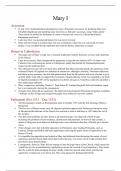
Mary I
Accession
In July 1553, Northumberland attempted to create a Protestant succession, by declaring Mary and
Elizabeth illegitimate and installing Lady Jane Grey as Edward’s successor, using ‘letters patent’.
These had to be ratified by Parliament in order to become law, however, Edward died before
Parliament could meet.
Lady Jane Grey was proclaimed Queen, but was never crowned.
Mary took her troops to London (thus, this was a rebellion), where she was welcomed; for most
people, it was essential that the legitimate heir took the throne, rather than a usurper.
Return to Catholicism
The major aim of Mary’s reign was to reinstate traditional Catholic doctrines, services and ornaments
in the Church.
Upon her accession, Mary interpreted her popularity as sign that her subjects (85% of whom were
Catholic) were welcoming the return to Catholicism, rather than dislike for Northumberland and
respect for the legitimate heir.
The whole process proved to be much more difficult than Mary had anticipated; the operations of the
reformed Church of England was enshrined in statute law; although a minority, Protestants adherents
had taken up key positions; the elite had gained much from the Dissolution and were reluctant to give
up their lands; many did not support the restoration of papal authority which was regarded as an insult
to English nationalism; 60% of the population was below the age of 25 and thus could not remember a
time under papal authority.
Mary’s supporters, including Charles V, Pope Julius III, Cardinal Reginald Pole and Gardiner, urged
her to act cautiously, fearing the consquences.
To begin with, Mary did act cautiously. She deprived most prominent Protestant clergymen, including
7 bishops, of their livings and foreign Protestants were ordered to leave the country.
Parliament (Oct.1533 – Dec.1533)
The first legislative attack on Protestantism came in October 1553 with the first meeting of Mary’s
Parliament.
The First Act of Repeal swept away all relgious legislation approved by Parliament during the reign
of Edward and the doctrine of the Church was restored to what it had been in 1547 under the Act of
Six Articles.
This did create problems for the Church as all married clergy were deprived of their livings,
increasing the problems of non-residency, absenteeism and pluralism. In Norwich and London, a
quatre of clergymen were deprived, although some were reinstated when they officially gave up their
wives.
These changes were met with little opposition in Parliament, since leading Protestants, such as
Cranmer, Hooper and Ridley had been imprisoned, removing the major source of opposition in the
House of Lords.
It is arguable that opposition was limited as Mary had refrained from discussing the matter of royal
supremacy and the Church lands which had sold to the laity, two issues which would certainly have
provoked a more heated debate.
Consequently, however, Mary did not manage to alter the legal status of the Church, which meant she
would have to rely on parliamentary legislation to secure the reversal of royal supremacy. This meant
that she would be acknowledging the legal validly of the laws passed under Henry and thus the
superiority of statute law over divine law. This went against her fundamental beliefs.
Accession
In July 1553, Northumberland attempted to create a Protestant succession, by declaring Mary and
Elizabeth illegitimate and installing Lady Jane Grey as Edward’s successor, using ‘letters patent’.
These had to be ratified by Parliament in order to become law, however, Edward died before
Parliament could meet.
Lady Jane Grey was proclaimed Queen, but was never crowned.
Mary took her troops to London (thus, this was a rebellion), where she was welcomed; for most
people, it was essential that the legitimate heir took the throne, rather than a usurper.
Return to Catholicism
The major aim of Mary’s reign was to reinstate traditional Catholic doctrines, services and ornaments
in the Church.
Upon her accession, Mary interpreted her popularity as sign that her subjects (85% of whom were
Catholic) were welcoming the return to Catholicism, rather than dislike for Northumberland and
respect for the legitimate heir.
The whole process proved to be much more difficult than Mary had anticipated; the operations of the
reformed Church of England was enshrined in statute law; although a minority, Protestants adherents
had taken up key positions; the elite had gained much from the Dissolution and were reluctant to give
up their lands; many did not support the restoration of papal authority which was regarded as an insult
to English nationalism; 60% of the population was below the age of 25 and thus could not remember a
time under papal authority.
Mary’s supporters, including Charles V, Pope Julius III, Cardinal Reginald Pole and Gardiner, urged
her to act cautiously, fearing the consquences.
To begin with, Mary did act cautiously. She deprived most prominent Protestant clergymen, including
7 bishops, of their livings and foreign Protestants were ordered to leave the country.
Parliament (Oct.1533 – Dec.1533)
The first legislative attack on Protestantism came in October 1553 with the first meeting of Mary’s
Parliament.
The First Act of Repeal swept away all relgious legislation approved by Parliament during the reign
of Edward and the doctrine of the Church was restored to what it had been in 1547 under the Act of
Six Articles.
This did create problems for the Church as all married clergy were deprived of their livings,
increasing the problems of non-residency, absenteeism and pluralism. In Norwich and London, a
quatre of clergymen were deprived, although some were reinstated when they officially gave up their
wives.
These changes were met with little opposition in Parliament, since leading Protestants, such as
Cranmer, Hooper and Ridley had been imprisoned, removing the major source of opposition in the
House of Lords.
It is arguable that opposition was limited as Mary had refrained from discussing the matter of royal
supremacy and the Church lands which had sold to the laity, two issues which would certainly have
provoked a more heated debate.
Consequently, however, Mary did not manage to alter the legal status of the Church, which meant she
would have to rely on parliamentary legislation to secure the reversal of royal supremacy. This meant
that she would be acknowledging the legal validly of the laws passed under Henry and thus the
superiority of statute law over divine law. This went against her fundamental beliefs.