Populations and Communities
A population is a group of organisms of the same species living in a particular area
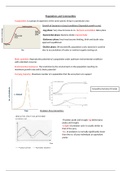
Growth of bacteria in closed conditions (Sigmoidal growth curve)
-Lag phase: Very slow increase in no. Nutrient assimilation takes place
-Exponential phase: Bacteria divide exponentially
-Stationary phase: food may become limiting, birth and death rates
approach equilibrium
-Decline phase: DR exceeds BR, population crash, bacteria it could be
due to accumulation of toxins or nutrient supply running out
Biotic potential: Reproductive potential of a population under optimum environmental conditions
with unlimited resources
Environmental resistance: The restriction by the environment on the population reaching its
maximum growth rate and its biotic potential
Carrying Capacity: Maximum number of a population that the ecosystem can support
Competitve Exclusion Principle
Predator-Prey Interaction:
-Predator peaks and troughs lag behind prey
peaks and troughs
-Length of predator cycle is usually similar to
that of the prey
-No. of predators is normally significantly lower
than the no. of prey individuals at equivalent
points
A population is a group of organisms of the same species living in a particular area
Growth of bacteria in closed conditions (Sigmoidal growth curve)
-Lag phase: Very slow increase in no. Nutrient assimilation takes place
-Exponential phase: Bacteria divide exponentially
-Stationary phase: food may become limiting, birth and death rates
approach equilibrium
-Decline phase: DR exceeds BR, population crash, bacteria it could be
due to accumulation of toxins or nutrient supply running out
Biotic potential: Reproductive potential of a population under optimum environmental conditions
with unlimited resources
Environmental resistance: The restriction by the environment on the population reaching its
maximum growth rate and its biotic potential
Carrying Capacity: Maximum number of a population that the ecosystem can support
Competitve Exclusion Principle
Predator-Prey Interaction:
-Predator peaks and troughs lag behind prey
peaks and troughs
-Length of predator cycle is usually similar to
that of the prey
-No. of predators is normally significantly lower
than the no. of prey individuals at equivalent
points