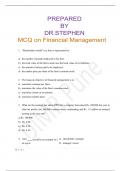
PREPARED
BY
DR.STEPHEN
MCQ on Financial Management
1. "Shareholder wealth" in a firm is represented by:
a) the number of people employed in the firm.
b) the book value of the firm's assets less the book value of its liabilities
c) the amount of salary paid to its employees.
d) the market price per share of the firm's common stock.
2. The long-run objective of financial management is to:
a) maximize earnings per share.
b) maximize the value of the firm's common stock.
c) maximize return on investment.
d) maximize market share.
3. What are the earnings per share (EPS) for a company that earned Rs. 100,000 last year in
after-tax profits, has 200,000 common shares outstanding and Rs. 1.2 million in retained
earning at the year end?
a) Rs. 100,000
b) Rs. 6.00
c) Rs. 0.50
d) Rs. 6.50
4. A(n) would be an example of a a) shareholder; manager
an agent. b) manager; owner
1|Page
, c) accountant; bondholder principal, while a(n) would be an example of
d) shareholder; bondholder
2|Page
, 5. The market price of a share of common stock is determined by:
a) the board of directors of the firm.
b) the stock exchange on which the stock is listed.
c) the president of the company.
d) individuals buying and selling the stock.
6. The focal point of financial management in a firm is:
a) the number and types of products or services provided by the firm.
b) the minimization of the amount of taxes paid by the firm.
c) the creation of value for shareholders.
d) the dollars profits earned by the firm.
7. of a firm refers to the composition of its long-term funds and its
capital structure.
a) Capitalisation
b) Over-capitalisation
c) Under-capitalisation
d) Market capitalization
8. In the , the future value of all cash inflow at the end of time horizon at
a particular rate of interest is calculated.
a) Risk-free rate
b) Compounding technique
c) Discounting technique
d) Risk Premium
3|Page
BY
DR.STEPHEN
MCQ on Financial Management
1. "Shareholder wealth" in a firm is represented by:
a) the number of people employed in the firm.
b) the book value of the firm's assets less the book value of its liabilities
c) the amount of salary paid to its employees.
d) the market price per share of the firm's common stock.
2. The long-run objective of financial management is to:
a) maximize earnings per share.
b) maximize the value of the firm's common stock.
c) maximize return on investment.
d) maximize market share.
3. What are the earnings per share (EPS) for a company that earned Rs. 100,000 last year in
after-tax profits, has 200,000 common shares outstanding and Rs. 1.2 million in retained
earning at the year end?
a) Rs. 100,000
b) Rs. 6.00
c) Rs. 0.50
d) Rs. 6.50
4. A(n) would be an example of a a) shareholder; manager
an agent. b) manager; owner
1|Page
, c) accountant; bondholder principal, while a(n) would be an example of
d) shareholder; bondholder
2|Page
, 5. The market price of a share of common stock is determined by:
a) the board of directors of the firm.
b) the stock exchange on which the stock is listed.
c) the president of the company.
d) individuals buying and selling the stock.
6. The focal point of financial management in a firm is:
a) the number and types of products or services provided by the firm.
b) the minimization of the amount of taxes paid by the firm.
c) the creation of value for shareholders.
d) the dollars profits earned by the firm.
7. of a firm refers to the composition of its long-term funds and its
capital structure.
a) Capitalisation
b) Over-capitalisation
c) Under-capitalisation
d) Market capitalization
8. In the , the future value of all cash inflow at the end of time horizon at
a particular rate of interest is calculated.
a) Risk-free rate
b) Compounding technique
c) Discounting technique
d) Risk Premium
3|Page