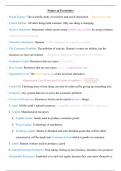
Nature of Economics
· Social Science: The scientific study of societies and social interaction. Hard to be tested
· Ceteris Paribus: All other things held constant. Only one thing is changing.
· Positive Statement: Statements which can be tested whether true or false by using evidence.
(Objective & Fact-based)
· Normative Statement: Opinion. (Value Judgments & Cannot be Tested)
· The Economic Problem: The problem of scarcity. Human’s wants are infinite, but the
resources we have are limited. Resources Allocation: What? How? For Whom?
· Economic Goods: Resources that are scarce. (Coal, Oil)
· Free Goods: Resources that are not scarce. (Air) 0 opportunity cost
· Opportunity Cost: The benefit given up of the next best alternative.
푇표� 퐺푖 푈
푇표� 퐺 푖
Opportunity Cost of one good in terms of another =
· Trade-Off: Choosing more of one thing can only be achieved by giving up something else.
· Economy: Any system that tries to solve the economic problem.
· Factors of Production: Resources which can be used to produce things.
1. Land: All the earth’s natural resources. (vegetables, animals, fossil fuels, water, etc.);
2. Capital: Manufactured resources.
Capital Goods: Goods used to produce consumer goods.
Fixed Capital: Technology or machinery.
Working Capital: Stocks of finished and semi-finished goods that will be either
consumed or will be made into Consumer Goods which is goods we consume.
3. Labor: Human workers used to produce a good.
4. Entrepreneurship/Enterprise: Risk taking, Setting up new business, Introduce new products.
· Sustainable Resources: Exploited over and over again, because they can renew themselves.
,· Renewable: Will replenish. It won’t run out.
· Non-Renewable: Will not replenish. It will run out.
· Production Possibility Frontier (PPF): Shows all the
possible combinations of two goods that can be produced
by using resources efficiently. Productively Efficient
· The PPF can be used to illustrate economic growth which is defined as a sustained increase
in a country’s productive capacity.
* Opportunity cost usually increased. As a country produces more of one good it has to
sacrifice every increasing amount of the other. This is because people have different skills,
land and raw materials vary from places. As a nation, concentrate more and more on the
production of one good, it has to start using resources that are less and less suitable.
· Unit Cost: The cost of producing just one unit.
· Specialization: When individuals, households, firms or countries concentrate on producing
certain goods and services and trading the surpluses with each other. Adam Smith
* Advantages: Increases Output; Variety; Increased Trade
* Disadvantages: Over-Specialization ( can’t adapt any big change in economy)
Natural Resource Depletion; Vulnerable (dependent on others)
· Division of Labor: Specialization by workers on a particular part of the production process
* Advantages: Increases Output & Quality; Decrease Unit Cost; Save on Training Cost
* Disadvantages: Demotivation ; Absenteeism; Employee Turnover & Unemployment
· Economic Agents: Households & Firms & Government
· Neoclassical Economists Assumptions:
1. Individuals maximize Utility; Firms maximize Profit
2. Firms or individuals make decisions in a rational way.
,· Utility: A measure of the satisfaction that we get from consuming a good or service.
· Maximization: Economic agents work in a way that will maximize their net benefits.
· Margin: One extra.
· Barter: One good is swapped to another.
* It is hard to find someone produce stuff I want and would want my stuff.
· Functions of Money :
1. Medium of exchange —— Use money to trade goods and services
2. Unit of Account —— Helps to compare prices of different products
3. Store of Value —— You can store it and save it for later. It will keep its value
4. Deferred Payment —— Borrow money to buy goods now and pay the money back later
· Herd Behavior: Consumers are influenced by the behavior of others.
· Habitual Behavior: When consumers are in the habit of making certain decisions.
· Weakness at Computation: Consumers are bad at making calculations, estimating
probabilities and working out future benefits/costs.
, How Markets Works
· Demand: The quantity of a good or service that consumers are willing and able to buy at a
given price in a given time period.
Quantity Demand Decrease = Contraction in Demand
Quantity Demand Increase = Extension in Demand
· Effective Demand: When desire to buy a product is backed up by an ability to pay for it.
· Price is the only thing that causes the movement along the demand curve.
· When something other than the price of good changes, the entire demand curve will shift.
Decrease in Demand / Increase in Demand
· Causes of Shifts in Demand Curve:
Prices of Substitute; Price of a Complement; Real Income; Distribution of Income;
Advertising & Marketing; Interest Rates; Size and Structure of Population; Season
· Normal Good: Standard good. Price ↑, Quantity Demand ↓
· Inferior Good: Cheaper alternative. Price ↓, Quantity Demand ↑
· Total Utility: The total satisfaction from a given level of consumption.
· Marginal Utility: The change in satisfaction from consuming an extra unit.
* The marginal utility of an extra unit declines as more is consumed. If marginal utility is
falling, then consumers will only be prepared to pay a lower price. This helps to explain
the downward sloping demand curve. —— The Law of Diminishing Marginal Utility
· Why Does the Demand Curve Slope Downwards:
1. When price decreases, more people can afford the good
2. When price decreases, more people will switch over from substitutes
3. Marginal Utility of an extra unit declines as more is consumed. Willing to pay less.
· Social Science: The scientific study of societies and social interaction. Hard to be tested
· Ceteris Paribus: All other things held constant. Only one thing is changing.
· Positive Statement: Statements which can be tested whether true or false by using evidence.
(Objective & Fact-based)
· Normative Statement: Opinion. (Value Judgments & Cannot be Tested)
· The Economic Problem: The problem of scarcity. Human’s wants are infinite, but the
resources we have are limited. Resources Allocation: What? How? For Whom?
· Economic Goods: Resources that are scarce. (Coal, Oil)
· Free Goods: Resources that are not scarce. (Air) 0 opportunity cost
· Opportunity Cost: The benefit given up of the next best alternative.
푇표� 퐺푖 푈
푇표� 퐺 푖
Opportunity Cost of one good in terms of another =
· Trade-Off: Choosing more of one thing can only be achieved by giving up something else.
· Economy: Any system that tries to solve the economic problem.
· Factors of Production: Resources which can be used to produce things.
1. Land: All the earth’s natural resources. (vegetables, animals, fossil fuels, water, etc.);
2. Capital: Manufactured resources.
Capital Goods: Goods used to produce consumer goods.
Fixed Capital: Technology or machinery.
Working Capital: Stocks of finished and semi-finished goods that will be either
consumed or will be made into Consumer Goods which is goods we consume.
3. Labor: Human workers used to produce a good.
4. Entrepreneurship/Enterprise: Risk taking, Setting up new business, Introduce new products.
· Sustainable Resources: Exploited over and over again, because they can renew themselves.
,· Renewable: Will replenish. It won’t run out.
· Non-Renewable: Will not replenish. It will run out.
· Production Possibility Frontier (PPF): Shows all the
possible combinations of two goods that can be produced
by using resources efficiently. Productively Efficient
· The PPF can be used to illustrate economic growth which is defined as a sustained increase
in a country’s productive capacity.
* Opportunity cost usually increased. As a country produces more of one good it has to
sacrifice every increasing amount of the other. This is because people have different skills,
land and raw materials vary from places. As a nation, concentrate more and more on the
production of one good, it has to start using resources that are less and less suitable.
· Unit Cost: The cost of producing just one unit.
· Specialization: When individuals, households, firms or countries concentrate on producing
certain goods and services and trading the surpluses with each other. Adam Smith
* Advantages: Increases Output; Variety; Increased Trade
* Disadvantages: Over-Specialization ( can’t adapt any big change in economy)
Natural Resource Depletion; Vulnerable (dependent on others)
· Division of Labor: Specialization by workers on a particular part of the production process
* Advantages: Increases Output & Quality; Decrease Unit Cost; Save on Training Cost
* Disadvantages: Demotivation ; Absenteeism; Employee Turnover & Unemployment
· Economic Agents: Households & Firms & Government
· Neoclassical Economists Assumptions:
1. Individuals maximize Utility; Firms maximize Profit
2. Firms or individuals make decisions in a rational way.
,· Utility: A measure of the satisfaction that we get from consuming a good or service.
· Maximization: Economic agents work in a way that will maximize their net benefits.
· Margin: One extra.
· Barter: One good is swapped to another.
* It is hard to find someone produce stuff I want and would want my stuff.
· Functions of Money :
1. Medium of exchange —— Use money to trade goods and services
2. Unit of Account —— Helps to compare prices of different products
3. Store of Value —— You can store it and save it for later. It will keep its value
4. Deferred Payment —— Borrow money to buy goods now and pay the money back later
· Herd Behavior: Consumers are influenced by the behavior of others.
· Habitual Behavior: When consumers are in the habit of making certain decisions.
· Weakness at Computation: Consumers are bad at making calculations, estimating
probabilities and working out future benefits/costs.
, How Markets Works
· Demand: The quantity of a good or service that consumers are willing and able to buy at a
given price in a given time period.
Quantity Demand Decrease = Contraction in Demand
Quantity Demand Increase = Extension in Demand
· Effective Demand: When desire to buy a product is backed up by an ability to pay for it.
· Price is the only thing that causes the movement along the demand curve.
· When something other than the price of good changes, the entire demand curve will shift.
Decrease in Demand / Increase in Demand
· Causes of Shifts in Demand Curve:
Prices of Substitute; Price of a Complement; Real Income; Distribution of Income;
Advertising & Marketing; Interest Rates; Size and Structure of Population; Season
· Normal Good: Standard good. Price ↑, Quantity Demand ↓
· Inferior Good: Cheaper alternative. Price ↓, Quantity Demand ↑
· Total Utility: The total satisfaction from a given level of consumption.
· Marginal Utility: The change in satisfaction from consuming an extra unit.
* The marginal utility of an extra unit declines as more is consumed. If marginal utility is
falling, then consumers will only be prepared to pay a lower price. This helps to explain
the downward sloping demand curve. —— The Law of Diminishing Marginal Utility
· Why Does the Demand Curve Slope Downwards:
1. When price decreases, more people can afford the good
2. When price decreases, more people will switch over from substitutes
3. Marginal Utility of an extra unit declines as more is consumed. Willing to pay less.