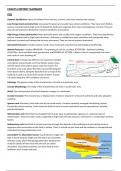
COASTS CONTENT SUMMARY
EQ1
Dynamic Equilibrium: Inputs of sediment from the sea, currents, and rivers matches the outputs.
Low Energy Coasts (constructive): Less powerful waves and usually have calmer conditions. They have short fetches
and are characterised by high levels of deposition. Sediment originates from rivers and longshore currents. They are
also sub-aerial process dominated. Common landforms are beaches.
High Energy Coasts (destructive): More powerful waves and usually have rougher conditions. They have long fetches
and are characterised by high levels of erosion. Sediment is eroded from these coastlines and transported away.
Sediment is eroded and transported via mass movement. They are marine process dominated.
Sub-Aerial Processes: Includes surface runoff, mass movement, and chemical and biological weathering.
Marine Processes: Includes ABRASION – The grinding of rock on a surface, ATTRITION – Sediment colliding,
SOLUTION – Acid and Alkali meet and dissolve, and HYDRAULIC ACTION – Water in the air compressed into faults
and cracks in rocks breaking off.
Littoral Zone: Includes the offshore, the nearshore, breaker
zone (where waves break), surf zone (where waves move,
and the swash zone (where waves reach the coast). The
foreshore is the area where the tides rise and fall along the
lower beach. Berms along the backshore are a result of the
build-up of sand as a result of the swash of water. A wave
cut notch along the cliff is evidence of erosion.
Lithology: The general study of the characteristics of rocks in a particular area.
Coastal Morphology: The study of the characteristics of rocks in a particular area.
Relief: The measurement of vertical elevation changes in a landscape.
Coastal recession: The erosion/ loss or displacement of land or long-term removal of sediment and rocks along the
coastline.
Igneous rock: Resistant, hard rocks that do not erode easily. Contains randomly arranged interlocking crystals.
Formed by volcanic activity. Cools inside the Earth to form intrusive rock which may be exposed later. Includes
granite and basalt.
Metamorphic rock: Rock that has changed from its prior type, ie sedimentary, igneous or a previous type of
metamorphic. They form when rock is subjected to high levels of heat, pressure, rich fluids or a combination of these
factors.
Sedimentary rock: Rock that is formed over time through the deposits of the sediments of pre-existing rocks or
organisms that accumulate on the Earth’s surface. There is a build up over time and the sediment is compacted and
cemented, forming sedimentary rock.
Concordant Vs. Discordant Coasts: Coasts where a single rock
type is found along its length are referred to as concordant
whereas coasts where the geology alternates between the
strata (or bands) of hard rock and soft rock are called
discordant. Discordant coastlines are more likely to have
landforms such as bays and spits.
,Cliff Profiles:
Coastal vegetation: Protects coastlines from erosion of
unconsolidated sediment. Protects coastal sand dunes, salt marshes and mangrove swamps. Stabilises sediment as
the roots of plants bind the sediment particles together, making it more difficult to erode and providing a protective
layer to prevent wind erosion (also called saltation – similar to the form of mass transport) by reducing the
windspeed at the surface due to friction with the vegetation.
Plants that live in these environments are often halophytes and xerophytes:
o Halophyte: Can tolerate salt water
o Xerophytes: Can tolerate dry conditions
A combination of dry climates, salt water, and strong winds makes coasts an extreme environment
for plants, meaning specific adaptations are required for these plants to survive. Mangroves are key
to coastal flooding prevention.
Plant succession: Refers to the changing structure of a plant community overtime as an area of initially bare
sediment is colonised by plants. On a coast, where
there is a supply of sediment and deposition takes
place, certain very specialised plants will begin to grow
in the bare sand or mud. These are pioneer species,
and they begin the first stage of plant succession.
Saltation: The bouncing of the grains of sand
Traction: Rolling
Solution: The dissolving of chemicals and minerals
Suspension: The carrying of sand and sediments
,EQ2
Wind creates waves. Wind is a source of energy for coastal erosion and sediment transportation in wave action.
Wave energy is generated by frictional drag of winds over water. The higher the wind speed, the longer the fetch,
and the larger the waves, the more energy they possess.
• Wind blows over the sea, this creates ripples. These ripples become bigger swells that then approach
land. As the sea becomes shallower, the bottom of the wave slows due to friction. The top keeps going
and forms a crest. The crest topples over, forming a breaking wave.
, Sub-aerial weathering processes:
▪ Weathering:
▪ Mechanical – Breaks down rocks due to the exertion of physical force; it does not involve chemical
change.
▪ Chemical – Involves a chemical reaction and the generation of new chemical compounds
▪ Biological – Often speeds up mechanical or chemical weathering through the action of plants, bacteria
and or animals.
Wave refraction:
As waves approach an uneven coastline, they are refracted so
that their energy is concentrated around headlands and reduced
around bays.
▪ Waves then tend to approach coastlines parallel to it, and
their energy decreases as water depth decreases. As waves come
up a shore, energy decreases. Wave refraction increases the rate
of erosion of the headland.
Erosional Landforms:
1. Cliffs
i.Destructive waves break repeatedly on relatively steep sloping coastlines.
ii.Undercutting can occur between the hightide water mark and low tide water mark,
forming a wave-cut notch.
iii. This weakens the strata above, leading to gravity acting on the overarching rock, leading to
collapse.
iv. This results in a steep profile and cliff. Constant removal of sediment at the base and wave
action ensures the cliff profile remains steep. Over time, the cliff retreats inland parallel to
the coast.
2. Headlands and Bays
i. If rock outcrops lie perpendicular to the coastlines, if the rock is weaker and bays are
formed, however if the rock is more resistant, headlands are formed. Usually occurs along
discordant coastlines.
ii. The width of these bays is determined by the width of the bands of rock and has
differential rates of erosion depending on each band of rock.
EQ1
Dynamic Equilibrium: Inputs of sediment from the sea, currents, and rivers matches the outputs.
Low Energy Coasts (constructive): Less powerful waves and usually have calmer conditions. They have short fetches
and are characterised by high levels of deposition. Sediment originates from rivers and longshore currents. They are
also sub-aerial process dominated. Common landforms are beaches.
High Energy Coasts (destructive): More powerful waves and usually have rougher conditions. They have long fetches
and are characterised by high levels of erosion. Sediment is eroded from these coastlines and transported away.
Sediment is eroded and transported via mass movement. They are marine process dominated.
Sub-Aerial Processes: Includes surface runoff, mass movement, and chemical and biological weathering.
Marine Processes: Includes ABRASION – The grinding of rock on a surface, ATTRITION – Sediment colliding,
SOLUTION – Acid and Alkali meet and dissolve, and HYDRAULIC ACTION – Water in the air compressed into faults
and cracks in rocks breaking off.
Littoral Zone: Includes the offshore, the nearshore, breaker
zone (where waves break), surf zone (where waves move,
and the swash zone (where waves reach the coast). The
foreshore is the area where the tides rise and fall along the
lower beach. Berms along the backshore are a result of the
build-up of sand as a result of the swash of water. A wave
cut notch along the cliff is evidence of erosion.
Lithology: The general study of the characteristics of rocks in a particular area.
Coastal Morphology: The study of the characteristics of rocks in a particular area.
Relief: The measurement of vertical elevation changes in a landscape.
Coastal recession: The erosion/ loss or displacement of land or long-term removal of sediment and rocks along the
coastline.
Igneous rock: Resistant, hard rocks that do not erode easily. Contains randomly arranged interlocking crystals.
Formed by volcanic activity. Cools inside the Earth to form intrusive rock which may be exposed later. Includes
granite and basalt.
Metamorphic rock: Rock that has changed from its prior type, ie sedimentary, igneous or a previous type of
metamorphic. They form when rock is subjected to high levels of heat, pressure, rich fluids or a combination of these
factors.
Sedimentary rock: Rock that is formed over time through the deposits of the sediments of pre-existing rocks or
organisms that accumulate on the Earth’s surface. There is a build up over time and the sediment is compacted and
cemented, forming sedimentary rock.
Concordant Vs. Discordant Coasts: Coasts where a single rock
type is found along its length are referred to as concordant
whereas coasts where the geology alternates between the
strata (or bands) of hard rock and soft rock are called
discordant. Discordant coastlines are more likely to have
landforms such as bays and spits.
,Cliff Profiles:
Coastal vegetation: Protects coastlines from erosion of
unconsolidated sediment. Protects coastal sand dunes, salt marshes and mangrove swamps. Stabilises sediment as
the roots of plants bind the sediment particles together, making it more difficult to erode and providing a protective
layer to prevent wind erosion (also called saltation – similar to the form of mass transport) by reducing the
windspeed at the surface due to friction with the vegetation.
Plants that live in these environments are often halophytes and xerophytes:
o Halophyte: Can tolerate salt water
o Xerophytes: Can tolerate dry conditions
A combination of dry climates, salt water, and strong winds makes coasts an extreme environment
for plants, meaning specific adaptations are required for these plants to survive. Mangroves are key
to coastal flooding prevention.
Plant succession: Refers to the changing structure of a plant community overtime as an area of initially bare
sediment is colonised by plants. On a coast, where
there is a supply of sediment and deposition takes
place, certain very specialised plants will begin to grow
in the bare sand or mud. These are pioneer species,
and they begin the first stage of plant succession.
Saltation: The bouncing of the grains of sand
Traction: Rolling
Solution: The dissolving of chemicals and minerals
Suspension: The carrying of sand and sediments
,EQ2
Wind creates waves. Wind is a source of energy for coastal erosion and sediment transportation in wave action.
Wave energy is generated by frictional drag of winds over water. The higher the wind speed, the longer the fetch,
and the larger the waves, the more energy they possess.
• Wind blows over the sea, this creates ripples. These ripples become bigger swells that then approach
land. As the sea becomes shallower, the bottom of the wave slows due to friction. The top keeps going
and forms a crest. The crest topples over, forming a breaking wave.
, Sub-aerial weathering processes:
▪ Weathering:
▪ Mechanical – Breaks down rocks due to the exertion of physical force; it does not involve chemical
change.
▪ Chemical – Involves a chemical reaction and the generation of new chemical compounds
▪ Biological – Often speeds up mechanical or chemical weathering through the action of plants, bacteria
and or animals.
Wave refraction:
As waves approach an uneven coastline, they are refracted so
that their energy is concentrated around headlands and reduced
around bays.
▪ Waves then tend to approach coastlines parallel to it, and
their energy decreases as water depth decreases. As waves come
up a shore, energy decreases. Wave refraction increases the rate
of erosion of the headland.
Erosional Landforms:
1. Cliffs
i.Destructive waves break repeatedly on relatively steep sloping coastlines.
ii.Undercutting can occur between the hightide water mark and low tide water mark,
forming a wave-cut notch.
iii. This weakens the strata above, leading to gravity acting on the overarching rock, leading to
collapse.
iv. This results in a steep profile and cliff. Constant removal of sediment at the base and wave
action ensures the cliff profile remains steep. Over time, the cliff retreats inland parallel to
the coast.
2. Headlands and Bays
i. If rock outcrops lie perpendicular to the coastlines, if the rock is weaker and bays are
formed, however if the rock is more resistant, headlands are formed. Usually occurs along
discordant coastlines.
ii. The width of these bays is determined by the width of the bands of rock and has
differential rates of erosion depending on each band of rock.