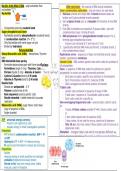
Nucleic Acids DNA & RNA – polynucleotides from DNA replication – the copying of DNA during interphase.
nucleotides Semi -conservative replication – one old strand, one new stand.
Nucleotide 1. Helicase unwinds and unzips DNA. H bonds between bases are
broken and 2 polynucleotide strands separate.
2. Each original strand acts as a template for formation of new DNA
strands
- Components joined by covalent bond 3. Free DNA nucleotides are activated & P groups added - pair with
Sugar-phosphate back bone complementary bases, forming H bonds
- Nucleotides joined by phosphodiester (covalent) bonds 4. DNA polymerase forms phosphodiester bonds between P & S,
in condensation reaction. (P + 5th C) forming sugar phosphate back bone.
- Only Nucleotides with same sugar can join - Enzyme can only bond at 5’ and move to 3’ end.
- Broken by hydrolysis 5. 2 genetically identical DNA molecules formed. 1 template strand, 1
Polynucleotides new complementary strand.
Deoxyribonucleic acid (DNA) – deoxyribose, Thymine Replication errors – sequences of bases not matched exactly causes
base random, spontaneous mutations
DNA Nucleotide base paring Genetic Code – DNA contains genetic code which codes for synthesis of
- Pyrimidine bases always pair with Purine bases all polypeptides.
- Pyrimidines (single C ring) - Thymine, Cytosine Gene - a sequence of DNA that codes for synthesis of a specific
- Purines (double C ring) - Adenine & Guanine polypeptide. In nucleus so code is conserved/ protected.
- Cystine & Guanine bond by 3 H bonds - Each gene occupies a specific locus (position on chromosome)
- Adenine & Thymine bond by 2 H bonds - Each chromosome consists of 1 molecule of DNA
Double Helix - DNA is wrapped around histone proteins (chromatin)
- Strands are antiparallel – 3’-5’ Triplet code
- Polymer contains lots of info - Genetic code contained in sequence of bases in DNA
- Base sequences used as genetic code - Triplet code – sequence of 3 nucleotides called a codon.
- Double stranded = stable molecule & accurate - Each codon codes for a specific aa
replication Non-overlapping Degenerate code – several codons code for same
Ribonucleic acid (RNA). sugar ribose, Uracil base aa
- Copy of sequence of DNA. - 4 bases, 64 base codons possible (43=64). Excess codons used
- Single stranded in;
- 1 start codon signals start of sequence (AUG)
ATP – universal energy currency - 3 stop codons, do not code for any aa, signal end of sequence
- Present in all organisms & cells. - Only 20 aa & lots more codons. Many codons code for same aa (a
- releases energy in small/ manageable quantities degenerate code).
Formation Mutation – changes triplet code which incorporates different aa.
- ATP formed in condensation reaction. ADP + Pi
Alters structure of protein (active site) & protein is non-functional.
ATP
- Hydrolysis ATP ADP + Pi releases energy
- Pi used in bond formation to release lots of energy.
Properties:
- Soluble
- releasing energy in small quantities (no wastage)
- unstable phosphate bond easily broken
- Stored as fat; long term energy store, stable
molecule, used for insulation.
nucleotides Semi -conservative replication – one old strand, one new stand.
Nucleotide 1. Helicase unwinds and unzips DNA. H bonds between bases are
broken and 2 polynucleotide strands separate.
2. Each original strand acts as a template for formation of new DNA
strands
- Components joined by covalent bond 3. Free DNA nucleotides are activated & P groups added - pair with
Sugar-phosphate back bone complementary bases, forming H bonds
- Nucleotides joined by phosphodiester (covalent) bonds 4. DNA polymerase forms phosphodiester bonds between P & S,
in condensation reaction. (P + 5th C) forming sugar phosphate back bone.
- Only Nucleotides with same sugar can join - Enzyme can only bond at 5’ and move to 3’ end.
- Broken by hydrolysis 5. 2 genetically identical DNA molecules formed. 1 template strand, 1
Polynucleotides new complementary strand.
Deoxyribonucleic acid (DNA) – deoxyribose, Thymine Replication errors – sequences of bases not matched exactly causes
base random, spontaneous mutations
DNA Nucleotide base paring Genetic Code – DNA contains genetic code which codes for synthesis of
- Pyrimidine bases always pair with Purine bases all polypeptides.
- Pyrimidines (single C ring) - Thymine, Cytosine Gene - a sequence of DNA that codes for synthesis of a specific
- Purines (double C ring) - Adenine & Guanine polypeptide. In nucleus so code is conserved/ protected.
- Cystine & Guanine bond by 3 H bonds - Each gene occupies a specific locus (position on chromosome)
- Adenine & Thymine bond by 2 H bonds - Each chromosome consists of 1 molecule of DNA
Double Helix - DNA is wrapped around histone proteins (chromatin)
- Strands are antiparallel – 3’-5’ Triplet code
- Polymer contains lots of info - Genetic code contained in sequence of bases in DNA
- Base sequences used as genetic code - Triplet code – sequence of 3 nucleotides called a codon.
- Double stranded = stable molecule & accurate - Each codon codes for a specific aa
replication Non-overlapping Degenerate code – several codons code for same
Ribonucleic acid (RNA). sugar ribose, Uracil base aa
- Copy of sequence of DNA. - 4 bases, 64 base codons possible (43=64). Excess codons used
- Single stranded in;
- 1 start codon signals start of sequence (AUG)
ATP – universal energy currency - 3 stop codons, do not code for any aa, signal end of sequence
- Present in all organisms & cells. - Only 20 aa & lots more codons. Many codons code for same aa (a
- releases energy in small/ manageable quantities degenerate code).
Formation Mutation – changes triplet code which incorporates different aa.
- ATP formed in condensation reaction. ADP + Pi
Alters structure of protein (active site) & protein is non-functional.
ATP
- Hydrolysis ATP ADP + Pi releases energy
- Pi used in bond formation to release lots of energy.
Properties:
- Soluble
- releasing energy in small quantities (no wastage)
- unstable phosphate bond easily broken
- Stored as fat; long term energy store, stable
molecule, used for insulation.