Week 5 - CH 6 (6.1–6.3)
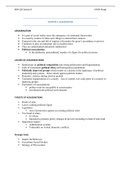
6.1 - Computational Problems in Object Recognition
Object recognition->there are four major concepts:
- Use terms precisely: e.g. don’t confuse bw perceive or recognize.
- Object perception is unified: Features like color and motion are processed along distinct
neural pathways. Perception, however, requires more than simply perceiving the features
of objects.
- Perceptual capabilities are enormously flexible and robust
- The product of perception is intimately interwoven with memory. Object recognition is
more than linking features to form a coherent whole; that whole triggers memories.
Object constancy => Our amazing ability to recognize an object in countless situations.
- The visual information emanating from an object varies as a function of three factors:
- viewing position -> Sensory information depends highly on your viewpoint,
which changes both when YOU move and when the OBJECT moves.
- illumination conditions -> Recognition is largely insensitive to changes in
illumination. A dog in the sun and a dog in the shade both register as a dog.
- Context -> People see objects surrounded by other objects and against varied
backgrounds. Yet we have no trouble separating a dog from other objects on a
crowded city street.
- Object recognition must be both general enough to support object constancy and specific
enough to pick out slight differences between members of a category or class.
6.2 - Multiple Pathways for Visual Perception
Visual info -> retina -> first few synapses in the cortex -> them segregating into multiple
processing streams -> Much of the information goes to the primary visual cortex, also called V1
or striate cortex in the occipital lobe.
- Output from V1 is contained primarily in two major fiber bundles, or fasciculi, which
carry visual information to regions of the parietal and temporal cortex that are involved
in visual object recognition.
- superior longitudinal fasciculus => takes a dorsal path from the striate cortex and other
visual areas [dorsal (occipitoparietal) stream]
- inferior longitudinal fasciculus => follows a ventral route from the occipital striate cortex
into the temporal lobe [ventral (occipitotemporal) stream].
The “What” and “Where” Pathways
Leslie Ungerleider and Mortimer Mishkin at the National Institutes of
Health (1982) hypothesized that:
6.1 - Computational Problems in Object Recognition
Object recognition->there are four major concepts:
- Use terms precisely: e.g. don’t confuse bw perceive or recognize.
- Object perception is unified: Features like color and motion are processed along distinct
neural pathways. Perception, however, requires more than simply perceiving the features
of objects.
- Perceptual capabilities are enormously flexible and robust
- The product of perception is intimately interwoven with memory. Object recognition is
more than linking features to form a coherent whole; that whole triggers memories.
Object constancy => Our amazing ability to recognize an object in countless situations.
- The visual information emanating from an object varies as a function of three factors:
- viewing position -> Sensory information depends highly on your viewpoint,
which changes both when YOU move and when the OBJECT moves.
- illumination conditions -> Recognition is largely insensitive to changes in
illumination. A dog in the sun and a dog in the shade both register as a dog.
- Context -> People see objects surrounded by other objects and against varied
backgrounds. Yet we have no trouble separating a dog from other objects on a
crowded city street.
- Object recognition must be both general enough to support object constancy and specific
enough to pick out slight differences between members of a category or class.
6.2 - Multiple Pathways for Visual Perception
Visual info -> retina -> first few synapses in the cortex -> them segregating into multiple
processing streams -> Much of the information goes to the primary visual cortex, also called V1
or striate cortex in the occipital lobe.
- Output from V1 is contained primarily in two major fiber bundles, or fasciculi, which
carry visual information to regions of the parietal and temporal cortex that are involved
in visual object recognition.
- superior longitudinal fasciculus => takes a dorsal path from the striate cortex and other
visual areas [dorsal (occipitoparietal) stream]
- inferior longitudinal fasciculus => follows a ventral route from the occipital striate cortex
into the temporal lobe [ventral (occipitotemporal) stream].
The “What” and “Where” Pathways
Leslie Ungerleider and Mortimer Mishkin at the National Institutes of
Health (1982) hypothesized that: