CRIMINAL LAW: THEFT (s1-6 Theft Act 1968)
DEFINITON
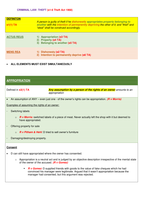
A person is guilty of theft if he dishonestly appropriates property belonging to
s1(1) TA another with the intention of permanently depriving the other of it; and “thief” and
“steal” shall be construed accordingly.
ACTUS REUS 1) Appropriation (s3 TA)
2) Property (s4 TA)
3) Belonging to another (s5 TA)
MENS REA 1) Dishonesty (s2 TA)
2) Intention to permanently deprive (s6 TA)
ALL ELEMENTS MUST EXIST SIMULTANEOUSLY
APPROPRIATION
Defined in s3(1) TA Any assumption by a person of the rights of an owner amounts to an
appropriation
An assumption of ANY – even just one - of the owner’s rights can be appropriation. (R v Morris)
Examples of assuming the rights of an owner:
- Switching labels
o R v Morris: switched labels of a piece of meat. Never actually left the shop with it but deemed to
have appropriated.
- Offering property for sale
o R v Pitham & Hehl: D tried to sell owner’s furniture
- Damaging/destroying property.
Consent
D can still have appropriated where the owner has consented.
o Appropriation is a neutral act and is judged by an objective description irrespective of the mental state
of the owner of the accused. (R v Gomez)
R v Gomez: D supplied friends with goods to the value of fake cheques which he had
convinced his manager were legitimate. Argued that it wasn’t appropriation because the
manager had consented, but this argument was rejected.
DEFINITON
A person is guilty of theft if he dishonestly appropriates property belonging to
s1(1) TA another with the intention of permanently depriving the other of it; and “thief” and
“steal” shall be construed accordingly.
ACTUS REUS 1) Appropriation (s3 TA)
2) Property (s4 TA)
3) Belonging to another (s5 TA)
MENS REA 1) Dishonesty (s2 TA)
2) Intention to permanently deprive (s6 TA)
ALL ELEMENTS MUST EXIST SIMULTANEOUSLY
APPROPRIATION
Defined in s3(1) TA Any assumption by a person of the rights of an owner amounts to an
appropriation
An assumption of ANY – even just one - of the owner’s rights can be appropriation. (R v Morris)
Examples of assuming the rights of an owner:
- Switching labels
o R v Morris: switched labels of a piece of meat. Never actually left the shop with it but deemed to
have appropriated.
- Offering property for sale
o R v Pitham & Hehl: D tried to sell owner’s furniture
- Damaging/destroying property.
Consent
D can still have appropriated where the owner has consented.
o Appropriation is a neutral act and is judged by an objective description irrespective of the mental state
of the owner of the accused. (R v Gomez)
R v Gomez: D supplied friends with goods to the value of fake cheques which he had
convinced his manager were legitimate. Argued that it wasn’t appropriation because the
manager had consented, but this argument was rejected.