The Law Relating to Private Companies – Corporate and Individual Liabilities
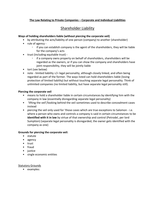
Shareholder Liability
Ways of holding shareholders liable (without piercing the corporate veil)
• by attributing the acts/liability of one person (company) to another (shareholder)
• rule of agency -
◦ if you can establish company is the agent of the shareholders, they will be liable
for the company’s acts
• trust (including equitable trust) -
◦ if a company owns property on behalf of shareholders, shareholders will be
regarded as the owners, or if you can show the company and shareholders have
joint responsibility, they will be jointly liable
• tort (see below)
• note - limited liability =/= legal personality, although closely linked, and often being
regarded as part of the former. The ways listed can hold shareholders liable (losing
protection of limited liability) but without touching separate legal personality. Think of
unlimited companies (no limited liability, but have separate legal personality still).
Piercing the corporate veil
• means to hold a shareholder liable in certain circumstances by identifying him with the
company in law (essentially disregarding separate legal personality)
• ‘lifting the veil’/looking behind the veil sometimes used to describe concealment cases
instead
• piercing the veil only used for ‘those cases which are true exceptions to Salomon - i.e.
where a person who owns and controls a company is said in certain circumstances to be
identified with it in law by virtue of that ownership and control (Petrodel, per lord
Sumption) (separate legal personality is disregarded, the owner gets identified with the
company as one)
Grounds for piercing the corporate veil:
• statute
• agency
• trust
• fraud
• justice
• single economic entities
Statutory Grounds
• examples:
Shareholder Liability
Ways of holding shareholders liable (without piercing the corporate veil)
• by attributing the acts/liability of one person (company) to another (shareholder)
• rule of agency -
◦ if you can establish company is the agent of the shareholders, they will be liable
for the company’s acts
• trust (including equitable trust) -
◦ if a company owns property on behalf of shareholders, shareholders will be
regarded as the owners, or if you can show the company and shareholders have
joint responsibility, they will be jointly liable
• tort (see below)
• note - limited liability =/= legal personality, although closely linked, and often being
regarded as part of the former. The ways listed can hold shareholders liable (losing
protection of limited liability) but without touching separate legal personality. Think of
unlimited companies (no limited liability, but have separate legal personality still).
Piercing the corporate veil
• means to hold a shareholder liable in certain circumstances by identifying him with the
company in law (essentially disregarding separate legal personality)
• ‘lifting the veil’/looking behind the veil sometimes used to describe concealment cases
instead
• piercing the veil only used for ‘those cases which are true exceptions to Salomon - i.e.
where a person who owns and controls a company is said in certain circumstances to be
identified with it in law by virtue of that ownership and control (Petrodel, per lord
Sumption) (separate legal personality is disregarded, the owner gets identified with the
company as one)
Grounds for piercing the corporate veil:
• statute
• agency
• trust
• fraud
• justice
• single economic entities
Statutory Grounds
• examples: