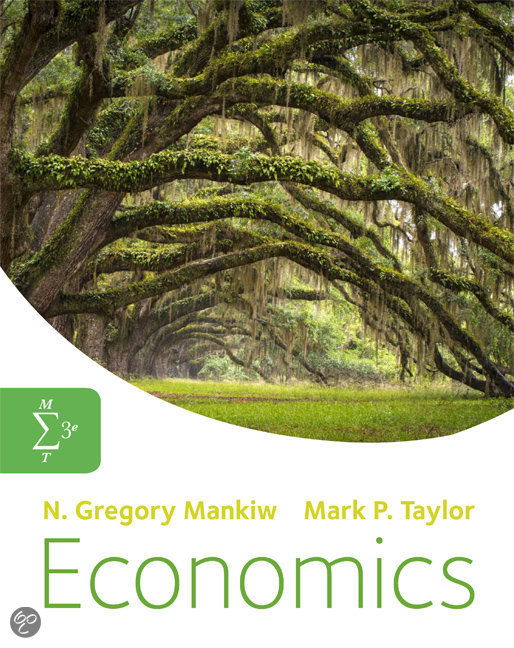
Mankiw, Taylor:
Economics 1
University of Applied Sciences Utrecht
Summary by: Viktória Dévényi (2016)
Viktória Dévényi – IBMS HU 2017 1
,Table of Contents
CHAPTER 1 –Ten principles of economics .......................................................................... 5
WHAT IS ECONOMICS? .............................................................................................................. 5
The economic problem ...................................................................................................................... 5
Scarcity and choice ............................................................................................................................ 5
HOW PEOPLE MAKE DECISIONS ............................................................................................. 5
Principle 1: People face trade-offs .................................................................................................... 6
Principle 2: The cost of something is what you give up to get it .................................................... 6
Principle 3: Rational people think at the margin ............................................................................ 6
Principle 4: People respond to incentives ........................................................................................ 6
Principle 5: Trade can make everyone better off ............................................................................ 6
Principle 6: Markets are usually a good way to organize economic activity ................................ 7
Principle 7: Governments can sometimes improve market outcomes........................................... 7
Microeconomics and macroeconomics ............................................................................................. 7
Principle 8: An economy’s standard of living depends on its ability to produce goods and
services ................................................................................................................................................ 8
Principle 9: Prices rise when the government prints too much money ......................................... 8
Principle 10: Society faces a short-run trade-off between inflation and unemployment ............. 8
SUMMARY .................................................................................................................................... 9
CHAPTER 3 – The market forces of supply and demand ...................................................10
MARKETS AND COMPETITION .............................................................................................. 10
Competitive markets ....................................................................................................................... 10
Competition: perfect and otherwise ............................................................................................... 10
DEMAND ...................................................................................................................................... 11
The demand curve: the relationship between price and quantity demanded ............................. 11
Shifts versus movements along the demand curve ........................................................................ 11
SUPPLY ........................................................................................................................................ 13
The supply curve: the relationship between price and quantity supplied .................................. 13
Shifts in the supply curve ................................................................................................................ 13
SUPPLY AND DEMAND TOGETHER ....................................................................................... 14
Equilibrium ...................................................................................................................................... 14
Prices as signals................................................................................................................................ 15
The algebra of market equilibrium ................................................................................................ 15
Three steps to analyzing changes in equilibrium .......................................................................... 15
What happens to price and quantity when demand or supply shifts? ........................................ 16
SUMMARY .................................................................................................................................. 16
CHAPTER 20 – Measuring a nation’s income ....................................................................17
THE ECONOMY’S INCOME AND EXPENDITURE ................................................................ 17
THE MEASUREMENT OF GROSS DOMESTIC PRODUCT ................................................... 18
THE COMPONENTS OF GDP .................................................................................................... 18
Measures of income: ........................................................................................................................ 18
REAL VERSUS NOMINAL GDP ................................................................................................ 19
The GDP deflator: ........................................................................................................................... 19
GDP AND ECONOMIC WELL-BEING ...................................................................................... 20
SUMMARY .................................................................................................................................. 20
Viktória Dévényi – IBMS HU 2017 2
,CHAPTER 21 – Measuring the cost of living ......................................................................21
THE CONSUMER PRICES INDEX ............................................................................................ 21
How the consumer prices index is calculated? .............................................................................. 21
Problems in measuring the cost of living ....................................................................................... 21
CORRECTIONG ECONOMIC VARIABLES FOR THE EFFECTS OF INFLATION ............. 22
Money figures from different times ............................................................................................... 22
Indexation ......................................................................................................................................... 22
Real and nominal interest rates ...................................................................................................... 23
SUMMARY .................................................................................................................................. 23
CHAPTER 22 – Production and growth..............................................................................24
ECONOMIC GROWTH AROUND THE WORLD ..................................................................... 24
GROWTH THEORY .................................................................................................................... 24
PRODUCTIVITY: ITS ROLE AND DETERMINANTS ............................................................. 24
Why productivity is so important................................................................................................... 24
The determinants of economic growth ........................................................................................... 25
ECONOMIC GROWTH AND PUBLIC POLICY ....................................................................... 25
The importance of saving and investment ..................................................................................... 25
Diminishing returns and the catch-up effect ................................................................................. 26
Investment from abroad ................................................................................................................. 26
Education ......................................................................................................................................... 27
Health and nutrition ........................................................................................................................ 27
Property rights, political stability and good governance .............................................................. 27
Free trade ......................................................................................................................................... 27
Research and development ............................................................................................................. 28
Population growth ........................................................................................................................... 28
SUMMARY .................................................................................................................................. 28
CHAPTER 24 - Saving, investment and the financial system .............................................29
FINANCIAL INSTITUTIONS IN THE ECONOMY .................................................................. 29
Financial markets ............................................................................................................................ 29
Financial intermediaries ................................................................................................................. 30
SAVING AND INVESTMENT IN THE NATIONAL INCOME ACCOUNTS ........................... 31
Some important identities ............................................................................................................... 32
THE MARKET FOR LOANABLE FUNDS................................................................................. 32
Supply and demand for loanable funds ......................................................................................... 33
Government policies that affect the economy’s saving and investment: ..................................... 33
SUMMARY .................................................................................................................................. 34
CHAPTER 26 – The monetary system ................................................................................35
THE MEANING OF MONEY ...................................................................................................... 35
The kinds of money.......................................................................................................................... 35
Money in the economy ..................................................................................................................... 36
THE ROLE OF CENTRAL BANKS ............................................................................................ 37
THE EUROPEAN CENTRAL BANK AND THE EUROSYSTEM ............................................. 37
THE BANK OF ENGLAND ......................................................................................................... 38
BANKS AND THE MONEY SUPPLY ......................................................................................... 39
The simple case of 100 percent reserve banking ........................................................................... 39
Money creation with fractional-reserve banking .......................................................................... 39
Viktória Dévényi – IBMS HU 2017 3
, The money multiplier ...................................................................................................................... 40
The central bank’s tools of monetary control ............................................................................... 41
Quantitative easing .......................................................................................................................... 42
Problems in controlling the money supply .................................................................................... 42
SUMMARY .................................................................................................................................. 43
CHAPTER 27 – Money growth and inflation ..................................................................- 45 -
THE CLASSICAL THEORY OF INFLATION ....................................................................... - 45 -
The level of prices and the value of money ................................................................................ - 45 -
Money supply, money demand and monetary equilibrium ..................................................... - 45 -
The effects of a monetary injection ............................................................................................ - 46 -
A brief look at the adjustment process ...................................................................................... - 47 -
The classical dichotomy and monetary neutrality .................................................................... - 47 -
Velocity and the quantity equation ............................................................................................ - 47 -
The inflation tax ........................................................................................................................... - 48 -
The Fisher effect .......................................................................................................................... - 48 -
THE COSTS OF INFLATION ................................................................................................. - 49 -
A fall in purchasing power? The inflation fallacy ..................................................................... - 49 -
Deflation ....................................................................................................................................... - 50 -
SUMMARY .............................................................................................................................. - 50 -
CHAPTER 28 – Open-economy macroeconomics: basic concepts ..................................- 51 -
THE INTERNATIONAL FLOWS OF GOODS AND CAPITAL ............................................ - 51 -
The flow of goods and services: exports, imports, and net exports ......................................... - 51 -
The flow of financial resources: net capital outflow ................................................................. - 51 -
The equality of net exports and net capital flow ....................................................................... - 52 -
Saving and investment, and their relationship to the international flows .............................. - 52 -
Summing up ................................................................................................................................. - 52 -
THE PRICES FOR INTERNATIONAL TRANSACTIONS: REAL AND NOMINAL
EXCHANGE RATES ............................................................................................................... - 53 -
Nominal exchange rates .............................................................................................................. - 53 -
Real exchange rates ..................................................................................................................... - 53 -
A FIRST THEORY OF EXCHANGE RATE DETERMINATION: PURCHASING POWER
PARITY .................................................................................................................................... - 53 -
The basic logic of PPP ................................................................................................................. - 54 -
Implications of PPP ..................................................................................................................... - 54 -
Limitations of PPP ....................................................................................................................... - 54 -
The Big Mac Index ...................................................................................................................... - 54 -
SUMMARY .............................................................................................................................. - 55 -
Viktória Dévényi – IBMS HU 2017 4
, CHAPTER 1 –Ten principles of economics
WHAT IS ECONOMICS?
Word economy comes from the Greek oikonomos, meaning ‘one who manages a household’. A
household and a society face many decisions:
• Tasks and jobs to be done and what each member gets in return.
• Who does what?
The economic problem
• What goods and services should be produced?
• How should these good and services be produced?
• Who should get the goods and services that have been produced?
Society’s resources:
• Land: all the natural resources of the earth.
• Labor: the human effort both mental and physical that goes in to production.
• Capital: the equipment and structures used to produce goods and services.
Scarcity and choice
• Scarcity: the limited nature of society’s resources.
• Economics: the study of how society manages its scarce resources.
What do economists do:
• Study how people make decisions: how much they work, what they buy, how much they
save, etc.
• Study how people interact with one another.
• Analyse forces and trends that affect the economy as a whole: growth in average income,
rate at which prices are rising, unemployment rate changes.
HOW PEOPLE MAKE DECISIONS
The economy: all the production and exchange activities that take place every day.
Economic activity: how much buying and selling goes on in the economy over a period of time.
Four principles of individual decision making:
1. People face trade-offs
2. The cost of something is what you give up to get it
3. Rational people think at the margin
4. People respond to incentives
Viktória Dévényi – IBMS HU 2017 5
Economics 1
University of Applied Sciences Utrecht
Summary by: Viktória Dévényi (2016)
Viktória Dévényi – IBMS HU 2017 1
,Table of Contents
CHAPTER 1 –Ten principles of economics .......................................................................... 5
WHAT IS ECONOMICS? .............................................................................................................. 5
The economic problem ...................................................................................................................... 5
Scarcity and choice ............................................................................................................................ 5
HOW PEOPLE MAKE DECISIONS ............................................................................................. 5
Principle 1: People face trade-offs .................................................................................................... 6
Principle 2: The cost of something is what you give up to get it .................................................... 6
Principle 3: Rational people think at the margin ............................................................................ 6
Principle 4: People respond to incentives ........................................................................................ 6
Principle 5: Trade can make everyone better off ............................................................................ 6
Principle 6: Markets are usually a good way to organize economic activity ................................ 7
Principle 7: Governments can sometimes improve market outcomes........................................... 7
Microeconomics and macroeconomics ............................................................................................. 7
Principle 8: An economy’s standard of living depends on its ability to produce goods and
services ................................................................................................................................................ 8
Principle 9: Prices rise when the government prints too much money ......................................... 8
Principle 10: Society faces a short-run trade-off between inflation and unemployment ............. 8
SUMMARY .................................................................................................................................... 9
CHAPTER 3 – The market forces of supply and demand ...................................................10
MARKETS AND COMPETITION .............................................................................................. 10
Competitive markets ....................................................................................................................... 10
Competition: perfect and otherwise ............................................................................................... 10
DEMAND ...................................................................................................................................... 11
The demand curve: the relationship between price and quantity demanded ............................. 11
Shifts versus movements along the demand curve ........................................................................ 11
SUPPLY ........................................................................................................................................ 13
The supply curve: the relationship between price and quantity supplied .................................. 13
Shifts in the supply curve ................................................................................................................ 13
SUPPLY AND DEMAND TOGETHER ....................................................................................... 14
Equilibrium ...................................................................................................................................... 14
Prices as signals................................................................................................................................ 15
The algebra of market equilibrium ................................................................................................ 15
Three steps to analyzing changes in equilibrium .......................................................................... 15
What happens to price and quantity when demand or supply shifts? ........................................ 16
SUMMARY .................................................................................................................................. 16
CHAPTER 20 – Measuring a nation’s income ....................................................................17
THE ECONOMY’S INCOME AND EXPENDITURE ................................................................ 17
THE MEASUREMENT OF GROSS DOMESTIC PRODUCT ................................................... 18
THE COMPONENTS OF GDP .................................................................................................... 18
Measures of income: ........................................................................................................................ 18
REAL VERSUS NOMINAL GDP ................................................................................................ 19
The GDP deflator: ........................................................................................................................... 19
GDP AND ECONOMIC WELL-BEING ...................................................................................... 20
SUMMARY .................................................................................................................................. 20
Viktória Dévényi – IBMS HU 2017 2
,CHAPTER 21 – Measuring the cost of living ......................................................................21
THE CONSUMER PRICES INDEX ............................................................................................ 21
How the consumer prices index is calculated? .............................................................................. 21
Problems in measuring the cost of living ....................................................................................... 21
CORRECTIONG ECONOMIC VARIABLES FOR THE EFFECTS OF INFLATION ............. 22
Money figures from different times ............................................................................................... 22
Indexation ......................................................................................................................................... 22
Real and nominal interest rates ...................................................................................................... 23
SUMMARY .................................................................................................................................. 23
CHAPTER 22 – Production and growth..............................................................................24
ECONOMIC GROWTH AROUND THE WORLD ..................................................................... 24
GROWTH THEORY .................................................................................................................... 24
PRODUCTIVITY: ITS ROLE AND DETERMINANTS ............................................................. 24
Why productivity is so important................................................................................................... 24
The determinants of economic growth ........................................................................................... 25
ECONOMIC GROWTH AND PUBLIC POLICY ....................................................................... 25
The importance of saving and investment ..................................................................................... 25
Diminishing returns and the catch-up effect ................................................................................. 26
Investment from abroad ................................................................................................................. 26
Education ......................................................................................................................................... 27
Health and nutrition ........................................................................................................................ 27
Property rights, political stability and good governance .............................................................. 27
Free trade ......................................................................................................................................... 27
Research and development ............................................................................................................. 28
Population growth ........................................................................................................................... 28
SUMMARY .................................................................................................................................. 28
CHAPTER 24 - Saving, investment and the financial system .............................................29
FINANCIAL INSTITUTIONS IN THE ECONOMY .................................................................. 29
Financial markets ............................................................................................................................ 29
Financial intermediaries ................................................................................................................. 30
SAVING AND INVESTMENT IN THE NATIONAL INCOME ACCOUNTS ........................... 31
Some important identities ............................................................................................................... 32
THE MARKET FOR LOANABLE FUNDS................................................................................. 32
Supply and demand for loanable funds ......................................................................................... 33
Government policies that affect the economy’s saving and investment: ..................................... 33
SUMMARY .................................................................................................................................. 34
CHAPTER 26 – The monetary system ................................................................................35
THE MEANING OF MONEY ...................................................................................................... 35
The kinds of money.......................................................................................................................... 35
Money in the economy ..................................................................................................................... 36
THE ROLE OF CENTRAL BANKS ............................................................................................ 37
THE EUROPEAN CENTRAL BANK AND THE EUROSYSTEM ............................................. 37
THE BANK OF ENGLAND ......................................................................................................... 38
BANKS AND THE MONEY SUPPLY ......................................................................................... 39
The simple case of 100 percent reserve banking ........................................................................... 39
Money creation with fractional-reserve banking .......................................................................... 39
Viktória Dévényi – IBMS HU 2017 3
, The money multiplier ...................................................................................................................... 40
The central bank’s tools of monetary control ............................................................................... 41
Quantitative easing .......................................................................................................................... 42
Problems in controlling the money supply .................................................................................... 42
SUMMARY .................................................................................................................................. 43
CHAPTER 27 – Money growth and inflation ..................................................................- 45 -
THE CLASSICAL THEORY OF INFLATION ....................................................................... - 45 -
The level of prices and the value of money ................................................................................ - 45 -
Money supply, money demand and monetary equilibrium ..................................................... - 45 -
The effects of a monetary injection ............................................................................................ - 46 -
A brief look at the adjustment process ...................................................................................... - 47 -
The classical dichotomy and monetary neutrality .................................................................... - 47 -
Velocity and the quantity equation ............................................................................................ - 47 -
The inflation tax ........................................................................................................................... - 48 -
The Fisher effect .......................................................................................................................... - 48 -
THE COSTS OF INFLATION ................................................................................................. - 49 -
A fall in purchasing power? The inflation fallacy ..................................................................... - 49 -
Deflation ....................................................................................................................................... - 50 -
SUMMARY .............................................................................................................................. - 50 -
CHAPTER 28 – Open-economy macroeconomics: basic concepts ..................................- 51 -
THE INTERNATIONAL FLOWS OF GOODS AND CAPITAL ............................................ - 51 -
The flow of goods and services: exports, imports, and net exports ......................................... - 51 -
The flow of financial resources: net capital outflow ................................................................. - 51 -
The equality of net exports and net capital flow ....................................................................... - 52 -
Saving and investment, and their relationship to the international flows .............................. - 52 -
Summing up ................................................................................................................................. - 52 -
THE PRICES FOR INTERNATIONAL TRANSACTIONS: REAL AND NOMINAL
EXCHANGE RATES ............................................................................................................... - 53 -
Nominal exchange rates .............................................................................................................. - 53 -
Real exchange rates ..................................................................................................................... - 53 -
A FIRST THEORY OF EXCHANGE RATE DETERMINATION: PURCHASING POWER
PARITY .................................................................................................................................... - 53 -
The basic logic of PPP ................................................................................................................. - 54 -
Implications of PPP ..................................................................................................................... - 54 -
Limitations of PPP ....................................................................................................................... - 54 -
The Big Mac Index ...................................................................................................................... - 54 -
SUMMARY .............................................................................................................................. - 55 -
Viktória Dévényi – IBMS HU 2017 4
, CHAPTER 1 –Ten principles of economics
WHAT IS ECONOMICS?
Word economy comes from the Greek oikonomos, meaning ‘one who manages a household’. A
household and a society face many decisions:
• Tasks and jobs to be done and what each member gets in return.
• Who does what?
The economic problem
• What goods and services should be produced?
• How should these good and services be produced?
• Who should get the goods and services that have been produced?
Society’s resources:
• Land: all the natural resources of the earth.
• Labor: the human effort both mental and physical that goes in to production.
• Capital: the equipment and structures used to produce goods and services.
Scarcity and choice
• Scarcity: the limited nature of society’s resources.
• Economics: the study of how society manages its scarce resources.
What do economists do:
• Study how people make decisions: how much they work, what they buy, how much they
save, etc.
• Study how people interact with one another.
• Analyse forces and trends that affect the economy as a whole: growth in average income,
rate at which prices are rising, unemployment rate changes.
HOW PEOPLE MAKE DECISIONS
The economy: all the production and exchange activities that take place every day.
Economic activity: how much buying and selling goes on in the economy over a period of time.
Four principles of individual decision making:
1. People face trade-offs
2. The cost of something is what you give up to get it
3. Rational people think at the margin
4. People respond to incentives
Viktória Dévényi – IBMS HU 2017 5