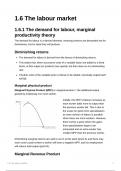
1.6 The labour market
1.6.1 The demand for labour, marginal
productivity theory
The demand for labour is a derived demand, meaning workers are demanded not for
themselves, but for what they will produce.
Diminishing returns
The demand for labour is derived from the theory of diminishing returns.
This states that, when successive units of a variable factor are added to a fixed
factor, at first output (or product) rises quickly, but then does so at a diminishing
rate.
If further units of the variable factor continue to be added, eventually output itself
will fall.
Marginal physical product
Marginal Physical Product (MPP) or marginal product = the additional output
gained by employing one more worker.
Initially, the MPP of labour increases as
each worker adds more to output than
the previous worker did. This is due to
the scope for gains from specialisation
as more division of labour is possible
when there are more workers. However,
there comes a point where the gains
from specialisation begin to be
exhausted and an extra worker has
smaller MPP than the previous worker.
Diminishing marginal returns are said to set in at this point (point A) and there may
even come a point where a worker will have a negative MPP, and his employment
will reduce total output (point B).
Marginal Revenue Product
1.6 The labour market 1
, MRP is the additional revenue gained from employing one more worker.
MRP = MPP x MR
If we assume that the firm’s product is sold in a perfectly competitive market, then
the firm becomes a price-taker and the price of its product is not reduced when extra
unites of output are sold (MR=AR=P):
MRP = MPP x P.
Extra workers will be employed so long as: MRP > W.
If the wage is W1, all workers prior to
the 1st worker have MRPs in excess of
the wage and are profitable to hire. All
workers between Q4A and Q4B have
MRPs in excess of the wage and hence
are profitable to employ. Because of
this, Q4B workers are employed and
the labour demand curve is the
downward sloping section of the MRP
curve.
A firm will never stop hiring workers whilst MRP is rising, neither will they continue
hiring workers when MRP is negative. So the demand curve is the downward sloping
section of the MRP curve.
Shifts in the labour demand curve
The two main factors are changes in productivity or changes in demand for the final
product.
Change in the price of the final
product that labour makes - this
means the MPP that each worker
produces is worth either more or
less when it is sold, MRP thus
changes.
Change in demand for the final
product - because labour is a
derived demand, a change in the
1.6 The labour market 2
, demand for final product results in a
change in the demand for labour.
Changes to labour productivity - when productivity is rising, each employee is
able to produce more per hour, MPP increases, so businesses will benefit by
employing more workers to generate more revenue, MRP increases.
Changes in the price of capital - in the long run, capital can be used to substitute
for labour in the production process, so other things being equal, it is expected
that a fall in the price of capital will lead to more of it being employed and less
labour, resulting in the labour demand curve shifting to the left.
The elasticity of demand for labour
The elasticity of labour measures the responsiveness of quantity of labour
demanded to a change in the real wage rate.
%∆ in quantity of labour demanded / %∆ in the wage rate
1.6 The labour market 3
1.6.1 The demand for labour, marginal
productivity theory
The demand for labour is a derived demand, meaning workers are demanded not for
themselves, but for what they will produce.
Diminishing returns
The demand for labour is derived from the theory of diminishing returns.
This states that, when successive units of a variable factor are added to a fixed
factor, at first output (or product) rises quickly, but then does so at a diminishing
rate.
If further units of the variable factor continue to be added, eventually output itself
will fall.
Marginal physical product
Marginal Physical Product (MPP) or marginal product = the additional output
gained by employing one more worker.
Initially, the MPP of labour increases as
each worker adds more to output than
the previous worker did. This is due to
the scope for gains from specialisation
as more division of labour is possible
when there are more workers. However,
there comes a point where the gains
from specialisation begin to be
exhausted and an extra worker has
smaller MPP than the previous worker.
Diminishing marginal returns are said to set in at this point (point A) and there may
even come a point where a worker will have a negative MPP, and his employment
will reduce total output (point B).
Marginal Revenue Product
1.6 The labour market 1
, MRP is the additional revenue gained from employing one more worker.
MRP = MPP x MR
If we assume that the firm’s product is sold in a perfectly competitive market, then
the firm becomes a price-taker and the price of its product is not reduced when extra
unites of output are sold (MR=AR=P):
MRP = MPP x P.
Extra workers will be employed so long as: MRP > W.
If the wage is W1, all workers prior to
the 1st worker have MRPs in excess of
the wage and are profitable to hire. All
workers between Q4A and Q4B have
MRPs in excess of the wage and hence
are profitable to employ. Because of
this, Q4B workers are employed and
the labour demand curve is the
downward sloping section of the MRP
curve.
A firm will never stop hiring workers whilst MRP is rising, neither will they continue
hiring workers when MRP is negative. So the demand curve is the downward sloping
section of the MRP curve.
Shifts in the labour demand curve
The two main factors are changes in productivity or changes in demand for the final
product.
Change in the price of the final
product that labour makes - this
means the MPP that each worker
produces is worth either more or
less when it is sold, MRP thus
changes.
Change in demand for the final
product - because labour is a
derived demand, a change in the
1.6 The labour market 2
, demand for final product results in a
change in the demand for labour.
Changes to labour productivity - when productivity is rising, each employee is
able to produce more per hour, MPP increases, so businesses will benefit by
employing more workers to generate more revenue, MRP increases.
Changes in the price of capital - in the long run, capital can be used to substitute
for labour in the production process, so other things being equal, it is expected
that a fall in the price of capital will lead to more of it being employed and less
labour, resulting in the labour demand curve shifting to the left.
The elasticity of demand for labour
The elasticity of labour measures the responsiveness of quantity of labour
demanded to a change in the real wage rate.
%∆ in quantity of labour demanded / %∆ in the wage rate
1.6 The labour market 3