Section 2 : Inorganic Chemistry
Transition Metals
• Transition metals are elements in the middle of the Periodic Table that have atoms w/ an incomplete
d sub-level.
• The rst transition series runs from Sc to Zn.
- However Sc + Zn are not true transition elements as they do not have variable oxidation states +
their ions, Zn2+ + Sc3+, do not have an incomplete d sub-level.
- ∴ speci cation only addresses the elements from Ti to Cu.
General Properties of Transition Metals
Transition metal characteristics of elements Ti–Cu arise from an incomplete d sub-level in atoms or
ions. The characteristic properties include:
• complex formation
• formation of coloured ions
• variable oxidation state
• catalytic activity
Electronic Con guration
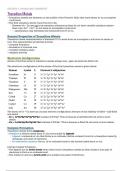
Atoms of the rst series of transition metals always lose + gain 4s electrons before 3d.
The electronic con guration of the atoms of the rst transition series is given below:
The atoms of Cr + Cu have an unusual electron con guration because of the stability of lled + half- lled
sub-shells…
• Cr is 1s22s22p63s23p63d54s1 instead of 3d44s2. This is because a half- lled 3d sub-level is more
stable.
• Cu is 1s22s22p63s23p63d104s1 instead of 3d94s2. This is because a lled 3d sub-level is more stable.
Complex Formation
Transition metals form complexes.
• Complex: a central metal atom or ion surrounded by ligands.
- Ligand: a molecule or ion that forms a co-ordinate (dative covalent) bond w/ a transition metal by
donating a lone pair of electrons.
- Co-ordination number: the no. of co-ordinate bonds to the central metal atom or ion.
During complex formation…
• The ligands act as Lewis bases when they bond to transition metals as they donate a lone pair of
electrons to form a co-ordinate bond.
• The metal ion acts as a Lewis acid as it accepts lone pairs of electrons.
fi fi fi fi
fi fi fi fi fi fi fi
, Section 2 : Inorganic Chemistry
Types of Ligands
Monodentate Ligands
Monodentate ligands: ligands which form one co-ordinate bond to a metal ion.
• E.g. H2O, NH3 + Cl-
- The ligands NH3 + H2O are similar in size + are uncharged.
- The Cl- ligand is larger than the uncharged ligands NH3 + H2O.
Ligand Cl- H2O NH3
Example complex [CuCl4]2- [Fe(H2O)6]2+ [Cr(NH3)6]3+
Bidentate Ligands
Bidentate ligands: ligands which form 2 co-ordinate bonds to a metal ion.
• E.g. H2NCH2CH2NH2 + C2O42–
H2NCH2CH2NH2 O C2O42– O
Ligand CH2 CH2
C C
H2N NH2 - -
O O
[Cr(NH2CH2CH2NH2)3]3+ [Cr(C2O4)3]3–
O
O C
NH2 3+ C O 3-
Example H2N NH2 O O C O
complex Cr Cr
H2N NH2 O O C O
NH2 C NH2
O C
O
Multidentate Ligands
Multidentate ligands: ligands which form more than 2 co-ordinate bonds to a metal ion.
• E.g. EDTA4- + porphyrin
EDTA4- (forms 6 bonds) Porphyrin (forms 4 bonds)
-
:OOC CH2 CH2 COO:-
Ligand
:N CH2 CH2 N:
-
:OOC CH2 CH2 COO:-
Example complex [Cu(EDTA)]2- Haemoglobin
Oxidation States of Metals in Complex Ions
The overall charge on a complex ion is put outside the square brackets. You can work out the oxidation
state of the metal ion w/in a complex using this eq. :
• Oxidation state of metal ion = Total charge of complex - Sum of the charges of the ligands
- E.g. oxidation state of Cu in [CuCl4]2-
= (-2) - (4 x -1)
= +2
Transition Metals
• Transition metals are elements in the middle of the Periodic Table that have atoms w/ an incomplete
d sub-level.
• The rst transition series runs from Sc to Zn.
- However Sc + Zn are not true transition elements as they do not have variable oxidation states +
their ions, Zn2+ + Sc3+, do not have an incomplete d sub-level.
- ∴ speci cation only addresses the elements from Ti to Cu.
General Properties of Transition Metals
Transition metal characteristics of elements Ti–Cu arise from an incomplete d sub-level in atoms or
ions. The characteristic properties include:
• complex formation
• formation of coloured ions
• variable oxidation state
• catalytic activity
Electronic Con guration
Atoms of the rst series of transition metals always lose + gain 4s electrons before 3d.
The electronic con guration of the atoms of the rst transition series is given below:
The atoms of Cr + Cu have an unusual electron con guration because of the stability of lled + half- lled
sub-shells…
• Cr is 1s22s22p63s23p63d54s1 instead of 3d44s2. This is because a half- lled 3d sub-level is more
stable.
• Cu is 1s22s22p63s23p63d104s1 instead of 3d94s2. This is because a lled 3d sub-level is more stable.
Complex Formation
Transition metals form complexes.
• Complex: a central metal atom or ion surrounded by ligands.
- Ligand: a molecule or ion that forms a co-ordinate (dative covalent) bond w/ a transition metal by
donating a lone pair of electrons.
- Co-ordination number: the no. of co-ordinate bonds to the central metal atom or ion.
During complex formation…
• The ligands act as Lewis bases when they bond to transition metals as they donate a lone pair of
electrons to form a co-ordinate bond.
• The metal ion acts as a Lewis acid as it accepts lone pairs of electrons.
fi fi fi fi
fi fi fi fi fi fi fi
, Section 2 : Inorganic Chemistry
Types of Ligands
Monodentate Ligands
Monodentate ligands: ligands which form one co-ordinate bond to a metal ion.
• E.g. H2O, NH3 + Cl-
- The ligands NH3 + H2O are similar in size + are uncharged.
- The Cl- ligand is larger than the uncharged ligands NH3 + H2O.
Ligand Cl- H2O NH3
Example complex [CuCl4]2- [Fe(H2O)6]2+ [Cr(NH3)6]3+
Bidentate Ligands
Bidentate ligands: ligands which form 2 co-ordinate bonds to a metal ion.
• E.g. H2NCH2CH2NH2 + C2O42–
H2NCH2CH2NH2 O C2O42– O
Ligand CH2 CH2
C C
H2N NH2 - -
O O
[Cr(NH2CH2CH2NH2)3]3+ [Cr(C2O4)3]3–
O
O C
NH2 3+ C O 3-
Example H2N NH2 O O C O
complex Cr Cr
H2N NH2 O O C O
NH2 C NH2
O C
O
Multidentate Ligands
Multidentate ligands: ligands which form more than 2 co-ordinate bonds to a metal ion.
• E.g. EDTA4- + porphyrin
EDTA4- (forms 6 bonds) Porphyrin (forms 4 bonds)
-
:OOC CH2 CH2 COO:-
Ligand
:N CH2 CH2 N:
-
:OOC CH2 CH2 COO:-
Example complex [Cu(EDTA)]2- Haemoglobin
Oxidation States of Metals in Complex Ions
The overall charge on a complex ion is put outside the square brackets. You can work out the oxidation
state of the metal ion w/in a complex using this eq. :
• Oxidation state of metal ion = Total charge of complex - Sum of the charges of the ligands
- E.g. oxidation state of Cu in [CuCl4]2-
= (-2) - (4 x -1)
= +2