ATP & Aerobic Respiration Introduction
7.3 i) Understand the overall reaction of aerobic respiration as splitting of the respiratory substrate,
including glucose, to release carbon dioxide as a waste product and reuniting of hydrogen with
atmospheric oxygen with the release of a large amount of energy.
ii) Understand that respiration is a many-stepped process, with each step controlled and catalysed by
a specific intracellular enzyme.
ATP
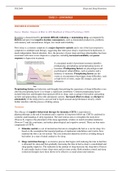
ATP (in water) ⇌ ADP (in water) + Hydrated Pi + Energy
Producing ATP:
• During respiration, glucose is broken down – this process releases energy.
• The energy is used in the phosphorylation of ADP into ATP, catalysed by ATP synthase.
• The energy is stored as chemical energy in the phosphate bond.
• ATP in water is higher in energy than ADP and Pi in water.
Using ATP:
• ATP diffuses to the part of the cell where it is used, where it is broken down via hydrolysis back into
ADP + Pi, catalysed by ATPase.
• Chemical energy is released and used by the cell.
• ADP and Pi are recycled.
Energetics:
• Energy is required to convert ADP + Pi into ATP because Pi is hydrated is solution and energy is
required to separate Pi from water molecules.
• Energy is released when ATP is hydrolysed as Pi becomes hydrated again and bonds form between
water and phosphate.
Aerobic Respiration
• Aerobic Respiration: A metabolic pathway where a large amount of energy is released by splitting
glucose into CO2 and H2, which combines with atmospheric O2 to produce H2O:
• C6H12O6 + 6O2 ! 6CO2 + 6H2O + Energy
• If enough oxygen is supplied to cells, ATP is regenerated by aerobic respiration.
• Metabolic Pathway: A multi-stepped process, with each step controlled and catalysed by a specific
intracellular enzyme.
• The bonds between carbon and hydrogen (in glucose) are weaker than those between hydrogen and
oxygen (in water).
• Therefore, energy input is less than the energy output, so there is an overall release of energy.
• Glucose is a respiratory substrate – a molecule broken down for the release of energy to produce
ATP.
• There are 4 stages in aerobic respiration: glycolysis, the link reaction, the Krebs cycle and oxidative
phosphorylation.
• Glycolysis happens in the cytoplasm and the remaining 3 stages occur in the mitochondria.
8
, Glycolysis
7.4 Understand the roles of glycolysis in aerobic and anaerobic respiration, including the
phosphorylation of hexoses, the production of ATP, reduced coenzyme, pyruvate and lactate (details
of intermediate stages and compounds are not required).
Coenzymes
• Small, organic, non-protein molecules that carry chemical ‘species’ between enzymes.
• In respiration, include NAD, FAD and coenzyme A.
• (Effectively act as carrier molecules in respiration).
Oxidation / Reduction
• Oxidation: the loss of electrons / hydrogen.
• Reduction: the gain of electrons / hydrogen.
• An oxidising agent: reduced in a redox reaction and oxidises another species.
• A reducing agent: oxidised in a redox reaction and reduces another species.
Glycolysis Facts
• Involves splitting 1 molecule of glucose (a hexose – 6C) into two smaller molecules of pyruvate (a
triose – 3C).
• Occurs in the cytoplasm of cells.
• Requires no oxygen, so is itself an anaerobic process and also the first stage of anaerobic respiration.
• Has a net gain of 2 ATP, 2 NADH + H+ and 2 pyruvate molecules.
Glycolysis Process
1. 2 molecules of ATP are dephosphorylated. Products = 2 x Pi and 2 x ADP
2. The hexose (glucose) is phosphorylated by Pi. Products = Phosphorylated Hexose
3. Phosphorylated hexose splits into 2 triose phosphates Products = 2 x Triose Phosphate
4. Triose phosphates are oxidised into pyruvate (loses H) Products = 2 x Pyruvate and 2 x H
5. 2 x NAD+ is reduced by H Products = 2 x NADH + H+
6. 2 x 2 ADP undergo substrate level phosphorylation Products = 4 ATP
• Substrate Level Phosphorylation: Phosphorylation of ADP ! ATP where Pi is derived from the
substrate that is undergoing oxidation
9
7.3 i) Understand the overall reaction of aerobic respiration as splitting of the respiratory substrate,
including glucose, to release carbon dioxide as a waste product and reuniting of hydrogen with
atmospheric oxygen with the release of a large amount of energy.
ii) Understand that respiration is a many-stepped process, with each step controlled and catalysed by
a specific intracellular enzyme.
ATP
ATP (in water) ⇌ ADP (in water) + Hydrated Pi + Energy
Producing ATP:
• During respiration, glucose is broken down – this process releases energy.
• The energy is used in the phosphorylation of ADP into ATP, catalysed by ATP synthase.
• The energy is stored as chemical energy in the phosphate bond.
• ATP in water is higher in energy than ADP and Pi in water.
Using ATP:
• ATP diffuses to the part of the cell where it is used, where it is broken down via hydrolysis back into
ADP + Pi, catalysed by ATPase.
• Chemical energy is released and used by the cell.
• ADP and Pi are recycled.
Energetics:
• Energy is required to convert ADP + Pi into ATP because Pi is hydrated is solution and energy is
required to separate Pi from water molecules.
• Energy is released when ATP is hydrolysed as Pi becomes hydrated again and bonds form between
water and phosphate.
Aerobic Respiration
• Aerobic Respiration: A metabolic pathway where a large amount of energy is released by splitting
glucose into CO2 and H2, which combines with atmospheric O2 to produce H2O:
• C6H12O6 + 6O2 ! 6CO2 + 6H2O + Energy
• If enough oxygen is supplied to cells, ATP is regenerated by aerobic respiration.
• Metabolic Pathway: A multi-stepped process, with each step controlled and catalysed by a specific
intracellular enzyme.
• The bonds between carbon and hydrogen (in glucose) are weaker than those between hydrogen and
oxygen (in water).
• Therefore, energy input is less than the energy output, so there is an overall release of energy.
• Glucose is a respiratory substrate – a molecule broken down for the release of energy to produce
ATP.
• There are 4 stages in aerobic respiration: glycolysis, the link reaction, the Krebs cycle and oxidative
phosphorylation.
• Glycolysis happens in the cytoplasm and the remaining 3 stages occur in the mitochondria.
8
, Glycolysis
7.4 Understand the roles of glycolysis in aerobic and anaerobic respiration, including the
phosphorylation of hexoses, the production of ATP, reduced coenzyme, pyruvate and lactate (details
of intermediate stages and compounds are not required).
Coenzymes
• Small, organic, non-protein molecules that carry chemical ‘species’ between enzymes.
• In respiration, include NAD, FAD and coenzyme A.
• (Effectively act as carrier molecules in respiration).
Oxidation / Reduction
• Oxidation: the loss of electrons / hydrogen.
• Reduction: the gain of electrons / hydrogen.
• An oxidising agent: reduced in a redox reaction and oxidises another species.
• A reducing agent: oxidised in a redox reaction and reduces another species.
Glycolysis Facts
• Involves splitting 1 molecule of glucose (a hexose – 6C) into two smaller molecules of pyruvate (a
triose – 3C).
• Occurs in the cytoplasm of cells.
• Requires no oxygen, so is itself an anaerobic process and also the first stage of anaerobic respiration.
• Has a net gain of 2 ATP, 2 NADH + H+ and 2 pyruvate molecules.
Glycolysis Process
1. 2 molecules of ATP are dephosphorylated. Products = 2 x Pi and 2 x ADP
2. The hexose (glucose) is phosphorylated by Pi. Products = Phosphorylated Hexose
3. Phosphorylated hexose splits into 2 triose phosphates Products = 2 x Triose Phosphate
4. Triose phosphates are oxidised into pyruvate (loses H) Products = 2 x Pyruvate and 2 x H
5. 2 x NAD+ is reduced by H Products = 2 x NADH + H+
6. 2 x 2 ADP undergo substrate level phosphorylation Products = 4 ATP
• Substrate Level Phosphorylation: Phosphorylation of ADP ! ATP where Pi is derived from the
substrate that is undergoing oxidation
9