Final Exam Summary
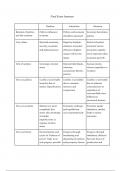
Realism Liberalism Marxism
Relation of politics Politics influences Politics and economy Economy determines
and the economy economy should be separated politics
Core values National autonomy, Negative freedom Positive freedom,
security, economic enhances economic economic justice
and political power efficiency (highest (economic equality
output with lowest more important than
input) economic growth)
Unit of analysis Sovereign, rational Rational individuals, Socioeconomic
states voluntary classes (capitalists vs
associations (NGOs, workers)
parties)
View on politics Conflict is inevitable Conflict is avoidable Conflict is inevitable
(anarchy) due to due to common due to inherent
market imperfections interests and contradictions in
cooperation capitalism of
irreconcilable class
differences
(structural feature)
View on economy Markets are never Economic exchange Economy equals
completely free, and equilibrium imbalance, market
states take advantage occur spontaneously leads to unjust
of market outcomes
imperfections at
expense of other
states
View on history Discontinuities and Progress through Progress through
cycles in “balance of broadening and imbalance, dialectic
power” leads to no deepening of markets between forces of
real progress possible and prosperity (better production and
, (hegemonic cycles) world is possible) relations of
production
International Hindered by striving Occurs naturally and “Dependency”
cooperation for relative gains; spontaneously; cooperation between
cooperation seeking absolute capital owners in
gains core and periphery to
periodically through
remain dominant
alliances
over those without
(power-balancing) capital
Globalization Limited but can only Occurs naturally and “Created” by
exist if it is in spontaneously capitalists to improve
hegemon’s interest because it helps their interests
everyone
Constructivism Poststructuralism
Mostly inspired by key themes Mostly based on advances in humanities and
philosophy
Focus on norms, identities, social interactions Focus on discourse
Emphasis on socialization, diffusion, and Emphasis on power, exclusion,
transformation marginalization, and reproduction
Maintaining some connection to objective Letting go of commitment to objective
science science
Lecture 11: Multi-level Politics of War
Violence classified into three types:
1. State-based: two or three states, at least 25 battle-related deaths per year
2. Non-state: two groups in conflict, 25 battle-related deaths in one year
3. One sided: state or group against civilians
, Internationalized armed conflict: virtually no armed conflict remains confined to the
territory of one state and free from foreign involvement
- All conflicts begin internally but globalization and fragmentation have led to
internationalized armed conflict
Old Wars:
- Actors: regular armed forces
- Goals: geopolitical interests or for ideology (democracy or socialism)
- Methods: capturing territory through military means (trench warfare)
- Forms of finance: largely financed by states and taxes
New Wars:
- Actors: private security, contractors, paramilitaries, organized crime groups
- Gender stereotypes constructed in new wars are different from those of
old wars (gendered recruitment, sexualized violence)
- Goals: identity (national, ethnic, religious, clan)
- Methods: violence towards civilians to control territory, displacing populations
- Forms of finance: “loot and pillage,” diaspora support, smuggling in goods (oil,
gold, diamonds, people, drugs)
- Ending with surrender, not as clear/decisive as in old wars; change of
power through regime change
New and Old Wars, Kaldor (2012)
- Revolution in social relations of warfare through a process of intensifying
interconnectedness involving both integration and fragmentation,
homogenization and diversification, globalization, and localization
- New wars arise in context of the erosion of the autonomy of the state and in some
cases, the disintegration of the state
- Understood as wars between exclusivism and cosmopolitanism
Realism Liberalism Marxism
Relation of politics Politics influences Politics and economy Economy determines
and the economy economy should be separated politics
Core values National autonomy, Negative freedom Positive freedom,
security, economic enhances economic economic justice
and political power efficiency (highest (economic equality
output with lowest more important than
input) economic growth)
Unit of analysis Sovereign, rational Rational individuals, Socioeconomic
states voluntary classes (capitalists vs
associations (NGOs, workers)
parties)
View on politics Conflict is inevitable Conflict is avoidable Conflict is inevitable
(anarchy) due to due to common due to inherent
market imperfections interests and contradictions in
cooperation capitalism of
irreconcilable class
differences
(structural feature)
View on economy Markets are never Economic exchange Economy equals
completely free, and equilibrium imbalance, market
states take advantage occur spontaneously leads to unjust
of market outcomes
imperfections at
expense of other
states
View on history Discontinuities and Progress through Progress through
cycles in “balance of broadening and imbalance, dialectic
power” leads to no deepening of markets between forces of
real progress possible and prosperity (better production and
, (hegemonic cycles) world is possible) relations of
production
International Hindered by striving Occurs naturally and “Dependency”
cooperation for relative gains; spontaneously; cooperation between
cooperation seeking absolute capital owners in
gains core and periphery to
periodically through
remain dominant
alliances
over those without
(power-balancing) capital
Globalization Limited but can only Occurs naturally and “Created” by
exist if it is in spontaneously capitalists to improve
hegemon’s interest because it helps their interests
everyone
Constructivism Poststructuralism
Mostly inspired by key themes Mostly based on advances in humanities and
philosophy
Focus on norms, identities, social interactions Focus on discourse
Emphasis on socialization, diffusion, and Emphasis on power, exclusion,
transformation marginalization, and reproduction
Maintaining some connection to objective Letting go of commitment to objective
science science
Lecture 11: Multi-level Politics of War
Violence classified into three types:
1. State-based: two or three states, at least 25 battle-related deaths per year
2. Non-state: two groups in conflict, 25 battle-related deaths in one year
3. One sided: state or group against civilians
, Internationalized armed conflict: virtually no armed conflict remains confined to the
territory of one state and free from foreign involvement
- All conflicts begin internally but globalization and fragmentation have led to
internationalized armed conflict
Old Wars:
- Actors: regular armed forces
- Goals: geopolitical interests or for ideology (democracy or socialism)
- Methods: capturing territory through military means (trench warfare)
- Forms of finance: largely financed by states and taxes
New Wars:
- Actors: private security, contractors, paramilitaries, organized crime groups
- Gender stereotypes constructed in new wars are different from those of
old wars (gendered recruitment, sexualized violence)
- Goals: identity (national, ethnic, religious, clan)
- Methods: violence towards civilians to control territory, displacing populations
- Forms of finance: “loot and pillage,” diaspora support, smuggling in goods (oil,
gold, diamonds, people, drugs)
- Ending with surrender, not as clear/decisive as in old wars; change of
power through regime change
New and Old Wars, Kaldor (2012)
- Revolution in social relations of warfare through a process of intensifying
interconnectedness involving both integration and fragmentation,
homogenization and diversification, globalization, and localization
- New wars arise in context of the erosion of the autonomy of the state and in some
cases, the disintegration of the state
- Understood as wars between exclusivism and cosmopolitanism