CSET World Languages Subtest I 40 Linguistic Terms 2023
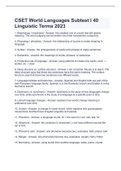
1. Morphology / morpheme - Answer- the smallest unit of a word that still retains meaning. The word outgoing can be broken into three morphemes: out/go/ing. 2. Phonology / phonetics - Answer- the relationship of sounds to make meaning in language. 3. Syntax - Answer- the arrangements of words and phrases to make sentences. 4. Semantics - Answer- the meanings of words, phrases, or sentences 5. Productive rule of language - Answer- using patterns to create new words, work → worker, do → doer 6. Deep structure vs. surface structure - Answer- I am a teacher. My job is to teach. The deep structure says that these two sentences have the same meaning. The surface structure says that these two sentences use different words. 7. Language families and branches - Answer- Spanish and English both are part of the Indo-European language family. Spanish is in the Romantic branch and English is in the Germanic branch. 8. Diachronic vs. synchronic - Answer- diachronic is the study of how languages change over time, while synchronic is the study of a language at a specific point in time. 9. Lexical language changes - Answer- explains how words change meaning or preference over time. 10. Umlaut - Answer- a change in vowel sound, which explains why goose/geese, mouse/mice, foot/feet have irregular singulars and plurals. 11. Phoneme - Answer- a language sound, /k/ = the sound in cart, cart, kite, kit 12. Allophone - Answer- the variations in phonemes, c can have different sounds like cat or fact. 13. Phonemic split - Answer- one phoneme becomes two, examples: bath, planet, bad 14. Merger - Answer- two phonemes become one, examples: caught, Harry Potter 15. Borrowing - Answer- using words from another language, salsa, puma, coyote 16. Euphemism - Answer- using a more polite word in place of an offensive one, died → passed away 17. Folk etymology - Answer- language change due to historical forces or social interaction, female is a combination of the words femina (Latin) and male. 18. Metaphor - Answer- saying one this is something else, She is a night owl, life is a highway 19. Taboo - Answer- saying something offensive, coger means "to catch" in Spain, but is a swear word in Mexico. 20. Pragmatics - Answer- the study of language in contexts such as conversation and writing. 21. Discourse analysis - Answer- a research method for studying pragmatics based on social contexts. 22. Command - Answer- ordering someone to do something 23. Tone - Answer- the speaker or writer's attitude portrayed in the communication 24. FLA vs. SLA - Answer- FLA occurs naturally from exposure to the language and then reading and writing are learned in school. SLA occurs in school and is often taught through direct language instruction. 25. SLA Theories - Answer- Grammar-translation, Direct approach, Audio-lingual, TPR, Natural, Silent way 26. Segmental - Answer- a group of vowels or consonants that make a syllable: morph/ol/ogy 27. Suprasegemental - Answer- a significant feature such as tone or pitch that occurs among consonants and vowels. Some call it the "musicality" of speech: trusty vs. trustee 28. Intonation patterns - Answer- the rising and falling of speech, especially seen in questions: James, is that you? ¿Diego, eres tú? Versus a statement: You are my friend. Tú eres mi amigo. 29. Syllable structure - Answer- CVC = consonant vowel consonant: cat, hat, bat; CV: go, me, toe 30. Orthography - Answer- correctly spelling words, including accent marks in Spanish 31. Inflectional morphology - Answer- Changing words by adding affixes and suffixes (morphemes): work → worker, trabajar →trabajador 32. Derivational morphology - Answer- words that are related, but have different meanings, write → writer, escribir → escritor. Note that these words would have separate entries in the dictionary. 33. Noun declensions - Answer- Changing a noun to add a description: man → men, joven → jóvenes 34. Syllabaries - Answer- Symbols that represent syllables of a language. Japanese characters are an example . 35. Logographic systems - Answer- use symbols to represent words. Chinese characters are an example. 36. Verb conjugations - Answer- Changing the endings of verbs to indicate who is doing the action and the verb tense. 37. Nuance - Answer- a subtle difference: gray vs. light gray 38. Cohesion - Answer- linking a sentence or text together. Talking about Marta, then referring to "her" 39. Idiomatic expression - Answer- Perro que ladra no muerde. = The dog's bark is worse than its bite. Meaning = someone appears tougher than he/she actually is. 40. Honorifics - Answer- a title of resp
Escuela, estudio y materia
- Institución
- CSET
- Grado
- CSET
Información del documento
- Subido en
- 17 de marzo de 2023
- Número de páginas
- 3
- Escrito en
- 2022/2023
- Tipo
- Examen
- Contiene
- Preguntas y respuestas
Temas
-
cset
-
cset world languages subtest i 40 linguistic terms 2023
-
1 morphology morpheme
-
2 phonology phonetics
-
3 syntax
-
4 semantics
-
5 productive rule of language

Documento también disponible en un lote