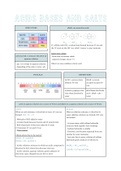
INDICATORS alkalis can neutralize acids
+ -
H (aq) + OH (aq) → H2O(l)
+ - +
H collides with OH , covalent bond formed between H ion and
-
the ‘O’ atom on the OH ion, which ‘creates’ a water molecule
Likely they collide:
universal ind. to measure the pH of an - both want to become stable
aqueous solution - opposite charges attract (+-)
- put 1 or 2 drops in aqueous solution Other two ions combine to form a salt
- depending of the color it turns = ph
PH SCALE DEFINITIONS
ACID= a proton donor BASE= a proton
(donates H+ ion) acceptor (accepts H+
ion)
ALKALI: produces OH- NEUTRALIZATION:
ions when dissolved in acid + alkali = salt +
water water
acids in aqueous solution are a source of H ions and alkalis in a aqueous solution are a source of H ions
ACIDS ALKALI
When an acid substance is dissolved in water, H+ ions are When an alkaline substance is dissolved in
+ - -
formed: HCl = H + Cl water, alkaline solutions are formed, OH ions
are formed
- Molecule of HCl added to water
- Covalent bond between H atom and Cl atom broken
- At room temp, solid sodium hydroxide
- Both shared pair of electrons taken by Cl atom
(structure held together ionic bonding)
+ -
C Formation: H ion and Cl ion
- Sodium hydroxide is soluble
= Dissociation
- Dissolves, ions become separated from one
another by water molecules
Charge always has to be neutral:
- Ions now free to move, solution of sodium
HNO3 = H + and NO3 -
hydroxide good conductor of electricity
H2SO4 = 2H + and SO4 2-
+ -
- Acidic solutions: mixtures in which an acidic compound is NaOH(s) = Na (aq) and OH (aq)
dissolved in H2O, where they dissociate into ions. 2+ -
Ca(OH)2 = Ca (aq) and 2OH (aq)
- Acidic solution, aqueous solution: good conductor of
electricity cause charged ions are free to move
+ -
H (aq) + OH (aq) → H2O(l)
+ - +
H collides with OH , covalent bond formed between H ion and
-
the ‘O’ atom on the OH ion, which ‘creates’ a water molecule
Likely they collide:
universal ind. to measure the pH of an - both want to become stable
aqueous solution - opposite charges attract (+-)
- put 1 or 2 drops in aqueous solution Other two ions combine to form a salt
- depending of the color it turns = ph
PH SCALE DEFINITIONS
ACID= a proton donor BASE= a proton
(donates H+ ion) acceptor (accepts H+
ion)
ALKALI: produces OH- NEUTRALIZATION:
ions when dissolved in acid + alkali = salt +
water water
acids in aqueous solution are a source of H ions and alkalis in a aqueous solution are a source of H ions
ACIDS ALKALI
When an acid substance is dissolved in water, H+ ions are When an alkaline substance is dissolved in
+ - -
formed: HCl = H + Cl water, alkaline solutions are formed, OH ions
are formed
- Molecule of HCl added to water
- Covalent bond between H atom and Cl atom broken
- At room temp, solid sodium hydroxide
- Both shared pair of electrons taken by Cl atom
(structure held together ionic bonding)
+ -
C Formation: H ion and Cl ion
- Sodium hydroxide is soluble
= Dissociation
- Dissolves, ions become separated from one
another by water molecules
Charge always has to be neutral:
- Ions now free to move, solution of sodium
HNO3 = H + and NO3 -
hydroxide good conductor of electricity
H2SO4 = 2H + and SO4 2-
+ -
- Acidic solutions: mixtures in which an acidic compound is NaOH(s) = Na (aq) and OH (aq)
dissolved in H2O, where they dissociate into ions. 2+ -
Ca(OH)2 = Ca (aq) and 2OH (aq)
- Acidic solution, aqueous solution: good conductor of
electricity cause charged ions are free to move