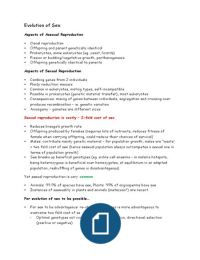
Evolution of Sex
Aspects of Asexual Reproduction
Clonal reproduction
Offspring and parent genetically identical
Prokaryotes, some eukaryotes (eg. yeast, lizards)
Fission or budding/vegetative growth, parthenogenesis
Offspring genetically identical to parents
Aspects of Sexual Reproduction
Combing genes from 2 individuals
Ploidy reduction: meiosis
Common in eukaryotes, mating types, self-incompatible
Possible in prokaryotes (genetic material transfer), most eukaryotes
Consequences: mixing of genes between individuals, segregation and crossing over
produces recombination – ie. genetic variation
Anisogamy – gametes are different sizes
Sexual reproduction is costly – 2-fold cost of sex
Reduces lineage’s growth rate
Offspring produced by females (requires lots of nutrients, reduces fitness of
female when carrying offspring, could reduce their chances of survival)
Males: contribute mainly genetic material – for population growth, males are “waste’
= two fold cost of sex (hence asexual population always outcompetes a sexual one in
terms of population growth)
Sex breaks up benefical genotypes (eg. sickle cell anaemia – in malaria hotspots,
being heterozygous is beneficial over homozygotes, at equilibrium in an adapted
population, reshuffling of genes is disadvantageous)
Yet sexual reproduction is very common
Animals: 99.9% of species have sex, Plants: 99% of angiosperms have sex
Instances of asexuality in plants and animals (metazoan?) are recent
For evolution of sex to be possible…
For sex to be advantageous: re-shuffling of genes is more advantageous to
overcome two fold cost of se
- Optimal genotypes not common : non-eqm. Situation, directional selection
(positive or negative)
, - Components of optimal genotype dispersed: alleles present in different
individuals, negative linkage-disequilibrium (combination of beneficial alleles is
rarer at that expected frequencies)
- Both are likely in populations under directional selection
Positive selection
Recombination can combine beneficial mutations
In asexual populations, for a new genotype to
arise, have to wait for new mutations to arise in
default genetic background
- Mutations rare and in different individuals
Sexual population: beneficial genotypes arise much
faster – adaption much more rapid
- Sex combines beneficial mutations and breaks down linkage disequlibrium
Experimental support (Goddard et al., 2005)
- Budding yeast – Saccharomyces
cerevisiase
- Adaptiation to benign or hot
environment: wildtype strain
(sex), mutant with disrupted
meiosis (no sex)
- Sexual populations adapt much
faster
- In benign environments, not
much difference between the two strains
- In harsh environments, particularly due to the log scale - the effect of sexual
reproduction is much more beneficial
Negative Selection
In asexual populations
- Mutation arises which reduces fitness –
selection could remove it, but drift
could also fixate this deleterious allele
- Once it reaches fixation, it cannot be
removed = Muller’s Ratchet (gradual
build-up of harmful mutations, declining
fitness) – if there is no exchange of
, genetic material you eventually gain so many deleterious mutations which kills
the organism (population goes extinct)
- Genetic drift - mutation-free genotypes are lost and a gradual decline in mean
fitness
Sex on Muller’s Ratchet
- Restores genotypes with fewer deleterious mutations
- Generates very deleterious genotypes for selection (possibility to reduce the
frequency of the deleterious allele?)
Greater genetic variation – flexibility to adapt to changing environments
Sex increases genetic variation
- Population level: generating higher adapted genotypes, countering Muller’s
Ratchet
- Individual level: more diverse offspring
Host-pathogen interactions (Red Queen Hypothesis – Van Halen, Arms Race)
- Host and pathogen become selection pressures for each other, so they are
always co-evolving
- Equilibrium of two mutually incompatible optima – explains why species don’t go
extinct?
Fluctuating Selection – Red Queen Dynamics and sex
Sex increases genetic and phenotypic variance – greater variance among offspring
can be beneficial
Sexual selection: genetically diverse – there is no preferential target for a parasite,
so the population does not suffer a lot, as the parasite cannot adapt to all different
genotypes at once
Red queen dynamics in asexuals
- Cyclical changes in host and parasite frequencies
- Asexual host lineages: competitive when rare, pathogen target when frequent
- Sexual host lineages: genetically diverse, escape parasite specialisation
Coexistence of sexual and asexual lineages – similar ecology (remove confounding
effects of diet etc.)
- The parasite – trematode (microcephalus) a castrating parasite, sterilises the
host (Aquatic snail Ptamopygus antipodarum)
- Prediction: parasitism selects for sexual
reproduction
Data: frequency of sex increases with
parasitism
- Prediction2: parasites target common asexual
clones (when the clone becomes common,
targeted by parasite, causing a reduction in the numbers of that clone)
Aspects of Asexual Reproduction
Clonal reproduction
Offspring and parent genetically identical
Prokaryotes, some eukaryotes (eg. yeast, lizards)
Fission or budding/vegetative growth, parthenogenesis
Offspring genetically identical to parents
Aspects of Sexual Reproduction
Combing genes from 2 individuals
Ploidy reduction: meiosis
Common in eukaryotes, mating types, self-incompatible
Possible in prokaryotes (genetic material transfer), most eukaryotes
Consequences: mixing of genes between individuals, segregation and crossing over
produces recombination – ie. genetic variation
Anisogamy – gametes are different sizes
Sexual reproduction is costly – 2-fold cost of sex
Reduces lineage’s growth rate
Offspring produced by females (requires lots of nutrients, reduces fitness of
female when carrying offspring, could reduce their chances of survival)
Males: contribute mainly genetic material – for population growth, males are “waste’
= two fold cost of sex (hence asexual population always outcompetes a sexual one in
terms of population growth)
Sex breaks up benefical genotypes (eg. sickle cell anaemia – in malaria hotspots,
being heterozygous is beneficial over homozygotes, at equilibrium in an adapted
population, reshuffling of genes is disadvantageous)
Yet sexual reproduction is very common
Animals: 99.9% of species have sex, Plants: 99% of angiosperms have sex
Instances of asexuality in plants and animals (metazoan?) are recent
For evolution of sex to be possible…
For sex to be advantageous: re-shuffling of genes is more advantageous to
overcome two fold cost of se
- Optimal genotypes not common : non-eqm. Situation, directional selection
(positive or negative)
, - Components of optimal genotype dispersed: alleles present in different
individuals, negative linkage-disequilibrium (combination of beneficial alleles is
rarer at that expected frequencies)
- Both are likely in populations under directional selection
Positive selection
Recombination can combine beneficial mutations
In asexual populations, for a new genotype to
arise, have to wait for new mutations to arise in
default genetic background
- Mutations rare and in different individuals
Sexual population: beneficial genotypes arise much
faster – adaption much more rapid
- Sex combines beneficial mutations and breaks down linkage disequlibrium
Experimental support (Goddard et al., 2005)
- Budding yeast – Saccharomyces
cerevisiase
- Adaptiation to benign or hot
environment: wildtype strain
(sex), mutant with disrupted
meiosis (no sex)
- Sexual populations adapt much
faster
- In benign environments, not
much difference between the two strains
- In harsh environments, particularly due to the log scale - the effect of sexual
reproduction is much more beneficial
Negative Selection
In asexual populations
- Mutation arises which reduces fitness –
selection could remove it, but drift
could also fixate this deleterious allele
- Once it reaches fixation, it cannot be
removed = Muller’s Ratchet (gradual
build-up of harmful mutations, declining
fitness) – if there is no exchange of
, genetic material you eventually gain so many deleterious mutations which kills
the organism (population goes extinct)
- Genetic drift - mutation-free genotypes are lost and a gradual decline in mean
fitness
Sex on Muller’s Ratchet
- Restores genotypes with fewer deleterious mutations
- Generates very deleterious genotypes for selection (possibility to reduce the
frequency of the deleterious allele?)
Greater genetic variation – flexibility to adapt to changing environments
Sex increases genetic variation
- Population level: generating higher adapted genotypes, countering Muller’s
Ratchet
- Individual level: more diverse offspring
Host-pathogen interactions (Red Queen Hypothesis – Van Halen, Arms Race)
- Host and pathogen become selection pressures for each other, so they are
always co-evolving
- Equilibrium of two mutually incompatible optima – explains why species don’t go
extinct?
Fluctuating Selection – Red Queen Dynamics and sex
Sex increases genetic and phenotypic variance – greater variance among offspring
can be beneficial
Sexual selection: genetically diverse – there is no preferential target for a parasite,
so the population does not suffer a lot, as the parasite cannot adapt to all different
genotypes at once
Red queen dynamics in asexuals
- Cyclical changes in host and parasite frequencies
- Asexual host lineages: competitive when rare, pathogen target when frequent
- Sexual host lineages: genetically diverse, escape parasite specialisation
Coexistence of sexual and asexual lineages – similar ecology (remove confounding
effects of diet etc.)
- The parasite – trematode (microcephalus) a castrating parasite, sterilises the
host (Aquatic snail Ptamopygus antipodarum)
- Prediction: parasitism selects for sexual
reproduction
Data: frequency of sex increases with
parasitism
- Prediction2: parasites target common asexual
clones (when the clone becomes common,
targeted by parasite, causing a reduction in the numbers of that clone)