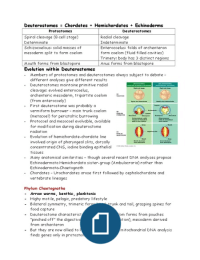
Deuterostomes = Chordates + Hemichordates + Echinoderms
Protostomes Deuterostomes
Spiral cleavage (8 cell stage) Radial cleavage
Determinate Indeterminate
Schizocoelous: solid masses of Enterocoelus: folds of archenteron
mesoderm split to form coelom form coelom (fluid filled cavities)
Trimery: body has 3 distinct regions
Mouth forms from blastopore Anus forms from blastopore
Evolution within Deuterostomes
- Members of protostomes and deuterostomes always subject to debate –
different analyses give different results
- Deuterostomes maintaine primitive radial
cleavage: evolved enterocoelus,
archenteric mesoderm, tripartite coelom
(from enterocoely)
- First deuterostome was probably a
vermiform burrower – main trunk coelom
(metacoel) for peristaltic burrowing
- Protocoel and mesocoel evolvable, available
for modification during deuterostome
radiation
- Evolution of hemichordate-chordate line
involved origin of pharyngeal slits, dorsally
concentrated CNS, iodine binding epithelial
tissues
- Many anatomical similarities – though several recent DNA analyses propose
Echinodermata Hemichordata sister-group (Ambulacraria) rather than
Echinodermata-Chaetognath
- Chordates – Urochordates arose first followed by cephalochordate and
vertebrate lineages
Phylum Chaetognatha
- Arrow worms, benthic, planktonic
- Highy motile, pelagic, predatory lifestyle
- Bilateral symmetry, trimeric form: head, trunk and tail, grasping spines for
food capture
- Deuterostome characteristics: entercoely (coelom forms from pouches
“pinched off” the digestive tract during gastrulation), mesoderm derived
from archenteron
- But they are now allied to Protostomes – MAD5 mitochondrial DNA analysis
finds genes only in protostomes
,Phylum Echinodermata
- Sea cucumbers, sea urchins, sea cucumbers, brittlestars, crinoids
- Embryogeny is deuterostomous – radial cleavage, enterocoely, through gut,
nervous system diffuse, no excretory organs
- Calcareous endoskeleton arising from mesodermal tissue, composed of
separate places or ossicles – each plate originates as a single calcite crystal
develops as an open meshwork structure (steroeom), interstices filled with
living tissue (stroma)
- Adults pentamerally symmetrical, larvae bilaterally symmetrical
- Unique coelomic water vascular system – evident as muscularpodia
- Originated from Pre-Cambrian invasion of epibenthic habitats by ancestral
burrowing deuterostome
- Calcichordates (extinct fossils) related to echninoderms
Phylum Hemichordata
- Enteropnuests (acorn worms), pterobranchs
- ~75 or 85 living species belong to Enteropneusta – all hemichordates are
bethic marine animals (except for Planctosphaera)
- In addition to deuterostome qualities – possess pharyngeal gill slits, most
have dorsal (sometimes hollow) nerve cord similar to those seen in Chordates
- Once thought to possess notochord – but is actually evagination of anterior
gut (buccal diverticum – stomochord), not homologous with notochord
- Unique excretory – glomerulus, open circulatory system, through gut
- Lophophore – convergent evolution
- Pterobranchs are largely colonial – the two classes represent highly
divergent clades within the phylum, each adapted to different ways of living
- Both represent exploitations of basic tripartite detuerostome architecture –
evolutionary plasticity of this fundamental body plan
- Hemichordate larva almost identical to echinoderm larvae
- Stylophora, cothurnocysts possess gill slits
- Bayesian Phylogenetic Analysisof 18S ribosomal DNA – supports monophyly
of Ambulacraria
Phylum Chordata
- Urochordates and vertebrates is a sistergroup to cephalochordates
- Notochord (dorsal stiffening rod - synapomorphy), dorsal hollow nerve cord,
segmented muscular postanal tail, endostyle (ciliated glandular groove on the
floor of the pharynx that secretes mucus for trapping food particles during
filter feeding)
- Vertebrates – skeletal vertebral column housing notochord, others are
, invertebrates
- Notochord = dorsal, elastic rod derived from middorsal strip of embryonic
mesoderm, provides structural and locomotory support in body of
larval/adult urochordates
Phylum Urochordates (Tunicates)
- Present day tunicates – marine animals that filter particles of food from
water with basketlike perforated pharynx (~3000 iving species, 0 or so
sedentary as adults)
- Adult tunicates bear little apparent similarity to cephalochordates and
vertebrates – most tunicate species have brief free-swimming larval period
lasting a few minutes to a few daysm, after which the larvae metamorphose
into sedentary adylts attached to the substrate, although some remain
motile
- Tunicate larvae – notochord, dorsal hollow nerve cord, muscular postanal tail
- At some point, stopped being mobile, sessile lifestyle adopted
- Almost all marine suspension feeders – ascidians, salps
- Adult body from varies, usually lacking obvious trimeric organisation (sea
squirt)
- Body covered by thick/thin cellulose like polysacchacaride (no bony tissue)
- Notochord restricted to tail – usually found only in larval stage, coelom not
developed
- Tadpole larva has chordate characteristics, most lost in adults
- Previously believed that the earliest chordates would have been sessile as
adults, and that cephalochordates and vertebrates evolved from an
ancestor that resembled a tunicate larva – however it seems more likely
that a sessile adult stage was a derived character
- Ancestral chordate was proobaby free swimming wormlike creature using
gill slits for filter feeding
Phylum Cephalochordata
- ~27 species – small, fishlike marine animals usually less than 5 cm long
(lancelet – Branchiostoma lanceolatum/amphioxus)
- Demonstrates many qualities intermediate between invertebrates and
vertebrates
- Lancets/amphioxus – shallow marine environments lie burrowed in clean
sands with only head protruding above sediment
- Notable characteristic is myomeres – blocks of striated muscle fibres
arranged along both sides of the body and seprated by sheets of connective
tissue, biticgird acts ab ab ubcinpressible elastic rod, extending the full
Protostomes Deuterostomes
Spiral cleavage (8 cell stage) Radial cleavage
Determinate Indeterminate
Schizocoelous: solid masses of Enterocoelus: folds of archenteron
mesoderm split to form coelom form coelom (fluid filled cavities)
Trimery: body has 3 distinct regions
Mouth forms from blastopore Anus forms from blastopore
Evolution within Deuterostomes
- Members of protostomes and deuterostomes always subject to debate –
different analyses give different results
- Deuterostomes maintaine primitive radial
cleavage: evolved enterocoelus,
archenteric mesoderm, tripartite coelom
(from enterocoely)
- First deuterostome was probably a
vermiform burrower – main trunk coelom
(metacoel) for peristaltic burrowing
- Protocoel and mesocoel evolvable, available
for modification during deuterostome
radiation
- Evolution of hemichordate-chordate line
involved origin of pharyngeal slits, dorsally
concentrated CNS, iodine binding epithelial
tissues
- Many anatomical similarities – though several recent DNA analyses propose
Echinodermata Hemichordata sister-group (Ambulacraria) rather than
Echinodermata-Chaetognath
- Chordates – Urochordates arose first followed by cephalochordate and
vertebrate lineages
Phylum Chaetognatha
- Arrow worms, benthic, planktonic
- Highy motile, pelagic, predatory lifestyle
- Bilateral symmetry, trimeric form: head, trunk and tail, grasping spines for
food capture
- Deuterostome characteristics: entercoely (coelom forms from pouches
“pinched off” the digestive tract during gastrulation), mesoderm derived
from archenteron
- But they are now allied to Protostomes – MAD5 mitochondrial DNA analysis
finds genes only in protostomes
,Phylum Echinodermata
- Sea cucumbers, sea urchins, sea cucumbers, brittlestars, crinoids
- Embryogeny is deuterostomous – radial cleavage, enterocoely, through gut,
nervous system diffuse, no excretory organs
- Calcareous endoskeleton arising from mesodermal tissue, composed of
separate places or ossicles – each plate originates as a single calcite crystal
develops as an open meshwork structure (steroeom), interstices filled with
living tissue (stroma)
- Adults pentamerally symmetrical, larvae bilaterally symmetrical
- Unique coelomic water vascular system – evident as muscularpodia
- Originated from Pre-Cambrian invasion of epibenthic habitats by ancestral
burrowing deuterostome
- Calcichordates (extinct fossils) related to echninoderms
Phylum Hemichordata
- Enteropnuests (acorn worms), pterobranchs
- ~75 or 85 living species belong to Enteropneusta – all hemichordates are
bethic marine animals (except for Planctosphaera)
- In addition to deuterostome qualities – possess pharyngeal gill slits, most
have dorsal (sometimes hollow) nerve cord similar to those seen in Chordates
- Once thought to possess notochord – but is actually evagination of anterior
gut (buccal diverticum – stomochord), not homologous with notochord
- Unique excretory – glomerulus, open circulatory system, through gut
- Lophophore – convergent evolution
- Pterobranchs are largely colonial – the two classes represent highly
divergent clades within the phylum, each adapted to different ways of living
- Both represent exploitations of basic tripartite detuerostome architecture –
evolutionary plasticity of this fundamental body plan
- Hemichordate larva almost identical to echinoderm larvae
- Stylophora, cothurnocysts possess gill slits
- Bayesian Phylogenetic Analysisof 18S ribosomal DNA – supports monophyly
of Ambulacraria
Phylum Chordata
- Urochordates and vertebrates is a sistergroup to cephalochordates
- Notochord (dorsal stiffening rod - synapomorphy), dorsal hollow nerve cord,
segmented muscular postanal tail, endostyle (ciliated glandular groove on the
floor of the pharynx that secretes mucus for trapping food particles during
filter feeding)
- Vertebrates – skeletal vertebral column housing notochord, others are
, invertebrates
- Notochord = dorsal, elastic rod derived from middorsal strip of embryonic
mesoderm, provides structural and locomotory support in body of
larval/adult urochordates
Phylum Urochordates (Tunicates)
- Present day tunicates – marine animals that filter particles of food from
water with basketlike perforated pharynx (~3000 iving species, 0 or so
sedentary as adults)
- Adult tunicates bear little apparent similarity to cephalochordates and
vertebrates – most tunicate species have brief free-swimming larval period
lasting a few minutes to a few daysm, after which the larvae metamorphose
into sedentary adylts attached to the substrate, although some remain
motile
- Tunicate larvae – notochord, dorsal hollow nerve cord, muscular postanal tail
- At some point, stopped being mobile, sessile lifestyle adopted
- Almost all marine suspension feeders – ascidians, salps
- Adult body from varies, usually lacking obvious trimeric organisation (sea
squirt)
- Body covered by thick/thin cellulose like polysacchacaride (no bony tissue)
- Notochord restricted to tail – usually found only in larval stage, coelom not
developed
- Tadpole larva has chordate characteristics, most lost in adults
- Previously believed that the earliest chordates would have been sessile as
adults, and that cephalochordates and vertebrates evolved from an
ancestor that resembled a tunicate larva – however it seems more likely
that a sessile adult stage was a derived character
- Ancestral chordate was proobaby free swimming wormlike creature using
gill slits for filter feeding
Phylum Cephalochordata
- ~27 species – small, fishlike marine animals usually less than 5 cm long
(lancelet – Branchiostoma lanceolatum/amphioxus)
- Demonstrates many qualities intermediate between invertebrates and
vertebrates
- Lancets/amphioxus – shallow marine environments lie burrowed in clean
sands with only head protruding above sediment
- Notable characteristic is myomeres – blocks of striated muscle fibres
arranged along both sides of the body and seprated by sheets of connective
tissue, biticgird acts ab ab ubcinpressible elastic rod, extending the full