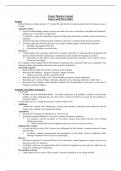
1. 1 INTRODUCTION TO CELL Metabolism
Growth
cell theory Response
.
composed of one or more cells Nutrition
-
Living organisms are
.
-
Cells are the smallest unit of life . Excretion
-
All cells come from pre -
existing cells Homeostasis
↳ by the process of mitosis and cell division .
Reproduction
↳ there's no spontaneous creation of cells .
Exceptions to cell theory History Of Cell Theory
1 . Skeletal muscle 1665 Robert HOOK observed a plant cell and
to refer the smallest unit
" "
↳ made of muscle fibres used the word cell
↳ multinucleated Of life . There was a need to clearly define what
2. Giant Algae cells actually are and their properties .
↳ unicellular 1818 Three scientists developed the cell theory
↳ visible with naked eye which offers a widely explanation of 'The relationship
3. A septate Fungi between cells and living things
↳ with many nuclei Development of cell theory was made possible
↳ no dividing cell wall thanks to advances in microscopy .
↳ posses continuous / Shared cytoplasm .
Electron microscope : more details of cell structure .
Unicellular (1940s )
consist only of 1 cell
↳ has to carry out all the functions of life .
Surface area TO volume ratio
4. Paramecium metabolic rate of the cell is pro potion
↳ heterotrophic to volume of the cell .
> Cilia ( moving all direction ) > substances used in reaction must be
2 .
Euglena absorbed and waste products must be
3. Amoeba removed .
4. Chlamydomonas substances move into and out
y through
> autotrophic ( make food with their large plasma membrane at the surface of cell .
Chloroplasts and photosynthesis ) very important for :
have cell wall > too small ,
substances will not enter
s
> TWO flagella > small cell may overheat bcs metabolism
" "
> eye detects light produces heat faster
Multicellular human 220 All types call develop by differentat ion )
cells in a tissueneed to carry out their role more
single mass of cells fused together ,
,
efficiently than if they had many different roles .
are able to specialize through Tissue : a group of cells specialise in the same
differentat ion
way to perform the same function .
display emergent properties
'
.
Different ation : process un specialised cells
different type of cells have different develop into cells with distinct structure and
_
functions . function
> division of labour ,
in simple terms Emergent properties : the whole organism
function is Can do more
things than individual cells are
a a job or a role .
ex . function of red blood cells > carry oxygen capable of > interaction between
the different parts .
↓
The whole is more than the sum
Of its parts .
, The difference between magnification and resolution
•
Magnification : degree to which the size of an image is larger than the image itself .
•
Resolution : degree to which it's possible to distinguish between two objects that are
very close together .
Eyepiece -
> ✗ 10
Objective magnification → ✗4 > ✗ 40 ( overall magnification )
> ✗ to > ✗ 100 ( overall magnification ) I
> ✗ 40 4 ✗ 400 ( overall magnification )
> ✗ 100 → ✗ 1000 ( overall magnification 1 A M
Magnification = size of image
actual size of Object
stem cells
A stem cell is that can form more cells
an undifferentiated cell of multicellular organism
of the same type indefinitely ,
and from which certain other kinds of cells arise by differentat .
•
Stem cells are ON SPECIALISED cells .
•
stem cells have the capacity to divide indetene-e.ly .
•
stem cells are not fully differentiated .
They can differentiate in different ways to produce
different type of cells .
4 TYPES OF STEM CELLS :
TOEI potent stem cells ( eight cells of the morula )
can differentiate into any type of cell , and can give rise to a complete organism .
Pluripotent stem cells ( embryonic stem cells of the blastocyst )
can differentiate into all body cells , but cannot give rise to a whole organism .
Multipotent stem cells ( umbilical cold stem cells I
differentiate into few related types of body cell
can a
closely .
Uni potent stem cells
can only differentiate into their associated cell type .
USE OF STEM CELLS TO TREAT DISEASE
regenerated tissue
]
-
produce ( skin for people who suffered burn )
Therapeutic
TO grow whole replacement organs ( hearts or kidneys )
TO produce large quantities of striated muscle fibres ,
or meat , for human consumption .
V
non -
therapeutic
small number of stem cells are still present in adult
body .
> give some human tissues considerable powers of regeneration and repair .
Growth
cell theory Response
.
composed of one or more cells Nutrition
-
Living organisms are
.
-
Cells are the smallest unit of life . Excretion
-
All cells come from pre -
existing cells Homeostasis
↳ by the process of mitosis and cell division .
Reproduction
↳ there's no spontaneous creation of cells .
Exceptions to cell theory History Of Cell Theory
1 . Skeletal muscle 1665 Robert HOOK observed a plant cell and
to refer the smallest unit
" "
↳ made of muscle fibres used the word cell
↳ multinucleated Of life . There was a need to clearly define what
2. Giant Algae cells actually are and their properties .
↳ unicellular 1818 Three scientists developed the cell theory
↳ visible with naked eye which offers a widely explanation of 'The relationship
3. A septate Fungi between cells and living things
↳ with many nuclei Development of cell theory was made possible
↳ no dividing cell wall thanks to advances in microscopy .
↳ posses continuous / Shared cytoplasm .
Electron microscope : more details of cell structure .
Unicellular (1940s )
consist only of 1 cell
↳ has to carry out all the functions of life .
Surface area TO volume ratio
4. Paramecium metabolic rate of the cell is pro potion
↳ heterotrophic to volume of the cell .
> Cilia ( moving all direction ) > substances used in reaction must be
2 .
Euglena absorbed and waste products must be
3. Amoeba removed .
4. Chlamydomonas substances move into and out
y through
> autotrophic ( make food with their large plasma membrane at the surface of cell .
Chloroplasts and photosynthesis ) very important for :
have cell wall > too small ,
substances will not enter
s
> TWO flagella > small cell may overheat bcs metabolism
" "
> eye detects light produces heat faster
Multicellular human 220 All types call develop by differentat ion )
cells in a tissueneed to carry out their role more
single mass of cells fused together ,
,
efficiently than if they had many different roles .
are able to specialize through Tissue : a group of cells specialise in the same
differentat ion
way to perform the same function .
display emergent properties
'
.
Different ation : process un specialised cells
different type of cells have different develop into cells with distinct structure and
_
functions . function
> division of labour ,
in simple terms Emergent properties : the whole organism
function is Can do more
things than individual cells are
a a job or a role .
ex . function of red blood cells > carry oxygen capable of > interaction between
the different parts .
↓
The whole is more than the sum
Of its parts .
, The difference between magnification and resolution
•
Magnification : degree to which the size of an image is larger than the image itself .
•
Resolution : degree to which it's possible to distinguish between two objects that are
very close together .
Eyepiece -
> ✗ 10
Objective magnification → ✗4 > ✗ 40 ( overall magnification )
> ✗ to > ✗ 100 ( overall magnification ) I
> ✗ 40 4 ✗ 400 ( overall magnification )
> ✗ 100 → ✗ 1000 ( overall magnification 1 A M
Magnification = size of image
actual size of Object
stem cells
A stem cell is that can form more cells
an undifferentiated cell of multicellular organism
of the same type indefinitely ,
and from which certain other kinds of cells arise by differentat .
•
Stem cells are ON SPECIALISED cells .
•
stem cells have the capacity to divide indetene-e.ly .
•
stem cells are not fully differentiated .
They can differentiate in different ways to produce
different type of cells .
4 TYPES OF STEM CELLS :
TOEI potent stem cells ( eight cells of the morula )
can differentiate into any type of cell , and can give rise to a complete organism .
Pluripotent stem cells ( embryonic stem cells of the blastocyst )
can differentiate into all body cells , but cannot give rise to a whole organism .
Multipotent stem cells ( umbilical cold stem cells I
differentiate into few related types of body cell
can a
closely .
Uni potent stem cells
can only differentiate into their associated cell type .
USE OF STEM CELLS TO TREAT DISEASE
regenerated tissue
]
-
produce ( skin for people who suffered burn )
Therapeutic
TO grow whole replacement organs ( hearts or kidneys )
TO produce large quantities of striated muscle fibres ,
or meat , for human consumption .
V
non -
therapeutic
small number of stem cells are still present in adult
body .
> give some human tissues considerable powers of regeneration and repair .