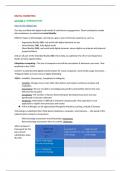
CIVIL LITIGATION
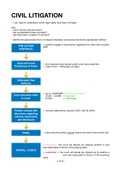
-> you need to understand which legal rights have been infringed
Ask:
- which are the relevant terms?
- has consideration been provided?
- has there been a breach of contract?
* identify the appropriate forum of dispute resolution and advise clients the appropriate method
-> parties engage in discussions regarding the claim and consider
PRE-ACTION ADR
PROTOCOL
Issue and serve -> the Claimant must decide which court has jurisdiction
Particulars of Claim -> Claim Form + Particulars of Claim
Defendant les
Defence
-> up to 10,000GBP -> small claims track
Court allocates claim 10,001 - 24,999 -> fast track
to track 25,000. -> multi-track
Parties comply with -> witness statements, experts, CMC, Part 36 o ers
directions regarding
witness statements
and disclosure
TRIAL -> assuming the parties cannot resolve the claim there will be trial
-> standard - the court will decide any dispute whether a cost
was reasonable in favour of the paying party
APPEAL / COSTS
-> indemnity -> the court will decide any dispute as to whether a
cost was reasonable in favour of the receiving
party.
1 of 41
fi ff
, 1. METHODS OF DISPUTE RESOLUTION
LITIGATION ALTERNATIVE DISPUTE RESOLUTION
Negotiation - clients must understand ADR
- can happen at any time - Parties must consent
- If not possible to avoid - ADR is considered throughout proceedings
litigation can take place after - Unreasonable refusal to engage in ADR can penalise party in
proceedings begun respect of legal costs
- Any conversations will be - Arbitration
“without prejudice”
Round table discussions Arbitration Mediation
- negotiations taking place under - formal procedure /contractual - con dential and WP
a more formal setting process - Parties are in control
- Usually held post-proceedings - Final and binding decision - No stricts rules of evidence
capable of enforcement - Mediator is neutral
- Non binding until a nal written
agreement has been signed
- CPR encourages parties to settle disputes
- it is unacceptable and unreasonable for a party to fail to respond to a request for ADR. Reasons:
nature of dispute // merits of the case // extent to attempting other settlement methods
2 of 41
fi fi
,2. PRE-ACTION CONSIDERATIONS : LIMITATION
‣ The law provides limitation periods in which a claim must be brought, and the periods vary
among the di erent types of claim
‣ The principle behind limitation is to ensure as a matter of public policy that a defendant is
not prejudiced by having to defend a claim when important evidence may no longer be
available
‣ A solicitor who does not do so and incurs costs advancing a claim that is statute barred will
be deemed negligent and not acting in the client’s best interests.
‣ Limitation Act 1980
LIMITATION IN TORT
- time can be measures from the accrual of the action i.e. when the relevant tortious act occurs
- in some situations the limitation begins to run when the claimant rst gains knowledge that
they have a claim.
Date of knowledge
‣ the point at which the claimant had knowledge of all the facts establishing all of the
essential elements of the claim
‣ not necessary to know the precise details of the alleged negligence or to be able to
conclusively identify causation
‣ claim
If the claimant had su cient information to commence investigations into a potential
against the defendant, time should begin to run.
‣ personal
accrual.
injury claims -> the date of knowledge is very often the same as the date of
‣ clinical negligence claims -> the date of knowledge is the date on which the claimant
has knowledge of the following facts:
- That the injury was signi cant;
- That it was attributable in whole or in part to the act or omission alleged to
constitute negligence, nuisance, or breach of duty;
- The identity of the defendant; and
- If it is alleged that the act or omission was that of a per- son other than the
defendant, the identity of that person and the additional facts supporting the
bringing of an action against the defendant.
‣ claims involving death -> If an injured party dies within three years of the accrual date,
the limitation period will be:
- Three years from the date of death; or
- Three years from the date of knowledge of the deceased’s personal
representative.
3 of 41
ff ffifi fi
, It is important, however, to note that a claim is statute-barred if the injured party died after
the three-year limitation period had already expired.
LIMITATION IN CONTRACT
‣ 6time
years to commence a claim for breach of contract
‣ time beings to run on the date on which the breach occurred
‣ o ceends when the claimant delivers the properly completed clam form to the court
with a request to issue together with the correct fee
‣ itexpired
may be possible to alter the name of a defendant after the limitation period has
if the defendant has been correctly identi ed but mistakenly named.
‣ Ifclaimant’s
the claimant is a minor, the clock for the limitation period will not start to run until the
18th birthday.
‣ if claimant lacks mental capacity -> clock never stops running
Contract for construction and defective construction
- 6 year limitation period
- parties may agree shorter limits (make good clause), but they don't apply
Latent Defects
The Latent Damage Act 1986 introduced an additional limitation period for claims for
which the limitation period may expire before a party is aware that a claim exists.
‣ available for negligence claims for latent defects—a defect in a property caused by a
fault in design, materials, or workmanship that existed at the time construction was
completed but that was not apparent at the time of completion.
‣ In such a case, the time limit is the later of the following:
- Six years from the date of accrual of the cause of action; or
- Three years from the earliest date on which the potential claimant knew, or
reasonably ought to have known, material facts necessary to bring an action
alleging negligence (the ‘starting date’).
‣ There is a longstop limitation period of 15 years from the act or omission alleged to
have caused the loss and damage, that is, if the latent damage becomes apparent on a
date later than 15 years after the alleged negligent act (normally when the building is
constructed), the claimant will be out of time.
‣ This ensures that contractors are not facing the prospect of legal action in perpetuity.
Limitations on contractual liability
Any agreed shorter limitation periods would be subject to a reasonableness test under the
legal provisions preventing unfair contract terms (Unfair Contract Terms Act 1977).
Fraud -> limitation period runs from the date when the claimant discovers the fraud or
could have done so with reasonable diligence.
mistake -> If the claim is for relief from the consequences of a mistake, time does not
start to run until the mistake has been discovered or could have been discovered with
reasonable diligence.
4 of 41
ffi
fi
-> you need to understand which legal rights have been infringed
Ask:
- which are the relevant terms?
- has consideration been provided?
- has there been a breach of contract?
* identify the appropriate forum of dispute resolution and advise clients the appropriate method
-> parties engage in discussions regarding the claim and consider
PRE-ACTION ADR
PROTOCOL
Issue and serve -> the Claimant must decide which court has jurisdiction
Particulars of Claim -> Claim Form + Particulars of Claim
Defendant les
Defence
-> up to 10,000GBP -> small claims track
Court allocates claim 10,001 - 24,999 -> fast track
to track 25,000. -> multi-track
Parties comply with -> witness statements, experts, CMC, Part 36 o ers
directions regarding
witness statements
and disclosure
TRIAL -> assuming the parties cannot resolve the claim there will be trial
-> standard - the court will decide any dispute whether a cost
was reasonable in favour of the paying party
APPEAL / COSTS
-> indemnity -> the court will decide any dispute as to whether a
cost was reasonable in favour of the receiving
party.
1 of 41
fi ff
, 1. METHODS OF DISPUTE RESOLUTION
LITIGATION ALTERNATIVE DISPUTE RESOLUTION
Negotiation - clients must understand ADR
- can happen at any time - Parties must consent
- If not possible to avoid - ADR is considered throughout proceedings
litigation can take place after - Unreasonable refusal to engage in ADR can penalise party in
proceedings begun respect of legal costs
- Any conversations will be - Arbitration
“without prejudice”
Round table discussions Arbitration Mediation
- negotiations taking place under - formal procedure /contractual - con dential and WP
a more formal setting process - Parties are in control
- Usually held post-proceedings - Final and binding decision - No stricts rules of evidence
capable of enforcement - Mediator is neutral
- Non binding until a nal written
agreement has been signed
- CPR encourages parties to settle disputes
- it is unacceptable and unreasonable for a party to fail to respond to a request for ADR. Reasons:
nature of dispute // merits of the case // extent to attempting other settlement methods
2 of 41
fi fi
,2. PRE-ACTION CONSIDERATIONS : LIMITATION
‣ The law provides limitation periods in which a claim must be brought, and the periods vary
among the di erent types of claim
‣ The principle behind limitation is to ensure as a matter of public policy that a defendant is
not prejudiced by having to defend a claim when important evidence may no longer be
available
‣ A solicitor who does not do so and incurs costs advancing a claim that is statute barred will
be deemed negligent and not acting in the client’s best interests.
‣ Limitation Act 1980
LIMITATION IN TORT
- time can be measures from the accrual of the action i.e. when the relevant tortious act occurs
- in some situations the limitation begins to run when the claimant rst gains knowledge that
they have a claim.
Date of knowledge
‣ the point at which the claimant had knowledge of all the facts establishing all of the
essential elements of the claim
‣ not necessary to know the precise details of the alleged negligence or to be able to
conclusively identify causation
‣ claim
If the claimant had su cient information to commence investigations into a potential
against the defendant, time should begin to run.
‣ personal
accrual.
injury claims -> the date of knowledge is very often the same as the date of
‣ clinical negligence claims -> the date of knowledge is the date on which the claimant
has knowledge of the following facts:
- That the injury was signi cant;
- That it was attributable in whole or in part to the act or omission alleged to
constitute negligence, nuisance, or breach of duty;
- The identity of the defendant; and
- If it is alleged that the act or omission was that of a per- son other than the
defendant, the identity of that person and the additional facts supporting the
bringing of an action against the defendant.
‣ claims involving death -> If an injured party dies within three years of the accrual date,
the limitation period will be:
- Three years from the date of death; or
- Three years from the date of knowledge of the deceased’s personal
representative.
3 of 41
ff ffifi fi
, It is important, however, to note that a claim is statute-barred if the injured party died after
the three-year limitation period had already expired.
LIMITATION IN CONTRACT
‣ 6time
years to commence a claim for breach of contract
‣ time beings to run on the date on which the breach occurred
‣ o ceends when the claimant delivers the properly completed clam form to the court
with a request to issue together with the correct fee
‣ itexpired
may be possible to alter the name of a defendant after the limitation period has
if the defendant has been correctly identi ed but mistakenly named.
‣ Ifclaimant’s
the claimant is a minor, the clock for the limitation period will not start to run until the
18th birthday.
‣ if claimant lacks mental capacity -> clock never stops running
Contract for construction and defective construction
- 6 year limitation period
- parties may agree shorter limits (make good clause), but they don't apply
Latent Defects
The Latent Damage Act 1986 introduced an additional limitation period for claims for
which the limitation period may expire before a party is aware that a claim exists.
‣ available for negligence claims for latent defects—a defect in a property caused by a
fault in design, materials, or workmanship that existed at the time construction was
completed but that was not apparent at the time of completion.
‣ In such a case, the time limit is the later of the following:
- Six years from the date of accrual of the cause of action; or
- Three years from the earliest date on which the potential claimant knew, or
reasonably ought to have known, material facts necessary to bring an action
alleging negligence (the ‘starting date’).
‣ There is a longstop limitation period of 15 years from the act or omission alleged to
have caused the loss and damage, that is, if the latent damage becomes apparent on a
date later than 15 years after the alleged negligent act (normally when the building is
constructed), the claimant will be out of time.
‣ This ensures that contractors are not facing the prospect of legal action in perpetuity.
Limitations on contractual liability
Any agreed shorter limitation periods would be subject to a reasonableness test under the
legal provisions preventing unfair contract terms (Unfair Contract Terms Act 1977).
Fraud -> limitation period runs from the date when the claimant discovers the fraud or
could have done so with reasonable diligence.
mistake -> If the claim is for relief from the consequences of a mistake, time does not
start to run until the mistake has been discovered or could have been discovered with
reasonable diligence.
4 of 41
ffi
fi