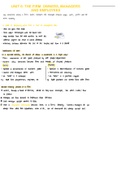
UNIT 6: THE FIRM: OWNERS, MANAGERS
AND EMPLOYEES
firm 's managers and and the
How interactions among a owners
, employees influence wages ,
work
, profits
entire
economy .
A model of bargaining within firms is built on assumptions that :
there are gains from trade
•
•
firms adopt technologies with the lowest costs
◦
wage increases have led most workers to work less
•
collective projects can result in social dilemmas
•
voluntary contracts determine the size of the surplus and how it is shared
coordination of work
In a capitalist economy the division of labour is coordinated in 2 major ways :
,
firms diff
of diff
goods produced by people / departments
•
:
components . .
•
markets : allow interaction between firms and transfer of finished products
Firms⑥ Mar@
represent concentration of economic represent decentralization of
a
power a economic
power
◦
owners and managers direct work ◦ transactions are voluntary
"
"
order is is purchase
"
command order
"
◦
◦
a an a
an -
request
e.
g. Apple hires programmers , engineers ,
etc .
e.g .
Apple purchases LCD screens from other firms
firm
Decision making process in a
-
① owners
, through a board of directors decide on long -
term strategies ,
like where / what / how
,
to produce .
② Managers are then directed to implement these decisions
③ Each workers to tasks
manager assigns
④ There is assy metric information between levels in a firm 's hierarchy .
( owners /
managers do not
always know what their subordinates know or do ;
not all commands are always carried out)
, A capitalist firm is a miniature
,
privately-owned ,
centrally planned economy .
* In markets :
people respond to prices
people follow orders
* In firms :
contracts and relationships
legal documents that of actions certain undertake
•
contracts are
specify sets parties must .
• contracts form the basis of exchange within firms
contracts for products
•
pennant transfer of the good from the seller to the buyer
•
short lived -
social interactions
contracts for labour
•
temporary transfer of authority over a worker 's activities to the manager / Owner .
•
long -
term social interactions
•
managers and employees require and develop firm -
specific assets : skills
,
networks and friendships
valuable white remains in the particular firm)
(
only remain
employee
firm closes you lose :
interests :
If a
, conflicting,
Owners , Managers and ×
your job / income .
distribution of profits
employees are United in
×
network
•
work conditions
their common interest in your
a firm 's success , as they × firm specific
-
assets
,
social -
◦
managerial perks
would all suffer if it
and technical skills • maker of key decisions
were to fail .
✗ cost of search / Unemployment
AND EMPLOYEES
firm 's managers and and the
How interactions among a owners
, employees influence wages ,
work
, profits
entire
economy .
A model of bargaining within firms is built on assumptions that :
there are gains from trade
•
•
firms adopt technologies with the lowest costs
◦
wage increases have led most workers to work less
•
collective projects can result in social dilemmas
•
voluntary contracts determine the size of the surplus and how it is shared
coordination of work
In a capitalist economy the division of labour is coordinated in 2 major ways :
,
firms diff
of diff
goods produced by people / departments
•
:
components . .
•
markets : allow interaction between firms and transfer of finished products
Firms⑥ Mar@
represent concentration of economic represent decentralization of
a
power a economic
power
◦
owners and managers direct work ◦ transactions are voluntary
"
"
order is is purchase
"
command order
"
◦
◦
a an a
an -
request
e.
g. Apple hires programmers , engineers ,
etc .
e.g .
Apple purchases LCD screens from other firms
firm
Decision making process in a
-
① owners
, through a board of directors decide on long -
term strategies ,
like where / what / how
,
to produce .
② Managers are then directed to implement these decisions
③ Each workers to tasks
manager assigns
④ There is assy metric information between levels in a firm 's hierarchy .
( owners /
managers do not
always know what their subordinates know or do ;
not all commands are always carried out)
, A capitalist firm is a miniature
,
privately-owned ,
centrally planned economy .
* In markets :
people respond to prices
people follow orders
* In firms :
contracts and relationships
legal documents that of actions certain undertake
•
contracts are
specify sets parties must .
• contracts form the basis of exchange within firms
contracts for products
•
pennant transfer of the good from the seller to the buyer
•
short lived -
social interactions
contracts for labour
•
temporary transfer of authority over a worker 's activities to the manager / Owner .
•
long -
term social interactions
•
managers and employees require and develop firm -
specific assets : skills
,
networks and friendships
valuable white remains in the particular firm)
(
only remain
employee
firm closes you lose :
interests :
If a
, conflicting,
Owners , Managers and ×
your job / income .
distribution of profits
employees are United in
×
network
•
work conditions
their common interest in your
a firm 's success , as they × firm specific
-
assets
,
social -
◦
managerial perks
would all suffer if it
and technical skills • maker of key decisions
were to fail .
✗ cost of search / Unemployment