Adversarial & Inquisitorial Systems
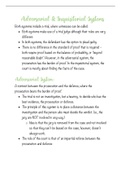
Both systems include a trial, where witnesses can be called.
• Both systems make use of a trial judge although their roles are very
different.
• In both systems, the defendant has the option to plead guilty.
• There is no difference in the standard of proof that is required –
both require proof based on the balance of probability, or ‘beyond
reasonable doubt’. However, in the adversarial system, the
prosecution has the burden of proof. In the inquisitorial system, the
court is mostly about finding the facts of the case.
Adversarial System:
A contest between the prosecution and the defence, where the
prosecution bears the burden of proof.
• The trial is not an investigation, but a hearing, to decide who has the
best evidence, the prosecution or defence.
• The principle of this system is to place a distance between the
investigation and the person who must decide the verdict. (i.e., the
jury are NOT involved in any way.)
o Idea is that the jury is removed from the case and not involved
so that they can’t be biased on the case, however, doesn’t
always work.
• The role of the court is that of an impartial referee between the
prosecution and defence
, • The judge focuses on the issues of law, fairness, equality, and
procedure, and allow the prosecution and defence to make their own
arguments to the jury.
• Neither the judge or jury can initiate an inquiry, and judges rarely
ask witnesses questions directly during trial. Discussions among
jurors and the reasoning behind their verdicts cannot be made public.
• Any decisions which are made by the higher courts from a
precedent, and the lower courts are bound to uphold these decisions.
Inquisitorial system:
The court is actively involved in investigating the facts of the case.
• The role of the court is that of an investigator.
• Sometimes there will be multiple judges, sometimes there is a judge
and a jury. (Such as a misdemeanour trials in America, and other
European courts)
• The judge/jury acts as an ‘inquisitor’ who participate in fact finding
about the case. They can request certain evidence to be examined,
question witnesses etc.
• The inquisitorial system is not bound by higher court decisions and
are free to make decisions on a case-by-case basis.
• This can be biased as the judge/jury can decide certain things about
the case and what gets examined etc
Both systems include a trial, where witnesses can be called.
• Both systems make use of a trial judge although their roles are very
different.
• In both systems, the defendant has the option to plead guilty.
• There is no difference in the standard of proof that is required –
both require proof based on the balance of probability, or ‘beyond
reasonable doubt’. However, in the adversarial system, the
prosecution has the burden of proof. In the inquisitorial system, the
court is mostly about finding the facts of the case.
Adversarial System:
A contest between the prosecution and the defence, where the
prosecution bears the burden of proof.
• The trial is not an investigation, but a hearing, to decide who has the
best evidence, the prosecution or defence.
• The principle of this system is to place a distance between the
investigation and the person who must decide the verdict. (i.e., the
jury are NOT involved in any way.)
o Idea is that the jury is removed from the case and not involved
so that they can’t be biased on the case, however, doesn’t
always work.
• The role of the court is that of an impartial referee between the
prosecution and defence
, • The judge focuses on the issues of law, fairness, equality, and
procedure, and allow the prosecution and defence to make their own
arguments to the jury.
• Neither the judge or jury can initiate an inquiry, and judges rarely
ask witnesses questions directly during trial. Discussions among
jurors and the reasoning behind their verdicts cannot be made public.
• Any decisions which are made by the higher courts from a
precedent, and the lower courts are bound to uphold these decisions.
Inquisitorial system:
The court is actively involved in investigating the facts of the case.
• The role of the court is that of an investigator.
• Sometimes there will be multiple judges, sometimes there is a judge
and a jury. (Such as a misdemeanour trials in America, and other
European courts)
• The judge/jury acts as an ‘inquisitor’ who participate in fact finding
about the case. They can request certain evidence to be examined,
question witnesses etc.
• The inquisitorial system is not bound by higher court decisions and
are free to make decisions on a case-by-case basis.
• This can be biased as the judge/jury can decide certain things about
the case and what gets examined etc