Overview of financial markets and institutions
Direct finance → Lenders bring money to the market, borrowers bring securities
Indirect finance → Take you money to a bank or asset manager/pension fund, those intermediaries
then take your money and bring it in the form of different securities to the financial market.
Equity Capital market (ECM) → IPO
Debt Capital market (DCM) → new issuance of debt instruments
Financial advisory = M&A
Equity underwriting = ECM
Debt underwriting = DCM
This is an overview of income for Goldman Sachs. We see a almost three times higher revenue for
secondary market.
Secondary market activities generate more revenue than primary market activities.
Debt secondary market gains more revenue than equity secondary market.
Much more debt than equity is this world
Loans to bond ratio for non-financial companies (liability side of the balance sheet).
Nominal value of all the loans/nominal value of bonds = loan to bond ratio
Public markets are much more developed in America, that’s why we see much more debt and equity
in this regon compared to Europe.
On exchanges, equity is the primarily instrument that is traded. On the OTC market, fixed income and
FX (forex) are the main instruments traded.
Notional values of traded instruments higher in OTC-markets than in equity markets.
Transaction costs are lower at exchanges. Information assymetry is quite high at exchanges.
At otc markets, besides trading costs, search costs will be quite high since you have to find a
buyer/seller.
Asset managers hold the majority of securities.
Share in AUM of alternatives is just 16% but their share in revenue is almost 50%! (Revenue = fees)
, Overview of Fixed Income markets
Three times more bonds issued by European companies than equity.
Interest rate contracts/derivatives → Most important category in the world!
Interest rate swaps are almost the biggest traded instrument within interest rate
contracts/derivatives.
Turnover ratio for bonds is typically around 1 while for equity this is around 2.5.
Most of interest rate derivatives is traded in the two financial capitals of the orld, New York and
London. Also Euro bonds.
The yield curve and fixed income instruments
Discount factors come from fixed income markets.
Z(0,1) means → discount factor (t,T) from period t to T.
In the fixed income world, basis points are used. NO percents!
Always be aware of the compounding period! Same discount rates can be shown differently by
having different compounding periods (annual, semi-annual, quarterly etc.)
The process of recovering the discount curve from the prices of different fixed income instruments is
typically called ‘bootstrapping the curve’.
Rates are always in percentages per annum! Even though they have more compounding periods,
they are always showed in percentage per year!
SOFR is secured
ESTER is not secured
The Economics of Money, Banking, and Financial Markets
Financial markets (bond and stock markets) and financial intermediaries (such as banks, insurance
companies, and pension funds) have the basic function of getting people who need money and
people who have a surplus of money together so that funds can move from those who have a surplus
of funds to those who have a shortage of funds.
Financial markets perform the essential economic function of channeling funds from households,
firms, and governments that have saved surplus funds by spending less than their income to those
that have a shortage of funds because they wish to spend more than their income.
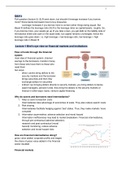
In direct finance (the route at the bottom of Figure 1), borrowers borrow funds directly from lenders
in financial markets by selling them securities (also called financial instruments), which are claims on
Direct finance → Lenders bring money to the market, borrowers bring securities
Indirect finance → Take you money to a bank or asset manager/pension fund, those intermediaries
then take your money and bring it in the form of different securities to the financial market.
Equity Capital market (ECM) → IPO
Debt Capital market (DCM) → new issuance of debt instruments
Financial advisory = M&A
Equity underwriting = ECM
Debt underwriting = DCM
This is an overview of income for Goldman Sachs. We see a almost three times higher revenue for
secondary market.
Secondary market activities generate more revenue than primary market activities.
Debt secondary market gains more revenue than equity secondary market.
Much more debt than equity is this world
Loans to bond ratio for non-financial companies (liability side of the balance sheet).
Nominal value of all the loans/nominal value of bonds = loan to bond ratio
Public markets are much more developed in America, that’s why we see much more debt and equity
in this regon compared to Europe.
On exchanges, equity is the primarily instrument that is traded. On the OTC market, fixed income and
FX (forex) are the main instruments traded.
Notional values of traded instruments higher in OTC-markets than in equity markets.
Transaction costs are lower at exchanges. Information assymetry is quite high at exchanges.
At otc markets, besides trading costs, search costs will be quite high since you have to find a
buyer/seller.
Asset managers hold the majority of securities.
Share in AUM of alternatives is just 16% but their share in revenue is almost 50%! (Revenue = fees)
, Overview of Fixed Income markets
Three times more bonds issued by European companies than equity.
Interest rate contracts/derivatives → Most important category in the world!
Interest rate swaps are almost the biggest traded instrument within interest rate
contracts/derivatives.
Turnover ratio for bonds is typically around 1 while for equity this is around 2.5.
Most of interest rate derivatives is traded in the two financial capitals of the orld, New York and
London. Also Euro bonds.
The yield curve and fixed income instruments
Discount factors come from fixed income markets.
Z(0,1) means → discount factor (t,T) from period t to T.
In the fixed income world, basis points are used. NO percents!
Always be aware of the compounding period! Same discount rates can be shown differently by
having different compounding periods (annual, semi-annual, quarterly etc.)
The process of recovering the discount curve from the prices of different fixed income instruments is
typically called ‘bootstrapping the curve’.
Rates are always in percentages per annum! Even though they have more compounding periods,
they are always showed in percentage per year!
SOFR is secured
ESTER is not secured
The Economics of Money, Banking, and Financial Markets
Financial markets (bond and stock markets) and financial intermediaries (such as banks, insurance
companies, and pension funds) have the basic function of getting people who need money and
people who have a surplus of money together so that funds can move from those who have a surplus
of funds to those who have a shortage of funds.
Financial markets perform the essential economic function of channeling funds from households,
firms, and governments that have saved surplus funds by spending less than their income to those
that have a shortage of funds because they wish to spend more than their income.
In direct finance (the route at the bottom of Figure 1), borrowers borrow funds directly from lenders
in financial markets by selling them securities (also called financial instruments), which are claims on