Commonly asked Life Science definitions
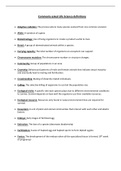
• Adaptive radiation: The process where many species evolved from one common ancestor.
• Allele: A variation of a gene.
• Biotechnology: Use of living organisms to create a product useful to man.
• Breed: A group of domesticated animals within a species.
• Carrying capacity: The total number of organisms an ecosystem can support.
• Chromosome mutation: The chromosome number or structure changes.
• Community: Group of populations in an area.
• Courtship: Behavioural patterns of male and female animals that indicate sexual maturity
and eventually lead to mating and fertilization.
• Crossbreeding: Mating of distantly related individuals.
• Culling: The selective killing of organisms to control the population size.
• Ecological niche: A specific role each species plays due to different environmental conditions
to survive. Survival depends on how well the organisms use their available resources.
• Ecological resource: Resources only found in natural environment that are required for
survival.
• Ecosystem: A unit of plant and animal communities that interact with each other and abiotic
factors.
• Embryo: Early stages of fertilized egg.
• Extinction: The lose of a species (decreases biodiversity)
• Fertilization: Fusion of haploid egg and haploid sperm to form diploid zygote.
• Foetus: The development of the embryo when all the specialized tissue is formed. (9th week
of pregnancy)
• Adaptive radiation: The process where many species evolved from one common ancestor.
• Allele: A variation of a gene.
• Biotechnology: Use of living organisms to create a product useful to man.
• Breed: A group of domesticated animals within a species.
• Carrying capacity: The total number of organisms an ecosystem can support.
• Chromosome mutation: The chromosome number or structure changes.
• Community: Group of populations in an area.
• Courtship: Behavioural patterns of male and female animals that indicate sexual maturity
and eventually lead to mating and fertilization.
• Crossbreeding: Mating of distantly related individuals.
• Culling: The selective killing of organisms to control the population size.
• Ecological niche: A specific role each species plays due to different environmental conditions
to survive. Survival depends on how well the organisms use their available resources.
• Ecological resource: Resources only found in natural environment that are required for
survival.
• Ecosystem: A unit of plant and animal communities that interact with each other and abiotic
factors.
• Embryo: Early stages of fertilized egg.
• Extinction: The lose of a species (decreases biodiversity)
• Fertilization: Fusion of haploid egg and haploid sperm to form diploid zygote.
• Foetus: The development of the embryo when all the specialized tissue is formed. (9th week
of pregnancy)