GIZMOS Student Exploration Ray
Tracing (Lenses)
Name: Ohm and Rohan
Student Exploration: Ray Tracing (Lenses)
Vocabulary: concave lens, convex lens, focal point, image, magnification,
real image, refraction, virtual image
Prior Knowledge Questions (Do these BEFORE using the Gizmo.)
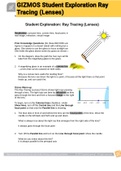
Agnes is trapped on a desert island with nothing but a magnifying
glass. She wants to use the glass to focus sunlight and start a fire.
She holds the glass above some dry grass as shown at right.
1. On the diagram, draw the path the Sun rays will likely
take from the magnifying glass to the grass.
2. A magnifying glass is an example of a convex lens
—a lens that curves outward on both sides.
Why is a convex lens useful for starting fires?
Because the lens can direct the light to a point, it focuses all the light there so that point
heats up, and can catch fire.
Gizmo Warm-up
The Ray Tracing (Lenses) Gizmo shows light rays passing
through a lens. The light rays are bent by refraction as they
pass through the lens and form a focused image to the right
of the lens.
To begin, turn on the Colorize lines checkbox. Under
Show lines, turn off the Central line and the Line through
focal point so that only the Parallel line is showing.
1. The blue dots in front of and behind the lens are the focal points of the lens. Move the
candle on the left back and forth and up and down.
What is always true about the light ray that emerges from the right side of the lens?
It always goes through the focal point
2. Turn off the Parallel line and turn on the Line through focal point. Move the candle.
What do you notice about this line?
It is always parallel to the principal axis
2019
, Get the Gizmo ready:
Activity A:
Turn on the Parallel line, Central line, and Line
Real and virtual through focal point.
images Move the candle to -24 on the central axis, with the
focal point at -12.
Introduction: A convex lens is called a “converging lens” because it focuses light rays into a
point. A real image is formed where the light rays emitted from a point converge on the other
side of the lens. If you placed a sheet of paper at the image, a focused image would be
projected onto the paper.
Question: How do lenses create images?
1. Observe: In its current configuration, the distance from the candle to the focal point is 12
units and the distance from the focal point to the lens is also 12 units.
A. What do you notice about the orientation of the candle’s image on the right side of
the lens? It’s inverted.
B. What do you notice about the size of the image? The image is slightly smaller.
2. Investigate: Complete each action listed in the table below, and describe how that action
affects the image to the right of the lens. Return the candle and focal point to their original
positions (-24 for the candle, -12 for the focal point) after each action.
Action Effect on image
Move the candle to the left. Image gets smaller and moves toward lens.
Move the candle to the right. Image gets bigger and moves away from lens.
Move the left focal point to the left. Image gets bigger and moves away from lens.
Move the left focal point to the right. Image gets smaller and moves toward lens.
3. Analyze: How is the image size related to the distance between the candle and the focal
point? As the distance between the candle and focal point increases, the image goes
smaller and moves towards the lens, and vice versa.
2019
Tracing (Lenses)
Name: Ohm and Rohan
Student Exploration: Ray Tracing (Lenses)
Vocabulary: concave lens, convex lens, focal point, image, magnification,
real image, refraction, virtual image
Prior Knowledge Questions (Do these BEFORE using the Gizmo.)
Agnes is trapped on a desert island with nothing but a magnifying
glass. She wants to use the glass to focus sunlight and start a fire.
She holds the glass above some dry grass as shown at right.
1. On the diagram, draw the path the Sun rays will likely
take from the magnifying glass to the grass.
2. A magnifying glass is an example of a convex lens
—a lens that curves outward on both sides.
Why is a convex lens useful for starting fires?
Because the lens can direct the light to a point, it focuses all the light there so that point
heats up, and can catch fire.
Gizmo Warm-up
The Ray Tracing (Lenses) Gizmo shows light rays passing
through a lens. The light rays are bent by refraction as they
pass through the lens and form a focused image to the right
of the lens.
To begin, turn on the Colorize lines checkbox. Under
Show lines, turn off the Central line and the Line through
focal point so that only the Parallel line is showing.
1. The blue dots in front of and behind the lens are the focal points of the lens. Move the
candle on the left back and forth and up and down.
What is always true about the light ray that emerges from the right side of the lens?
It always goes through the focal point
2. Turn off the Parallel line and turn on the Line through focal point. Move the candle.
What do you notice about this line?
It is always parallel to the principal axis
2019
, Get the Gizmo ready:
Activity A:
Turn on the Parallel line, Central line, and Line
Real and virtual through focal point.
images Move the candle to -24 on the central axis, with the
focal point at -12.
Introduction: A convex lens is called a “converging lens” because it focuses light rays into a
point. A real image is formed where the light rays emitted from a point converge on the other
side of the lens. If you placed a sheet of paper at the image, a focused image would be
projected onto the paper.
Question: How do lenses create images?
1. Observe: In its current configuration, the distance from the candle to the focal point is 12
units and the distance from the focal point to the lens is also 12 units.
A. What do you notice about the orientation of the candle’s image on the right side of
the lens? It’s inverted.
B. What do you notice about the size of the image? The image is slightly smaller.
2. Investigate: Complete each action listed in the table below, and describe how that action
affects the image to the right of the lens. Return the candle and focal point to their original
positions (-24 for the candle, -12 for the focal point) after each action.
Action Effect on image
Move the candle to the left. Image gets smaller and moves toward lens.
Move the candle to the right. Image gets bigger and moves away from lens.
Move the left focal point to the left. Image gets bigger and moves away from lens.
Move the left focal point to the right. Image gets smaller and moves toward lens.
3. Analyze: How is the image size related to the distance between the candle and the focal
point? As the distance between the candle and focal point increases, the image goes
smaller and moves towards the lens, and vice versa.
2019