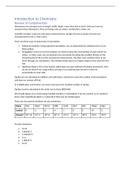
Introduction to Chemistry:
Review of Fundamentals:
Dimensions are concepts such as length, width, depth, mass, time and so forth. Units are how we
measure those dimensions. They are things such as meters, centimeters, moles, etc.
Scientific notation is how we note down measurements. Sig figs are how accurate we know our
measurements to be (+- that much)
There are three ways to keep track of uncertainty:
1. Statistical methods: Using repeated calculations, we can determine the standard error of our
final number.
2. Propagation of errors: For this method, we need to know the uncertainties of each datum we
collect. In other cases, we can estimate the uncertainty by taking the smallest division of the
measuring device X0.2 as the uncertainty measurement. We then must combine them as we
move through our calculations. This method always gives us a larger range of error than the first
one.
3. Significant figures: This is the easiest, albeit least accurate method of tracking uncertainty. Here
we do not know if our range will be too big or too small because we don’t know our
uncertainties to start with.
Sig figs are not calculated in addition and subtraction, instead we count the number of decimal places
and base our answer off that.
In multiplication and division, we must round up to the smallest number of sig figs.
Sig figs must be calculated in the order we do them (BEDMAS)
We should always try to avoid using rounded numbers in calculations if we can avoid it, so it’s useful to
keep a few insignificant digits in a subscript if they may be needed again.
There are also special notations we use sometimes:
Name Pico Nano Micro Milli Centi Deci Kilo Mega Giga
Symbol P n μ m c d k M G
Amount 10^-12 10^-9 10^-6 10^-3 10^-2 10^-1 10^3 10^6 10^9
Practice Questions:
a. 53.33
b. 5.06X10^2
c. 1.253X10^3
d. 51.2
e. 1.08X10^4
f. 10.91
, g. 0.15
h. (35.2+75.3)/1.4532=1824 (80)
i. 4.6X10^6
j. 2.127
k. -6.41
l. 3580
m. 3.4706
65 km
∗1000 m
h ¿ ∗1 ft
∗100 cm
1.2: 1 km 2.54 cm
∗1∈ ¿
1m ¿∗1 mile 6500000 mile
12∈ = =40 mph¿
5280 ft 160934.4 h
1.4 kg
∗7 d
1s
∗24 h
1
1.3: ∗60 m
1d
∗60 s
1h
=8.5∗105
1m
1.4:
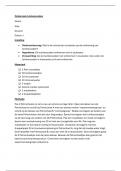
Nomenclature:
Naming Systems:
Binary naming system:
The metal stays the same while the halogen becomes “ide”
-ous -ic system:
The lower oxidation state become sous, while the higher state becomes ic. This naming method uses the
latin terminology.
IUPAC naming system:
Instead of the latin name, we simply use a roman numeral after the metal
Prefix System:
Allows us to know how many of each atom are in a compound. This is commonly used for nonmetal-
nonmetal molecules.
Polyatomic Ions:
Oxy-Acids:
- Nitric Acid HNO3
- Carbonic Acid H2CO3
- Chloric Acid HCLO3 (Iodic HIO3, Bromic HBrO3)
, - Sulphuric Acid H2SO4 (selenic H2SeO4, telluric H2TeO4
- Phosphoric Acid H3PO4
There are subcategories of these acids that follow the -ous -ic naming convention. Below they are listed
in order of most oxygen to least oxygen:
- Per_ic acid
- ic acid
- ous acid
- Hypo_ous acid
The ion left behind when we remove the acid is an -ate ion:
- Per_ate
- ate
- ite
- Hypo_ite
There are also other polyatomic ions that should be known:
NAME FORMULA OF ION “OXIDATION NUMBER”
hydroxide OH- 1-
ammonium NH41+ 1+
acetate CH3COO- (C2H3O2-) 1-
permanganate MnO4- 1-
chromate CrO42- 2-
dichromate Cr2O72- 2-
bicarbonate HCO3- 1-
bisulfate HSO4- 1-
cyanide CN- 1-
thiocyanate SCN- 1-
oxalate C2O42- 2-
Review of Fundamentals:
Dimensions are concepts such as length, width, depth, mass, time and so forth. Units are how we
measure those dimensions. They are things such as meters, centimeters, moles, etc.
Scientific notation is how we note down measurements. Sig figs are how accurate we know our
measurements to be (+- that much)
There are three ways to keep track of uncertainty:
1. Statistical methods: Using repeated calculations, we can determine the standard error of our
final number.
2. Propagation of errors: For this method, we need to know the uncertainties of each datum we
collect. In other cases, we can estimate the uncertainty by taking the smallest division of the
measuring device X0.2 as the uncertainty measurement. We then must combine them as we
move through our calculations. This method always gives us a larger range of error than the first
one.
3. Significant figures: This is the easiest, albeit least accurate method of tracking uncertainty. Here
we do not know if our range will be too big or too small because we don’t know our
uncertainties to start with.
Sig figs are not calculated in addition and subtraction, instead we count the number of decimal places
and base our answer off that.
In multiplication and division, we must round up to the smallest number of sig figs.
Sig figs must be calculated in the order we do them (BEDMAS)
We should always try to avoid using rounded numbers in calculations if we can avoid it, so it’s useful to
keep a few insignificant digits in a subscript if they may be needed again.
There are also special notations we use sometimes:
Name Pico Nano Micro Milli Centi Deci Kilo Mega Giga
Symbol P n μ m c d k M G
Amount 10^-12 10^-9 10^-6 10^-3 10^-2 10^-1 10^3 10^6 10^9
Practice Questions:
a. 53.33
b. 5.06X10^2
c. 1.253X10^3
d. 51.2
e. 1.08X10^4
f. 10.91
, g. 0.15
h. (35.2+75.3)/1.4532=1824 (80)
i. 4.6X10^6
j. 2.127
k. -6.41
l. 3580
m. 3.4706
65 km
∗1000 m
h ¿ ∗1 ft
∗100 cm
1.2: 1 km 2.54 cm
∗1∈ ¿
1m ¿∗1 mile 6500000 mile
12∈ = =40 mph¿
5280 ft 160934.4 h
1.4 kg
∗7 d
1s
∗24 h
1
1.3: ∗60 m
1d
∗60 s
1h
=8.5∗105
1m
1.4:
Nomenclature:
Naming Systems:
Binary naming system:
The metal stays the same while the halogen becomes “ide”
-ous -ic system:
The lower oxidation state become sous, while the higher state becomes ic. This naming method uses the
latin terminology.
IUPAC naming system:
Instead of the latin name, we simply use a roman numeral after the metal
Prefix System:
Allows us to know how many of each atom are in a compound. This is commonly used for nonmetal-
nonmetal molecules.
Polyatomic Ions:
Oxy-Acids:
- Nitric Acid HNO3
- Carbonic Acid H2CO3
- Chloric Acid HCLO3 (Iodic HIO3, Bromic HBrO3)
, - Sulphuric Acid H2SO4 (selenic H2SeO4, telluric H2TeO4
- Phosphoric Acid H3PO4
There are subcategories of these acids that follow the -ous -ic naming convention. Below they are listed
in order of most oxygen to least oxygen:
- Per_ic acid
- ic acid
- ous acid
- Hypo_ous acid
The ion left behind when we remove the acid is an -ate ion:
- Per_ate
- ate
- ite
- Hypo_ite
There are also other polyatomic ions that should be known:
NAME FORMULA OF ION “OXIDATION NUMBER”
hydroxide OH- 1-
ammonium NH41+ 1+
acetate CH3COO- (C2H3O2-) 1-
permanganate MnO4- 1-
chromate CrO42- 2-
dichromate Cr2O72- 2-
bicarbonate HCO3- 1-
bisulfate HSO4- 1-
cyanide CN- 1-
thiocyanate SCN- 1-
oxalate C2O42- 2-