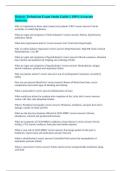
(Solution) NRS 306-week 5 Final Quiz / HLT 306V Topic 5 Quiz
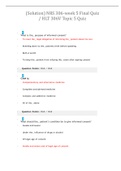
QUIZ 2 Week 5 1 What is the purpose of informed consent? To meet the legal obligation of informing the patient about his care Kneeling down to the patients level before speaking Both A and B To keep the patient from refusing the exam after signing consent Question Points: 10.0 / 10.0 2 CAM is: Complementary and alternative medicine Complete and advised medicine Complex and addictive medicine All of the above Question Points: 10.0 / 10.0 3 What should the patient’s condition be to give informed consent? Awake and aware Under the influence of drugs or alcohol Of legal age of consent Awake and aware and of legal age of consent Question Points: 10.0 / 10.0 4 Which of the following ethical theories means “do no harm”? Justice Beneficence Nonautonomy Nonmaleficence Question Points: 10.0 / 10.0 5 What is the goal of patient education of the elderly? To coerce the patient into compliance To maximize both the quantity and quality of life of the patient To overly simplify information for the patient To teach the patient to understand directions Question Points: 10.0 / 10.0 6 Which of the following is a barrier to education of the elderly? Lack of tolerance and respect for the patient Patient reminisces too much Must repeat directions to patient several times Patient is overly demanding Question Points: 10.0 / 10.0 7 When a patient receives a terminal diagnosis what are some of the stages he will experience? Fear Denial Anger All of the Above Question Points: 10.0 / 10.0 8 What are values? Personal ethics Personal theories Duties Responsibilities Question Points: 10.0 / 10.0 9 Teaching aids should be used To enhance oral communication Giving the patient something to do while waiting To substitute for one-on-one patient education None of the above Question Points: 10.0 / 10.0 10 What is “ageism” in healthcare? Recording the patient’s correct age The same as geriatrics Discrimination based on age The same as pediatrics Question Points: 10.0 / 10.0 11 The definition of negotiation as it applies to patient education is: Telling the patient to ask the doctor what they should do Insisting the patient follow the treatment as prescribed Letting the patient direct his treatment Conferring, discussing and bargaining with the patient to conform treatment to his needs Question Points: 10.0 / 10.0 12 What is the one thing terminal patients find most difficult? Poor hospital food Lack of visitors or too many visitors Others acting as if the patient is already deceased Too many painful treatments Question Points: 10.0 / 10.0 13 How is it possible to integrate CAM and conventional medicine? Under medical professional guidance Considering CAM as a type of treatment also Avoidance of negative interactions about CAM All of the above Question Points: 10.0 / 10.0 14 Illiteracy is: Rare in the United States Only occurs in low income, unemployed, uneducated people Connected to intelligence Inability to read and understand written material Question Points: 10.0 / 10.0 15 Activity/passivity is usually used in patient education under such circumstances as Emergency room treatment Semi-conscious patient Elderly patient who does not understand All of the above Question Points: 0.0 / 10.0
Escuela, estudio y materia
- Institución
- Grand Canyon University
- Grado
- NRS 306-week 5 Final Quiz (NRS306)
Información del documento
- Subido en
- 12 de noviembre de 2021
- Número de páginas
- 6
- Escrito en
- 2021/2022
- Tipo
- Examen
- Contiene
- Preguntas y respuestas
Temas
-
nrs 306 week 5 final quiz
-
hlt 306v topic 5 quiz
-
what is the purpose of informed consent
-
what is the purpose of informed consent
-
cam is
-
what should the patient’s condition be to give informed conse

Documento también disponible en un lote