HPLC
Carotenoids
• Terpenoids, synthesized from the C5-terpenoid precursor isopenyl diphosphate
• Phytochemicals
• Two main groups of carotenoids:
○ Carotenes- containing only carbons and hydrogens (lycopene, beta-
carotene)
○ Xanthophyll's-containing also oxygen (lutein, zeaxantin)
• Many double bonds => high conjugation, a-polar
• Have a color (red-orange-yellow), therefore they absorb blue-green light
• Because of the many double bonds, they are prone to light and oxygen
degradation
Analysis of carotenoids
Extraction
• First step in analysis: separating carotenoids from the biological matrix
• Grinding of the sample
• Removal of proteins, sugars and other small molecules
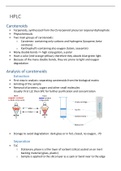
Usually: first LLE then SPE for further purification and concentration
• Storage to avoid degradation: dark glass or in foil, closed, no oxygen, -70
Separation
• TLC
○ Stationary phase is a thin layer of sorbent (silica) coated on an inert
backing material (glass, plastic)
○ Sample is applied to the silica layer as a spot or band near to the edge
○ Separation occurs in an enclosed chamber by contacting the bottom edge
of the layer by the mobile phase.
○ By capillary force, the mobile phase runs through the silica and the
Carotenoids
• Terpenoids, synthesized from the C5-terpenoid precursor isopenyl diphosphate
• Phytochemicals
• Two main groups of carotenoids:
○ Carotenes- containing only carbons and hydrogens (lycopene, beta-
carotene)
○ Xanthophyll's-containing also oxygen (lutein, zeaxantin)
• Many double bonds => high conjugation, a-polar
• Have a color (red-orange-yellow), therefore they absorb blue-green light
• Because of the many double bonds, they are prone to light and oxygen
degradation
Analysis of carotenoids
Extraction
• First step in analysis: separating carotenoids from the biological matrix
• Grinding of the sample
• Removal of proteins, sugars and other small molecules
Usually: first LLE then SPE for further purification and concentration
• Storage to avoid degradation: dark glass or in foil, closed, no oxygen, -70
Separation
• TLC
○ Stationary phase is a thin layer of sorbent (silica) coated on an inert
backing material (glass, plastic)
○ Sample is applied to the silica layer as a spot or band near to the edge
○ Separation occurs in an enclosed chamber by contacting the bottom edge
of the layer by the mobile phase.
○ By capillary force, the mobile phase runs through the silica and the