Memory
1. Introduction and neurobiology of memory
What is memory?
Old book on memory improvement: Rhetorica ad Herennium
- Method of Loci; walking around a room and placing memories there
for improvement of recollection.
Randolf Menzel: Bees have memory stages optimized for supporting their
efforts in finding flowers for honey; some kind of intermediate
“temporary” memory that lasts only a few days.
Hermann Ebbinghaus
- Founder of modern memory psychology
- “Ebbinghaus’ forgetting curve”
Adolf Jost
- Jost’s Law: if 2 memory traces have equal retrieval probability, but
different ages, the older one will:
o Be forgotten more slowly than the younger one
o Benefit more from additional learning
Francis Bartlett
- Memory as a construction:
o Memories are complemented by known information; e.g., you
automatically complete an object when not being able to see
the whole thing, this is based on your knowledge of the object.
Lasley
- Neurobiologist who tried to find the memory storage in mice
- Cut different parts of cortex out after learning a maze; see which
mice can still do it
- Concluded that there is no specific place in the cortex, rather the
whole cortex combined is responsible for memory in mice
,Cognitive Psychology (> 1950’s)
- Influenced by emerging computer science
- RAM vs Hard Disk = STM vs LTM
- Memory is now viewed as carrier of information that is manipulated
during cognition
- Miller’s Law: we can retain 7 +/- 2 things in memory storage at the
same time
Atkinson and Shiffrin Model (1968)
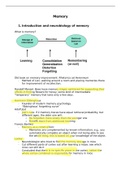
- Sensory store,
- short-term/working store; maintenance rehearsal is necessary
- long-term store
Baddeley and Hitch added the “central executive”
Tulving (1985)
- Episodic memory (events in time, can “time travel” to them)
o “Experiences” that you “remember”
- Semantic memory (general knowledge)
o “knowledge” that you “know”
- Procedural memory (operations for executing tasks; e.g., know
how to tie your shoelaces)
Watson: fear experiment with baby; little Albert
- Used conditioning to make Albert afraid of objects that were first
neutral or even liked
- By means of presenting them combined with a loud bang
The Neurobiology of Memory
Donald Hebb: Long-Term Potentiation (LTP)
- Repeated stimulation -> “fire together wire together”
- Firing together increase physical size of the synapse
- More vesicles and more receptors arise between these neurons
Hebbian Learning
- when something new is learned, neurons actually physically make a
new connection
o can be shown in real life with two-photon microscopy in mice
- Dendritic spines grow AND shrink over time; this is fairly random;
neural connections fluctuate like crazy!
o Even happens in a time period of only 15 minutes
, Hippocampus
- Essential for the formation of Episodic Memory
- Spatial memory in rats (John O’Keefe): different cells in
hippocampus have shown to respond selectively to specific locations
in space; “place cells”
o Moser and Moser showed that place cells are specific to
Hexagons on a larger map; meaning that if you put the rat in
a larger space, the place cell will fire again when it is
represented in the next hexagon.
o These hexagonal patterns in space are formed by “grid
cells”
o Not found as much in monkey and human brain
Morris Water Maze
- For testing learning and forgetting in rats
- Rat has to find an invisible platform in the water so that they can
stand and not drown
- When no change in the maze; rats learn to find the platform very
quickly
- Normal vs hippocampal lesion rats:
o At variable starting positions: hippocampal lesion rats cannot
learn the maze, normal rats can; gradually faster with trials
o At constant starting positions: hippocampal lesion rats DO
learn it, but it takes more trials to be as fast as normal rats
- In people: hippocampal lesions still allow for learning new
procedural memory things; like a new skill
o This is an unconscious kind of learning; they do not know they
learned it
Hippocampus and memory
- Old idea: hippocampus is specialized in spatial memory
- Alternative idea: hippocampus plays a role in remembering complex
associations
Parahippocampal Areas (around the
hippocampus)
- Essential for formation of complex
associations; e.g., objects and their context
- The Delayed Non-Matching-to-Sample
Task
o Monkey is presented with a key and
another object
o Food can be found under the key
o After delay, the food will always be
found under the OTHER object; the
food is thus associated with the non-
1. Introduction and neurobiology of memory
What is memory?
Old book on memory improvement: Rhetorica ad Herennium
- Method of Loci; walking around a room and placing memories there
for improvement of recollection.
Randolf Menzel: Bees have memory stages optimized for supporting their
efforts in finding flowers for honey; some kind of intermediate
“temporary” memory that lasts only a few days.
Hermann Ebbinghaus
- Founder of modern memory psychology
- “Ebbinghaus’ forgetting curve”
Adolf Jost
- Jost’s Law: if 2 memory traces have equal retrieval probability, but
different ages, the older one will:
o Be forgotten more slowly than the younger one
o Benefit more from additional learning
Francis Bartlett
- Memory as a construction:
o Memories are complemented by known information; e.g., you
automatically complete an object when not being able to see
the whole thing, this is based on your knowledge of the object.
Lasley
- Neurobiologist who tried to find the memory storage in mice
- Cut different parts of cortex out after learning a maze; see which
mice can still do it
- Concluded that there is no specific place in the cortex, rather the
whole cortex combined is responsible for memory in mice
,Cognitive Psychology (> 1950’s)
- Influenced by emerging computer science
- RAM vs Hard Disk = STM vs LTM
- Memory is now viewed as carrier of information that is manipulated
during cognition
- Miller’s Law: we can retain 7 +/- 2 things in memory storage at the
same time
Atkinson and Shiffrin Model (1968)
- Sensory store,
- short-term/working store; maintenance rehearsal is necessary
- long-term store
Baddeley and Hitch added the “central executive”
Tulving (1985)
- Episodic memory (events in time, can “time travel” to them)
o “Experiences” that you “remember”
- Semantic memory (general knowledge)
o “knowledge” that you “know”
- Procedural memory (operations for executing tasks; e.g., know
how to tie your shoelaces)
Watson: fear experiment with baby; little Albert
- Used conditioning to make Albert afraid of objects that were first
neutral or even liked
- By means of presenting them combined with a loud bang
The Neurobiology of Memory
Donald Hebb: Long-Term Potentiation (LTP)
- Repeated stimulation -> “fire together wire together”
- Firing together increase physical size of the synapse
- More vesicles and more receptors arise between these neurons
Hebbian Learning
- when something new is learned, neurons actually physically make a
new connection
o can be shown in real life with two-photon microscopy in mice
- Dendritic spines grow AND shrink over time; this is fairly random;
neural connections fluctuate like crazy!
o Even happens in a time period of only 15 minutes
, Hippocampus
- Essential for the formation of Episodic Memory
- Spatial memory in rats (John O’Keefe): different cells in
hippocampus have shown to respond selectively to specific locations
in space; “place cells”
o Moser and Moser showed that place cells are specific to
Hexagons on a larger map; meaning that if you put the rat in
a larger space, the place cell will fire again when it is
represented in the next hexagon.
o These hexagonal patterns in space are formed by “grid
cells”
o Not found as much in monkey and human brain
Morris Water Maze
- For testing learning and forgetting in rats
- Rat has to find an invisible platform in the water so that they can
stand and not drown
- When no change in the maze; rats learn to find the platform very
quickly
- Normal vs hippocampal lesion rats:
o At variable starting positions: hippocampal lesion rats cannot
learn the maze, normal rats can; gradually faster with trials
o At constant starting positions: hippocampal lesion rats DO
learn it, but it takes more trials to be as fast as normal rats
- In people: hippocampal lesions still allow for learning new
procedural memory things; like a new skill
o This is an unconscious kind of learning; they do not know they
learned it
Hippocampus and memory
- Old idea: hippocampus is specialized in spatial memory
- Alternative idea: hippocampus plays a role in remembering complex
associations
Parahippocampal Areas (around the
hippocampus)
- Essential for formation of complex
associations; e.g., objects and their context
- The Delayed Non-Matching-to-Sample
Task
o Monkey is presented with a key and
another object
o Food can be found under the key
o After delay, the food will always be
found under the OTHER object; the
food is thus associated with the non-