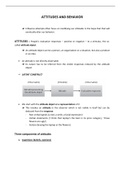
ATTITUDES AND BEHAVIOR
Influence attempts often focus on modifying our attitudes in the hope that that will
eventually alter our behavior.
ATTITUDES = People’s evaluative responses – positive or negative – to a stimulus, the so-
called attitude object.
An attitude object can be a person, an organization or a situation, but also a product
or an idea.
An attitude is not directly observable
Its nature has to be inferred from the visible responses induced by the attitude
object.
LATENT CONSTRUCT
We start with the attitude object or a representation of it
This invokes an attitude in the observer which is not visible in itself but can be
deduced from the response
- Non-verbal signals (a nod, a smile, a facial expression)
- Verbal statements (‘I think that laptop’s the best in its price category’, ‘those
flowers are ugly’)
- Actions (buying the laptop or the flowers).
Three components of attitudes
1. Cognitions (beliefs, opinions)
, COGNITIVE RESPONSE = The thoughts aroused by particular characteristics of
the attitude object, on the basis of which we form an evaluative judgement about it
(‘positive-negative’).
2. Affect (feelings, emotions)
AFFECTIVE RESPONSE = Feelings, sentiments or emotions an attitude object
elicits
- Can be expressed through verbal and non-verbal communications but also
through a physiological response – an accelerated heartbeat, for instance.
Some attitudes are largely instinctive and so primarily expressed affectively, whilst
others are more reasoned and so reflected in the cognitive response.
3. Behavior (actions, conduct)
Includes
- Consumer buying habits
- Voter behavior
- Interpersonal activities etc
Each of the three components – cognition, affect and behavior – manifests an
evaluation
, Behavior is often regarded as the consequence of an attitude towards which both
cognitive considerations and affective reactions have contributed
Conversely, behavior can also influence the cognitive and affective responses to an
attitude object.
- For example, a positive attitude that led to the purchase of a product which
proved to be a bad buy will become less positive as a result, and will therefore
also affect subsequent behavior.
The affective and cognitive components of an attitude are often closely related.
- This appears to be particularly true in the case of controversial topics with a
strong human dimension.
Examples include euthanasia, a blanket ban on immigration and the
reintroduction of the death penalty.
Components can contradict one another.
- This is often the case with organ donation
Many people are persuaded of the benefits, but nonetheless an
instinctive, emotional response prevents them from registering as donors
, If we want to influence people, it is important to know what their attitude is based
on.
Although it is tempting to think behavior is primarily the result of careful cognitive
considerations, research demonstrates that affective responses are better
predictors of intentions to act, at least for some behaviors
- Health behaviors
Long-term cognitive benefits
But direct affective consequences
Influence attempts often focus on modifying our attitudes in the hope that that will
eventually alter our behavior.
ATTITUDES = People’s evaluative responses – positive or negative – to a stimulus, the so-
called attitude object.
An attitude object can be a person, an organization or a situation, but also a product
or an idea.
An attitude is not directly observable
Its nature has to be inferred from the visible responses induced by the attitude
object.
LATENT CONSTRUCT
We start with the attitude object or a representation of it
This invokes an attitude in the observer which is not visible in itself but can be
deduced from the response
- Non-verbal signals (a nod, a smile, a facial expression)
- Verbal statements (‘I think that laptop’s the best in its price category’, ‘those
flowers are ugly’)
- Actions (buying the laptop or the flowers).
Three components of attitudes
1. Cognitions (beliefs, opinions)
, COGNITIVE RESPONSE = The thoughts aroused by particular characteristics of
the attitude object, on the basis of which we form an evaluative judgement about it
(‘positive-negative’).
2. Affect (feelings, emotions)
AFFECTIVE RESPONSE = Feelings, sentiments or emotions an attitude object
elicits
- Can be expressed through verbal and non-verbal communications but also
through a physiological response – an accelerated heartbeat, for instance.
Some attitudes are largely instinctive and so primarily expressed affectively, whilst
others are more reasoned and so reflected in the cognitive response.
3. Behavior (actions, conduct)
Includes
- Consumer buying habits
- Voter behavior
- Interpersonal activities etc
Each of the three components – cognition, affect and behavior – manifests an
evaluation
, Behavior is often regarded as the consequence of an attitude towards which both
cognitive considerations and affective reactions have contributed
Conversely, behavior can also influence the cognitive and affective responses to an
attitude object.
- For example, a positive attitude that led to the purchase of a product which
proved to be a bad buy will become less positive as a result, and will therefore
also affect subsequent behavior.
The affective and cognitive components of an attitude are often closely related.
- This appears to be particularly true in the case of controversial topics with a
strong human dimension.
Examples include euthanasia, a blanket ban on immigration and the
reintroduction of the death penalty.
Components can contradict one another.
- This is often the case with organ donation
Many people are persuaded of the benefits, but nonetheless an
instinctive, emotional response prevents them from registering as donors
, If we want to influence people, it is important to know what their attitude is based
on.
Although it is tempting to think behavior is primarily the result of careful cognitive
considerations, research demonstrates that affective responses are better
predictors of intentions to act, at least for some behaviors
- Health behaviors
Long-term cognitive benefits
But direct affective consequences