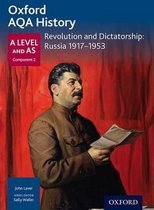
Revolution and Dictatorship:
Russia 1917-1953
Exam Questions
,Dissent and Revolution, 1917
With reference to Sources 1 and 2 and your understanding of the historical
context, assess the value of these sources to an historian studying discontent in
Russia by the beginning of 1917.
Source 1:
Adapted from Aleksandr Kerensky's memoirs, Crucifixion of Liberty, 1934
Aleksandr Kerensky was a socialist member of the third and fourth State Dumas and
Prime Minister between August and October 1917, after the Tsar's abdication. In
this extract he describes Nicholas Il:
He merely believed what his father and Pobedonostsev had instilled into him; there
would be no Russia without autocracy; Russia and the autocracy were one; he
himself was the impersonation of the autocracy. So the magic circle closed. There
was no way out, unless it was into disaster and void. Living in the twentieth century,
he had the mentality of the Muscovite Kings. The daily work of a monarch he found
intolerably boring. He could not stand listening long or seriously to ministers'
reports, or reading them. He liked such ministers as could tell an amusing story and
did not weary the monarch's attention with too much business. When it came to
defending his divine right his usual indifference left him, he became cunning,
obstinate and cruel, merciless at times.
Source 2:
Adapted from official government reports into the state of the war in October 1916
The atmosphere in the army is very tense, and the relations between the common
soldiers and the officers are much strained, the result being that several unpleasant
incidents leading even to bloodshed have taken place. The behaviour of the soldiers,
especially in the units located in the rear is most provocative. They openly accuse
military authorities of cowardice, drunkenness and even treason.
Everyone who has approached the army cannot but carry away the belief that
complete demoralisation is in progress. The soldiers began to demand peace a long
time ago, but never was this done so openly and with such force as now. The
officers, not infrequently, even refuse to lead their units against the enemy because
they are afraid of being killed by their own men.
, Dissent and Revolution, 1917
With reference to Sources 1, 2 and 3 and your understanding of the historical context, assess
the value of these sources to an historian studying the condition of Russia on the eve of the
Revolution in 1917
Source 1:
Adapted from official government reports into the state of the war in October 1916
The atmosphere in the army is very tense, and the relations between the common soldiers and
the officers are much strained, the result being that several unpleasant incidents leading even
to bloodshed have taken place. The behaviour of the soldiers, especially in the units located in
the rear is most provocative. They openly accuse military authorities of cowardice, drunkenness
and even treason.
Everyone who has approached the army cannot but carry away the belief that complete
demoralisation is in progress. The soldiers began to demand peace a long time ago, but never
was this done so openly and with such force as now. The officers, not infrequently, even refuse
to lead their units against the enemy because they are afraid of being killed by their own men.
Source 2:
Adapted from a 1916 Bolshevik report into the food crisis in Bryansk, a city near the front line,
south-west of Moscow. The report was made by Alexander Shliapnikov, a Russian communist
revolutionary, metalworker, and trade union leader who published it in, On the Eve of 1917, in
1923.
In Bryansk there is no rye flour, salt, paraffin or sugar. Discontent is rife and more than once
there have been strikes in the factories with the demand for 'flour and sugar'. There is, in
Bryansk country, a village called Star, where there is a factory making glass products and is
engaged in war contracts. Workers there went on strike on 8 October 1916 because they had
not eaten bread for two weeks, having only potatoes. They selected two spokesmen and sent
them to the factory manager with a demand for flour and sugar (for the company had
undertaken to procure the items at pre-war prices as it had kept wages at peacetime levels).
The manager could not give an answer but just made promises. The following day the two
spokesmen were arrested as unreliable elements and held under emergency regulations. Two
days later the workers went back but still did not get bread. I travelled round the villages:
grumbling, discontent and a vague apprehension all around.
Source 3:
Adapted from a government-commissioned Okhrana report, January 1917
There is a marked increase in hostile feelings among the peasants, not only against the
government but against all other social groups. The proletariat of the capital is on the verge of
despair. The mass of industrial workers are quite ready to let themselves go to the wildest
excesses of a hunger riot. The prohibition of all labour meetings, the closing of trade unions,
the suspension of labour newspapers and so on, make the labour masses, led by the more
advanced and already revolutionary-minded elements, assume an openly hostile attitude
towards the Government and protest with all means at their disposal against the continuation
of the war.
Russia 1917-1953
Exam Questions
,Dissent and Revolution, 1917
With reference to Sources 1 and 2 and your understanding of the historical
context, assess the value of these sources to an historian studying discontent in
Russia by the beginning of 1917.
Source 1:
Adapted from Aleksandr Kerensky's memoirs, Crucifixion of Liberty, 1934
Aleksandr Kerensky was a socialist member of the third and fourth State Dumas and
Prime Minister between August and October 1917, after the Tsar's abdication. In
this extract he describes Nicholas Il:
He merely believed what his father and Pobedonostsev had instilled into him; there
would be no Russia without autocracy; Russia and the autocracy were one; he
himself was the impersonation of the autocracy. So the magic circle closed. There
was no way out, unless it was into disaster and void. Living in the twentieth century,
he had the mentality of the Muscovite Kings. The daily work of a monarch he found
intolerably boring. He could not stand listening long or seriously to ministers'
reports, or reading them. He liked such ministers as could tell an amusing story and
did not weary the monarch's attention with too much business. When it came to
defending his divine right his usual indifference left him, he became cunning,
obstinate and cruel, merciless at times.
Source 2:
Adapted from official government reports into the state of the war in October 1916
The atmosphere in the army is very tense, and the relations between the common
soldiers and the officers are much strained, the result being that several unpleasant
incidents leading even to bloodshed have taken place. The behaviour of the soldiers,
especially in the units located in the rear is most provocative. They openly accuse
military authorities of cowardice, drunkenness and even treason.
Everyone who has approached the army cannot but carry away the belief that
complete demoralisation is in progress. The soldiers began to demand peace a long
time ago, but never was this done so openly and with such force as now. The
officers, not infrequently, even refuse to lead their units against the enemy because
they are afraid of being killed by their own men.
, Dissent and Revolution, 1917
With reference to Sources 1, 2 and 3 and your understanding of the historical context, assess
the value of these sources to an historian studying the condition of Russia on the eve of the
Revolution in 1917
Source 1:
Adapted from official government reports into the state of the war in October 1916
The atmosphere in the army is very tense, and the relations between the common soldiers and
the officers are much strained, the result being that several unpleasant incidents leading even
to bloodshed have taken place. The behaviour of the soldiers, especially in the units located in
the rear is most provocative. They openly accuse military authorities of cowardice, drunkenness
and even treason.
Everyone who has approached the army cannot but carry away the belief that complete
demoralisation is in progress. The soldiers began to demand peace a long time ago, but never
was this done so openly and with such force as now. The officers, not infrequently, even refuse
to lead their units against the enemy because they are afraid of being killed by their own men.
Source 2:
Adapted from a 1916 Bolshevik report into the food crisis in Bryansk, a city near the front line,
south-west of Moscow. The report was made by Alexander Shliapnikov, a Russian communist
revolutionary, metalworker, and trade union leader who published it in, On the Eve of 1917, in
1923.
In Bryansk there is no rye flour, salt, paraffin or sugar. Discontent is rife and more than once
there have been strikes in the factories with the demand for 'flour and sugar'. There is, in
Bryansk country, a village called Star, where there is a factory making glass products and is
engaged in war contracts. Workers there went on strike on 8 October 1916 because they had
not eaten bread for two weeks, having only potatoes. They selected two spokesmen and sent
them to the factory manager with a demand for flour and sugar (for the company had
undertaken to procure the items at pre-war prices as it had kept wages at peacetime levels).
The manager could not give an answer but just made promises. The following day the two
spokesmen were arrested as unreliable elements and held under emergency regulations. Two
days later the workers went back but still did not get bread. I travelled round the villages:
grumbling, discontent and a vague apprehension all around.
Source 3:
Adapted from a government-commissioned Okhrana report, January 1917
There is a marked increase in hostile feelings among the peasants, not only against the
government but against all other social groups. The proletariat of the capital is on the verge of
despair. The mass of industrial workers are quite ready to let themselves go to the wildest
excesses of a hunger riot. The prohibition of all labour meetings, the closing of trade unions,
the suspension of labour newspapers and so on, make the labour masses, led by the more
advanced and already revolutionary-minded elements, assume an openly hostile attitude
towards the Government and protest with all means at their disposal against the continuation
of the war.