

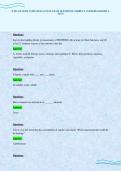
D 203 ANATOM 2 UPDATED ACTUAL EXAM QUESTIONS CORRECT ANSWERS GRADED A
PLUS
Question:
List (A) the building blocks (or monomers) of PROTEINS, (B) at least 2 of their functions, and (C)
at least 2 common sources of the nutrient in the diet.
Answer:
A. Amino acids B. Energy source, structure and regulation C. Meats, dairy products, legumes,
vegetables, and grains
Question:
Vitamins contain both ____ and ____ forms.
Answer:
fat soluble; water soluble
Question:
Micro-minerals are referred to as _______ minerals.
Answer:
Trace
Question:
Tom is on a diet restricting his consumption of starches and sugars. Which macromolecule would he
be limiting?
Answer:
Carbohydrate
Question:
, Which of the 6 nutrient classes are NOT sources of energy? (Select all that apply): Lipids Vitamins
Minerals Protein Water Carbohydrate
Answer:
Vitamins minerals water
Question:
Explain how a calorie (the general term), a Calorie (the dietary term) and a kilocalorie are related.
Answer:
A calorie is the amount of heat needed to raise the temperature of 1 gram of water by 1 degree
Celsius. Food calories (Calories) is expressed in terms of kilocalories. Or Calorie = 1 kilocalorie =
1,000 calories
Question:
You bring your teenage nephew to lunch at the mall food court. He decides to get a soda and bag of
chips. You suggest he also try a vegetable and rice bowl as a more nutrient dense option. How
would you explain the difference between nutrient dense and empty calorie foods to him?
Answer:
Nutrient-dense foods are those with a high amount of vitamins and minerals, along with the
macronutrients that can be used as fuel. Empty calorie foods are high in calories but contain little
vitamins or minerals, so they have lower nutrient value.
Question:
Compare and contrast (i.e. explain the similarities and differences) between undernutrition and
overnutrition. Include the terms' definitions and how they influence health outcomes.
Answer:
Both over- and undernutrition have negative health consequences with an imbalance of the
consumption (or lack of) nutrients. They are both forms of malnutrition. Overnutrition is the
consumption of excess calories and fats (cholesterol/saturated), which increases the risk of chronic
disease and obesity, and can lead to toxicity. Undernutrition is the opposite, when nutrient intake
does not meet the nutrient needs of the body. This can lead to slowed metabolic processes and
deficiencies.
PLUS
Question:
List (A) the building blocks (or monomers) of PROTEINS, (B) at least 2 of their functions, and (C)
at least 2 common sources of the nutrient in the diet.
Answer:
A. Amino acids B. Energy source, structure and regulation C. Meats, dairy products, legumes,
vegetables, and grains
Question:
Vitamins contain both ____ and ____ forms.
Answer:
fat soluble; water soluble
Question:
Micro-minerals are referred to as _______ minerals.
Answer:
Trace
Question:
Tom is on a diet restricting his consumption of starches and sugars. Which macromolecule would he
be limiting?
Answer:
Carbohydrate
Question:
, Which of the 6 nutrient classes are NOT sources of energy? (Select all that apply): Lipids Vitamins
Minerals Protein Water Carbohydrate
Answer:
Vitamins minerals water
Question:
Explain how a calorie (the general term), a Calorie (the dietary term) and a kilocalorie are related.
Answer:
A calorie is the amount of heat needed to raise the temperature of 1 gram of water by 1 degree
Celsius. Food calories (Calories) is expressed in terms of kilocalories. Or Calorie = 1 kilocalorie =
1,000 calories
Question:
You bring your teenage nephew to lunch at the mall food court. He decides to get a soda and bag of
chips. You suggest he also try a vegetable and rice bowl as a more nutrient dense option. How
would you explain the difference between nutrient dense and empty calorie foods to him?
Answer:
Nutrient-dense foods are those with a high amount of vitamins and minerals, along with the
macronutrients that can be used as fuel. Empty calorie foods are high in calories but contain little
vitamins or minerals, so they have lower nutrient value.
Question:
Compare and contrast (i.e. explain the similarities and differences) between undernutrition and
overnutrition. Include the terms' definitions and how they influence health outcomes.
Answer:
Both over- and undernutrition have negative health consequences with an imbalance of the
consumption (or lack of) nutrients. They are both forms of malnutrition. Overnutrition is the
consumption of excess calories and fats (cholesterol/saturated), which increases the risk of chronic
disease and obesity, and can lead to toxicity. Undernutrition is the opposite, when nutrient intake
does not meet the nutrient needs of the body. This can lead to slowed metabolic processes and
deficiencies.


