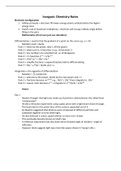
Inorganic Chemistry Notes
Electronic Configuration
1. Aufbau principle = electrons fill lower-energy atomic orbitals before the higher-
energy ones
2. Hund’s rule of maximum multiplicity = electrons will occupy orbitals singly before
filling in the pairs
Mathematics (if not sure just use calculator)
Differentiation = used to find the gradient of a point on the curve e.g., y = 3x2
- Notation used = dy/dx
Rule 1 = times by the power, take 1 off the power
Rule 2 = when just nx, it becomes n e.g., 3x becomes 3
Rule 3 = any numbers are cancelled out, so +8 disappears
Rule 4 = √𝑥 becomes x1/2 = 1/2x-1/2
Rule 5 = if 6x5-2x-3 = 30x4 + 6x-4
Rule 6 = simplify fractions + expand brackets before differentiating
Rule 7 = f(x) = y f1(x) = dy/dx, y(x) = y
Integration = the opposite of differentiation
- Notation = ∫(𝑐𝑗𝑑𝑖𝑗𝑏𝑒)𝑑𝑥
Rule 1 = add one to the power, divide by the new power and + C
Rule 2 = fractions because nx-power e.g., 10/x2 = 10x-2 then integrate to -10x-1
Rule 3 = square roots because x1/2 + integrate to x3/2/(3/2) = 2/3x3/2
Atoms
Day 1
- Newton thought that light was made up of particles called photons (he called them
“compuscular”
- He did a refraction experiment using a glass prism with a light beam shone through.
This beam bent in the prism then all the colours separated out of it
- So Newton suggested that photons were composed of different particles and
combined together to form white light,
- He also deduced a colour-speed relation so more red = slower
- This eventually became known as Snell’s law
- A reflection experiment was also done which showed angle of incident = angle of
reflection
- However Hook suggests light was more like waves shown in Young’s slits +
, - This produces a bifringent pattern somewhat like an
out of focuses zebra + Hugglie refraction
- The lines shown imitate the maxima and minima wave
points
- With sound if two waves are in sync, they join whereas
if they are opposite the sound cancels out seen in
headphones
- The same is with light, where maxima and minima
points cross the ways are destructive + cause darkness
- But when 2 maxima or 2 minima points cross bright
light is seen (structive)
- This leads the question is light a particle or a wave?
Day 2 = Photoelectric effect + Einstein’s equation
- Hertz showed is you take a circuit with a break, electrons can jump across (arcing
electron) causing a flash, if you shine light on the gap more electrons will jump
causing more flashing, but why?
- An electroscope has a thin gold leaf in a vacuum which floats if electrostatically
charged
- If light is shone the gold can move
- The height of the gold leaf will change depending on
the colour of light shone on the box
Red light = no movement
Blue light (UV) = appreciable movement
- Therefore energy is transferred from light to electrons + there is a relationship
between colour + energy (speed) like Newton suggested
- Millikan Experiment
- It was known that if you shine light on a metal surface and
electron is released
- So a circuit is broken and the current is measured to see how
many electrons jump the gap
- A battery can be added with the negative side being the side
the electrons jump to causing repulsion, the voltage can be
changed to see the stopping potential Vs, which = E/Q or energy
(kinetic energy = 1/2mv2)/charge
- Therefore Vs = 1/2mv2/e(charge of an electron)
, - As stated there is a relationship between colour and energy therefore frequency
- In the graph you can see a certain amount of
energy is needed for an electron to be liberated in
the circuit
- Therefore electrons are bound to the surface of
metals by a specific energy (which is dependent
upon the metal itself)
- If you increase the intensity of light (amount)
then the nymber of electrons increases not the
energy
- This doesn’t sense to make sense classically
- But you can deduce that 1 photon is interacting with 1 electron, electrons are
particles
- So KEelectron = hf – work function (energy required for electron liberation
- This is Einsteins equation as it is mx+c
- H = planks constant F = frequency (energy) of a photon
Day 3 = The Photoelectric Effect
- The KE experiment is the same as Einstein’s y=mx+c as the intercept is the work
function seen in the graph above
- Potential V = has to climb past barrier or surface metal
- Einstein had an idea, known as Einstein’s theory of light in 4 papers in 1905. Millikan
tried to prove Einstein wrong from 1906-1916 + actually proved him right
- De Broglie had a theory which was then tested + he won the Noble prize
- His theory was that the wavelength of a particle = a constant/momentum
- h = constant p = momentum
- But how can a particle with no mass have
momentum
- Elight = h x c (speed of light)/wavelength
- Combined with e = mc2
- Wavelength = h/mv = h/p
Electronic Configuration
1. Aufbau principle = electrons fill lower-energy atomic orbitals before the higher-
energy ones
2. Hund’s rule of maximum multiplicity = electrons will occupy orbitals singly before
filling in the pairs
Mathematics (if not sure just use calculator)
Differentiation = used to find the gradient of a point on the curve e.g., y = 3x2
- Notation used = dy/dx
Rule 1 = times by the power, take 1 off the power
Rule 2 = when just nx, it becomes n e.g., 3x becomes 3
Rule 3 = any numbers are cancelled out, so +8 disappears
Rule 4 = √𝑥 becomes x1/2 = 1/2x-1/2
Rule 5 = if 6x5-2x-3 = 30x4 + 6x-4
Rule 6 = simplify fractions + expand brackets before differentiating
Rule 7 = f(x) = y f1(x) = dy/dx, y(x) = y
Integration = the opposite of differentiation
- Notation = ∫(𝑐𝑗𝑑𝑖𝑗𝑏𝑒)𝑑𝑥
Rule 1 = add one to the power, divide by the new power and + C
Rule 2 = fractions because nx-power e.g., 10/x2 = 10x-2 then integrate to -10x-1
Rule 3 = square roots because x1/2 + integrate to x3/2/(3/2) = 2/3x3/2
Atoms
Day 1
- Newton thought that light was made up of particles called photons (he called them
“compuscular”
- He did a refraction experiment using a glass prism with a light beam shone through.
This beam bent in the prism then all the colours separated out of it
- So Newton suggested that photons were composed of different particles and
combined together to form white light,
- He also deduced a colour-speed relation so more red = slower
- This eventually became known as Snell’s law
- A reflection experiment was also done which showed angle of incident = angle of
reflection
- However Hook suggests light was more like waves shown in Young’s slits +
, - This produces a bifringent pattern somewhat like an
out of focuses zebra + Hugglie refraction
- The lines shown imitate the maxima and minima wave
points
- With sound if two waves are in sync, they join whereas
if they are opposite the sound cancels out seen in
headphones
- The same is with light, where maxima and minima
points cross the ways are destructive + cause darkness
- But when 2 maxima or 2 minima points cross bright
light is seen (structive)
- This leads the question is light a particle or a wave?
Day 2 = Photoelectric effect + Einstein’s equation
- Hertz showed is you take a circuit with a break, electrons can jump across (arcing
electron) causing a flash, if you shine light on the gap more electrons will jump
causing more flashing, but why?
- An electroscope has a thin gold leaf in a vacuum which floats if electrostatically
charged
- If light is shone the gold can move
- The height of the gold leaf will change depending on
the colour of light shone on the box
Red light = no movement
Blue light (UV) = appreciable movement
- Therefore energy is transferred from light to electrons + there is a relationship
between colour + energy (speed) like Newton suggested
- Millikan Experiment
- It was known that if you shine light on a metal surface and
electron is released
- So a circuit is broken and the current is measured to see how
many electrons jump the gap
- A battery can be added with the negative side being the side
the electrons jump to causing repulsion, the voltage can be
changed to see the stopping potential Vs, which = E/Q or energy
(kinetic energy = 1/2mv2)/charge
- Therefore Vs = 1/2mv2/e(charge of an electron)
, - As stated there is a relationship between colour and energy therefore frequency
- In the graph you can see a certain amount of
energy is needed for an electron to be liberated in
the circuit
- Therefore electrons are bound to the surface of
metals by a specific energy (which is dependent
upon the metal itself)
- If you increase the intensity of light (amount)
then the nymber of electrons increases not the
energy
- This doesn’t sense to make sense classically
- But you can deduce that 1 photon is interacting with 1 electron, electrons are
particles
- So KEelectron = hf – work function (energy required for electron liberation
- This is Einsteins equation as it is mx+c
- H = planks constant F = frequency (energy) of a photon
Day 3 = The Photoelectric Effect
- The KE experiment is the same as Einstein’s y=mx+c as the intercept is the work
function seen in the graph above
- Potential V = has to climb past barrier or surface metal
- Einstein had an idea, known as Einstein’s theory of light in 4 papers in 1905. Millikan
tried to prove Einstein wrong from 1906-1916 + actually proved him right
- De Broglie had a theory which was then tested + he won the Noble prize
- His theory was that the wavelength of a particle = a constant/momentum
- h = constant p = momentum
- But how can a particle with no mass have
momentum
- Elight = h x c (speed of light)/wavelength
- Combined with e = mc2
- Wavelength = h/mv = h/p