

Escrito por estudiantes que aprobaron Inmediatamente disponible después del pago Leer en línea o como PDF ¿Documento equivocado? Cámbialo gratis 4,6 TrustPilot
logo-home
Document preview thumbnail
Vista previa 4 fuera de 47 páginas
Examen

OB HESI MATERNITY

Document preview thumbnail
Vista previa 4 fuera de 47 páginas

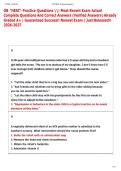
D A 30-year-old multiparous woman who has a 3-year-old boy and a newborn girl tells the nurse, "My son is so jealous of my daughter, I don't know how I'll ever manage both children when I get home." How should the nurse respond? A. "Tell the older child that he is a big boy now and should love his new sister." B. "Ask friends and relatives not to bring gifts to the older sibling because you do not want to spoil him." C. "Let the older child stay with his grandparents for the first six weeks to allow him to adjust to the newborn." D. "Regression in behaviors in the older child is a typical reaction so he needs attention at this time." A A vaginally delivered infant of an HIV positive mother is admitted to the newborn nursery. What intervention should the nurse perform first? A. Bathe the infant with an antimicrobial soap B. Measure the head and chest circumference C. Obtain the infant's footprints D. Administer vitamin K 2/27/26, 10:25 AM OB "HESI" Practice Questions 2/47 A A client in active labor is admitted with preeclampsia. Which assessment finding is most significant in planning this client's care? A. Patellar reflex 4+ B. Blood pressure 158/80 C. Four-hour urine output 240 ml D. Respiration 12/minute A A pregnany client with mitral stenosis Class III is prescribed complete bedrest. The client asks the nurse, "Why must I stay in bed all the time?" Which response is best for the nurse to provide this client? A. "Complete bedrest decreases oxygen needs and demands on the heart muscle tissue." B. "We want your baby to be healthy, and this is the only way we can make sure that will happen." C. "I know you're upset. Would you like to talk about some things you could do while in bed?" D. "Labor is difficult and you need to use this time to rest before you have to assume all child-caring duties." 2/27/26, 10:25 AM OB "HESI" Practice Questions 3/47 CDF The nurse is preparing a client with a term pregnancy who is in active labor for an amniotomy. What equipment should the nurse have available at the client's bedside? (Select all that apply) A. Litmus paper B. Fetal scalp electrode C. A sterile glove D. An amnihook E. Sterile vaginal speculum F. Lubricant D The nurse is preparing to give an enema to a laboring client. Which client requires the most caution when carrying out this procedure? A. A gravida 6. para 5 who is 38 years of age and in early labor B. A 37-week primigravida who presents at 100% effacement, 3 cm dilatation, and a -1 station C. A gravida 2, para 1 who is at 1 cm cervical dilatation and a 0 station admitted for induction of labor due to post dates D. A 40-week primigravida who is at 6 cm cervical dilatation and the presenting part is not engaged 2/27/26, 10:25 AM OB "HESI" Practice Questions 4/47 D A primigravida client who is 5 cm dilated, 90% effaced, and at 0 station is requesting an epidural for pain relief. Which assessment finding is most important for the nurse to report to the healthcare provider? A. Cervical dilation of 5 cm with 90% effacement B. White blood cell count of 12,000/mm3 C. Hemoglobin of 12 mg/dl and hematocrit of 38% D. A platelet count of 67,000/mm3 A The father of a newborn tells the nurse, "My son just died." How should the nurse respond A. "I am sorry for your loss." B. "I understand how you feel." C. "There is an angel in heaven." D. "You can have other children." C A macrosomic infant is in stable condition after a difficult forceps-assisted delivery. After obtaining the infant's weight at 4550 grams (9 lbs., 6 oz.), what is the priority nursing action? A. Assess newborn reflexes for signs of neurological impairment. B. Leave the infant in the room with the mother to foster attachment. C. Obtain serum glucose levels frequently while observing for signs of hypoglycemia. D. Perform a gestational age assessment to determine if the infant is large-for- gestational-age. 2/27/26, 10:25 AM OB "HESI" Practice Questions D The nurse is calculating the estimated date of confinement (EDC) using Ngele's rule for a client whose last menstrual period started on December 1. Which date is most accurate? A. August 1 B. August 10 C. September 3 D. September 8 ABC The nurse is performing a gestational age assessment on a full-term newborn during the first hour of transition using the Ballard (Dubowitz) scale. Based on this assessment, the nurse determines that the neonate has a maturity rating of 40-weeks. What findings should the nurse identify to determine if the neonate is small for gestational age (SGA)? (Select all that apply.) A. Admission weight of 4 pounds, 15 ounces (2244 grams) B. Head to heel length of 17 inches (42.5 cm) E. Anterior plantar crease and smooth heel surfaces F. full flexion of all extremities in resting supine position C. Frontal occipital circumference of 12.5 inches (31.25 cm) D. Skin smooth with visible veins and abundant vernix C The nurse is assessing the umbilical cord of a newborn. Which finding constitutes a normal finding? A. Two vessels; one artery and one vein B. Two vessels; two arteries and no veins C. Three vessels; two arteries and one vein D. Three vessels; two veins and one artery 5/47 2/27/26, 10:25 AM OB "HESI" Practice Questions 6/47 A A full term infant is admitted to the newborn nursery. After careful assessment, the nurse suspects that the infant may have an esophageal atresia. Which symptoms is this newborn likely to exhibit? A. Choking, coughing, and cyanosis B. Projectile vomiting and cyanosis C. Apneic spells and grunting D. Scaphoid abdomen and anorexia A A women with Type 2 diabetes mellitus becomes pregnant, and her oral hypoglycemic agents are discontinued. Which intervention is most important for the nurse to implement? A. Describe diet changes that can improve the management of her diabetes B. Inform the client that oral hypoglycemic agents are teratogenic during pregnancy C. Demonstrate self-administration of insulin D. Evaluate the client's ability to do glucose monitoring C A client at 30-weeks gestation, complaining of pressure over the pubic area, is admitted for observation. She is contracting irregularly and demonstrates underlying uterine irritability. Vaginal examination reveals that her cervix is closed, thick, and high. Based on these data, which intervention should the nurse implement first? A. Provide oral hydration B. Have a complete blood count (CBC) drawn C. Obtain a specimen for urine analysis D. Place the client on strict bedrest 2/27/26, 10:25 AM OB "HESI" Practice Questions 7/47 A A woman who thinks she could be pregnant calls her neighbor, a nurse, to ask when she could use a home pregnancy test to diagnose pregnancy. Which response appropriate? A. "A home pregnancy test can be used right after your missed period." B. "These tests are most accurate after you have missed your second period." C. "Home pregnancy tests often give false positives and should not be trusted." D. "The test can provide accurate information when used right after ovulation." B A client who is attending antepartum classes asks the nurse why her healthcare provider has prescribed iron tablets. The nurse's response is based on what knowledge? A. Supplementary iron is more efficiently utilized during pregnancy B. It is difficult to consume 18 mg of additional iron by diet alone C. Iron absorption is decreased in the GI tract during pregnancy D. Iron is needed to prevent megaloblastic anemia in the last trimester B A female client with insulin-dependent diabetes arrives at the clinic seeking a plan to get pregnant in approximately 6 months. She tells the nurse that she wants to have an uncomplicated pregnancy and a healthy baby. What information should the nurse share with the client? A. "Your current dose of insulin should be maintained throughout your pregnancy." B. "Maintain blood sugar levels in a constant range within normal limits during pregnancy." C. "The course and outcome of your pregnancy is not an achievable goal with diabetes." D. "Expect an increase in insulin dosages by 5 units/week during the first trimester." 2/27/26, 10:25 AM OB "HESI" Practice Questions 8/47 A The nurse is providing discharge teaching for a client who is 24 hours postpartum. The nurse explains to the client that her vaginal discharge will change from red to pink and then to white. The client asks, "What if I start having red bleeding AFTER it changes?" What should the nurse instruct the client to do? A. Reduce activity level and notify the healthcare provider B. Go to bed and assume a knee-chest position C. Massage the uterus and go to the emergency room D. Do not worry as this is a normal occurance D Just after delivery, a new mother tells the nurse, "I was unsuccessful breastfeeding my first child, but I would like to try with this baby." Which intervention is best for the nurse to implement first? A. Assess the husband's feelings about his wife's decision to breastfeed their baby B. Ask the client to describe why she was unsuccessful with breastfeeding her last child C. Encourage the client to develop a positive attitude about breastfeeding to help ensure success D. Provide assistance to the mother to begin breastfeeding as soon as possible after delivery A Immediately after birth a newborn infant is suctioned, dried, and placed under a radiant warmer. The infant has spontaneous respirations and the nurse assesses an apical heart rate of 80 beats/minute and respirations of 20 breaths/minute. What action should the nurse perform next? A. Initiate positive pressure ventilation B. Intervene after the one minute Apgar is assessed C. Initiate CPR on the infant D. Assess the infant's blood glucose level 2/27/26, 10:25 AM OB "HESI" Practice Questions 9/47 A A 42-week gestational client is receiving an intravenous infusion of oxytocin (Pitocin) to augment early labor. the nurse should discontinue the oxytocin infusion for which pattern of contractions? A. Transition labor with contractions every 2 minutes, lasting 90 seconds each B. Early labor with contractions every 5 minutes, lasting 40 seconds each C. Active labor with contractions every 31 minutes, lasting 60 seconds each D. Active labor with contractions every 3 to 3 minutes, lasting 70 to 80 seconds each A The nurse is teaching a woman how to use her basal body temperature (BBT) pattern as a tool to assist her in conceiving a child. Which temperature pattern indicates the occurrence of ovulation, and therefore, the best time for intercourse to ensure conception? A. Between the time the temperature falls and rises B. Between 36 and 48 hours after the temperature rises C. When the temperature falls and remains low for 36 hours D. Within 72 hours before the temperature falls

Vista previa del contenido

2/27/26, 10:25 AM OB "HESI" Practice Questions


OB "HESI" Practice Questions \\| Most Recent Exam Actual
Complete Questions And Correct Answers (Verified Answers) Already
Graded A+ | Guaranteed Success!! Newest Exam | Just Released!!
2026-2027


D


A 30-year-old multiparous woman who has a 3-year-old boy and a newborn
girl tells the nurse, "My son is so jealous of my daughter, I don't know how I'll
ever manage both children when I get home." How should the nurse
respond?


A. "Tell the older child that he is a big boy now and should love his new sister."
B. "Ask friends and relatives not to bring gifts to the older sibling because
you do not want to spoil him."
C. "Let the older child stay with his grandparents for the first six weeks to
allow him to adjust to the newborn."
D. "Regression in behaviors in the older child is a typical reaction so he needs
attention at this time."

A


A vaginally delivered infant of an HIV positive mother is admitted to the
newborn nursery. What intervention should the nurse perform first?
A. Bathe the infant with an antimicrobial soap
B. Measure the head and chest circumference
C. Obtain the infant's footprints
D. Administer vitamin K


1/47

,2/27/26, 10:25 AM OB "HESI" Practice Questions


A


A client in active labor is admitted with preeclampsia. Which assessment finding
is most significant in planning this client's care?
A. Patellar reflex 4+
B. Blood pressure 158/80
C. Four-hour urine output 240 ml
D. Respiration 12/minute


A


A pregnany client with mitral stenosis Class III is prescribed complete bedrest.
The client asks the nurse, "Why must I stay in bed all the time?" Which
response is best for the nurse to provide this client?
A. "Complete bedrest decreases oxygen needs and demands on the heart
muscle tissue."
B. "We want your baby to be healthy, and this is the only way we can make sure
that will happen."
C. "I know you're upset. Would you like to talk about some things you could
do while in bed?"
D. "Labor is difficult and you need to use this time to rest before you have to
assume all child-caring duties."


2/47

,2/27/26, 10:25 AM OB "HESI" Practice Questions


CDF


The nurse is preparing a client with a term pregnancy who is in active labor for
an amniotomy. What equipment should the nurse have available at the client's
bedside? (Select all that apply)
A. Litmus paper
B. Fetal scalp electrode
C. A sterile glove
D. An amnihook
E. Sterile vaginal speculum
F. Lubricant


D


The nurse is preparing to give an enema to a laboring client. Which client
requires the most caution when carrying out this procedure?
A. A gravida 6. para 5 who is 38 years of age and in early labor
B. A 37-week primigravida who presents at 100% effacement, 3 cm
dilatation, and a -1 station
C. A gravida 2, para 1 who is at 1 cm cervical dilatation and a 0
station admitted for induction of labor due to post dates
D. A 40-week primigravida who is at 6 cm cervical dilatation and the
presenting part is not engaged


3/47

, 2/27/26, 10:25 AM OB "HESI" Practice Questions


D


A primigravida client who is 5 cm dilated, 90% effaced, and at 0 station is
requesting an epidural for pain relief. Which assessment finding is most
important for the nurse to report to the healthcare provider?
A. Cervical dilation of 5 cm with 90% effacement
B. White blood cell count of 12,000/mm3
C. Hemoglobin of 12 mg/dl and hematocrit of 38%
D. A platelet count of 67,000/mm3


A


The father of a newborn tells the nurse, "My son just died." How should the
nurse respond
A. "I am sorry for your loss."
B. "I understand how you feel."
C. "There is an angel in heaven."
D. "You can have other children."


C


A macrosomic infant is in stable condition after a difficult forceps-assisted
delivery. After obtaining the infant's weight at 4550 grams (9 lbs., 6 oz.), what is
the priority nursing action?
A. Assess newborn reflexes for signs of neurological impairment.
B. Leave the infant in the room with the mother to foster attachment.
C. Obtain serum glucose levels frequently while observing for signs of
hypoglycemia.
D. Perform a gestational age assessment to determine if the infant is
large-for- gestational-age.


4/47

Información del documento

Subido en
27 de febrero de 2026
Número de páginas
47
Escrito en
2025/2026
Tipo
Examen
Contiene
Preguntas y respuestas
20,47 €

¿Documento equivocado? Cámbialo gratis Dentro de los 14 días posteriores a la compra y antes de descargarlo, puedes elegir otro documento. Puedes gastar el importe de nuevo.
Escrito por estudiantes que aprobaron
Inmediatamente disponible después del pago
Leer en línea o como PDF

Seller avatar
Los indicadores de reputación están sujetos a la cantidad de artículos vendidos por una tarifa y las reseñas que ha recibido por esos documentos. Hay tres niveles: Bronce, Plata y Oro. Cuanto mayor reputación, más podrás confiar en la calidad del trabajo del vendedor.
NURSEGENLPN
4,0
(21)
Vendido
144
Seguidores
4
Artículos
10663
Última venta
3 días hace


Por qué los estudiantes eligen Stuvia

Creado por compañeros estudiantes, verificado por reseñas

Calidad en la que puedes confiar: escrito por estudiantes que aprobaron y evaluado por otros que han usado estos resúmenes.

¿No estás satisfecho? Elige otro documento

¡No te preocupes! Puedes elegir directamente otro documento que se ajuste mejor a lo que buscas.

Paga como quieras, empieza a estudiar al instante

Sin suscripción, sin compromisos. Paga como estés acostumbrado con tarjeta de crédito y descarga tu documento PDF inmediatamente.

Student with book image

“Comprado, descargado y aprobado. Así de fácil puede ser.”

Alisha Student

¿Trabajando en tus referencias?

Crea citas precisas en APA, MLA y Harvard con nuestro generador de citas gratuito.

¿Trabajando en tus referencias?

Preguntas frecuentes

