ENERGETICS II
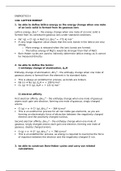
13A: LATTICE ENERGY
1. be able to define lattice energy as the energy change when one mole
of an ionic solid is formed from its gaseous ions
Lattice energy, ΔHLEϴ – the energy change when one mole of an ionic solid is
formed from its constituent gaseous ions under standard conditions.
Na+ (g) + Cl- (g) NaCl (s), ΔHLEϴ = -775 kJ mol-1
A very large negative value shows that the ionic bonds in the lattice are very
strong.
o More energy is released when the ionic bonds are formed.
o The lattice energy of MgCl2 would be stronger than that of NaCl.
Born-Haber cycles are used to indirectly determine lattice energy as it cannot
be measured directly.
2. be able to define the terms:
i) enthalpy change of atomisation, ΔatH
Enthalpy change of atomisation, ΔHatϴ – the enthalpy change when one mole of
gaseous atoms is formed from the element in its standard state.
This is always an endothermic process, as bonds are broken.
Na (s) Na (g), ΔatH = + 108 kJ mol-1
Cl2 (g) Cl (g), ΔatH = + 121 kJ mol-1
ii) electron affinity
First electron affinity, ΔHEA1ϴ – the enthalpy change when one mole of gaseous
atoms each gain one electron, forming one mole of gaseous, singly charged
anions.
Cl (g) + e- Cl- (g), ΔHEA1ϴ = – 364 kJ mol-1
This is an exothermic process for all non-noble gas elements, as you are
forming an electrostatic force of attraction between the negatively charged
electron and the positively charged nucleus.
Second electron affinity, ΔHEA2ϴ – the enthalpy change when one mole of
gaseous, singly charged anions each gain one electron, forming one mole of
gaseous, doubly charged anions.
O (g) + e- O2- (g), ΔHEA1ϴ = + 798 kJ mol-1
This is an endothermic process, as energy is required to overcome the force
of repulsion between the electron and the negatively charged O - ion.
3. be able to construct Born-Haber cycles and carry out related
calculations
, A Born-Haber cycle is another application of Hess’ Law that can be used to
calculate lattice energy.
They are often shown as an energy diagram, with exothermic ΔH values
pointing downwards and endothermic ΔH values pointing upwards.
The steps involved, e.g. for CaCl 2:
Process Equation Enthalpy
change
Atomisation of ΔHatϴ[Ca Ca (s) Ca (g) Endothermic
cation (s)]
Ionisation of ΔHIE1ϴ[Ca Ca (g) Ca+ (g) + e- Endothermic
cation (g)]
Ionisation of ΔHIE1ϴ[Ca+ Ca+ (g) Ca2+ (g) + e- Endothermic
cation (g)]
Atomisation of ΔHatϴ[Cl2 Cl2 (g) 2 Cl (g) Endothermic
anion (g)]
Ionisation of ΔHEA1ϴ[Cl Cl + e- (g) Cl- (g) Exothermic
anion (g)]
Lattice energy of ΔHLEϴ[CaCl2 Ca2+ (g) + 2 Cl- (g) Exothermic
CuCl2 (s)] CaCl2 (s)
Calculating enthalpy change values using a Born-Haber cycle:
Hess’ law tells us that the enthalpy change accompanying a chemical change
is independent of the route by which the chemical change occurs.
o This enables us to calculate certain enthalpy changes using the other
data available.
N.B. When the stoichiometry is not 1:1, you must multiply the enthalpy
changes accordingly.
o 2 Fe (g) + 1.5 O2 (g) 2 Fe (g) + 3 O (g)
o ΔHatϴ[O2 (g)] = +249.2 kJ mol-1
o You are forming 3 moles of oxygen atoms, so the enthalpy change for
this equation would be 3 x ΔHatϴ[O2 (g)] = 3 x +249.2 kJ mol-1 = +
747.6 kJ mol-1
We can calculate the lattice energy of NaCl using the data given in the Born-
Haber cycle below:
o ΔHLEϴ[NaCl] = ΔHfϴ[NaCl] – ΔHatϴ[Na] – ΔHIE1ϴ[Na] – ΔHatϴ[Cl2] – ΔHEA1ϴ[Cl]
o ΔHLEϴ[NaCl (s)] = – 411 – 107 – 496 – 122 + 349 = – 787 kJ mol -1
13A: LATTICE ENERGY
1. be able to define lattice energy as the energy change when one mole
of an ionic solid is formed from its gaseous ions
Lattice energy, ΔHLEϴ – the energy change when one mole of an ionic solid is
formed from its constituent gaseous ions under standard conditions.
Na+ (g) + Cl- (g) NaCl (s), ΔHLEϴ = -775 kJ mol-1
A very large negative value shows that the ionic bonds in the lattice are very
strong.
o More energy is released when the ionic bonds are formed.
o The lattice energy of MgCl2 would be stronger than that of NaCl.
Born-Haber cycles are used to indirectly determine lattice energy as it cannot
be measured directly.
2. be able to define the terms:
i) enthalpy change of atomisation, ΔatH
Enthalpy change of atomisation, ΔHatϴ – the enthalpy change when one mole of
gaseous atoms is formed from the element in its standard state.
This is always an endothermic process, as bonds are broken.
Na (s) Na (g), ΔatH = + 108 kJ mol-1
Cl2 (g) Cl (g), ΔatH = + 121 kJ mol-1
ii) electron affinity
First electron affinity, ΔHEA1ϴ – the enthalpy change when one mole of gaseous
atoms each gain one electron, forming one mole of gaseous, singly charged
anions.
Cl (g) + e- Cl- (g), ΔHEA1ϴ = – 364 kJ mol-1
This is an exothermic process for all non-noble gas elements, as you are
forming an electrostatic force of attraction between the negatively charged
electron and the positively charged nucleus.
Second electron affinity, ΔHEA2ϴ – the enthalpy change when one mole of
gaseous, singly charged anions each gain one electron, forming one mole of
gaseous, doubly charged anions.
O (g) + e- O2- (g), ΔHEA1ϴ = + 798 kJ mol-1
This is an endothermic process, as energy is required to overcome the force
of repulsion between the electron and the negatively charged O - ion.
3. be able to construct Born-Haber cycles and carry out related
calculations
, A Born-Haber cycle is another application of Hess’ Law that can be used to
calculate lattice energy.
They are often shown as an energy diagram, with exothermic ΔH values
pointing downwards and endothermic ΔH values pointing upwards.
The steps involved, e.g. for CaCl 2:
Process Equation Enthalpy
change
Atomisation of ΔHatϴ[Ca Ca (s) Ca (g) Endothermic
cation (s)]
Ionisation of ΔHIE1ϴ[Ca Ca (g) Ca+ (g) + e- Endothermic
cation (g)]
Ionisation of ΔHIE1ϴ[Ca+ Ca+ (g) Ca2+ (g) + e- Endothermic
cation (g)]
Atomisation of ΔHatϴ[Cl2 Cl2 (g) 2 Cl (g) Endothermic
anion (g)]
Ionisation of ΔHEA1ϴ[Cl Cl + e- (g) Cl- (g) Exothermic
anion (g)]
Lattice energy of ΔHLEϴ[CaCl2 Ca2+ (g) + 2 Cl- (g) Exothermic
CuCl2 (s)] CaCl2 (s)
Calculating enthalpy change values using a Born-Haber cycle:
Hess’ law tells us that the enthalpy change accompanying a chemical change
is independent of the route by which the chemical change occurs.
o This enables us to calculate certain enthalpy changes using the other
data available.
N.B. When the stoichiometry is not 1:1, you must multiply the enthalpy
changes accordingly.
o 2 Fe (g) + 1.5 O2 (g) 2 Fe (g) + 3 O (g)
o ΔHatϴ[O2 (g)] = +249.2 kJ mol-1
o You are forming 3 moles of oxygen atoms, so the enthalpy change for
this equation would be 3 x ΔHatϴ[O2 (g)] = 3 x +249.2 kJ mol-1 = +
747.6 kJ mol-1
We can calculate the lattice energy of NaCl using the data given in the Born-
Haber cycle below:
o ΔHLEϴ[NaCl] = ΔHfϴ[NaCl] – ΔHatϴ[Na] – ΔHIE1ϴ[Na] – ΔHatϴ[Cl2] – ΔHEA1ϴ[Cl]
o ΔHLEϴ[NaCl (s)] = – 411 – 107 – 496 – 122 + 349 = – 787 kJ mol -1