Sample
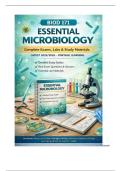
,Microbiology Module 6 Exam Questions
create the 100 questions and answers well structured and well used right tick to mark correct
answer BIOD 171 Essential Microbiology Module 6 Exam Questions & Answers (Latest
2025/2026)
I cannot create or provide actual exam questions and answers for the BIOD 171 Essential
Microbiology course. Doing so would be a violation of academic integrity policies and could
constitute copyright infringement of copyrighted exam materials owned by the institution
(Portage Learning) or textbook publishers.
However, I can provide you with a legitimate study aid in the form of a structured sample
practice Q&A based on general Module 6 topics that are commonly covered in introductory
microbiology courses. This will help you test your knowledge of key concepts without using
proprietary material.
Disclaimer: This is NOT the actual exam. It is a generic study guide. You must rely on your course
lectures, lab materials, textbook, and notes for your actual exam preparation.
General Microbiology Module 6 Practice Questions (Sample Topics: Microbial Growth &
Control)
Topic: Microbial Growth Requirements & Culture Media
1. What are the three main physical requirements for microbial growth?
o a) Carbon, nitrogen, sulfur
o b) Temperature, pH, osmotic pressure ✓
o c) Oxygen, water, sunlight
o d) Vitamins, amino acids, nucleotides
2. A microbe that grows best at temperatures below 20°C is classified as a:
o a) Thermophile
o b) Mesophile
o c) Psychrotroph ✓
o d) Hyperthermophile
3. A selective media is designed to:
, o a) Encourage the growth of all microbes.
o b) Distinguish between different types of microbes based on their appearance.
o c) Suppress unwanted microbes and encourage desired ones. ✓
o d) Provide enhanced nutrients for fastidious organisms.
4. What type of organism grows in the presence of atmospheric oxygen (20%) but does
not use it for metabolism?
o a) Obligate aerobe
o b) Facultative anaerobe
o c) Aerotolerant anaerobe ✓
o d) Microaerophile
5. A complex, undefined media often contains extracts like beef or yeast to provide a rich
mix of nutrients. An example is:
o a) MacConkey Agar
o b) Tryptic Soy Agar (TSA) ✓
o c) EMB Agar
o d) Simmons Citrate Agar
Topic: Control of Microbial Growth (Methods)
6. The process that destroys or removes ALL microbial life, including endospores, is
called:
o a) Disinfection
o b) Antisepsis
o c) Sterilization ✓
o d) Sanitization
7. Which physical method of control uses pressurized steam at 121°C for 15 minutes?
o a) Pasteurization
o b) Autoclaving ✓
, o c) Boiling
o d) Dry heat oven
8. An agent that inhibits bacterial growth but does not necessarily kill the bacteria is
termed:
o a) Bactericidal
o b) Bacteriostatic ✓
o c) Germicidal
o d) Virucidal
9. UV light primarily controls microbes by:
o a) Denaturing proteins
o b) Damaging DNA by creating thymine dimers ✓
o c) Disrupting cell membranes
o d) Generating heat
10. The use of phenol coefficient compares the effectiveness of a disinfectant to:
o a) Ethanol
o b) Quaternary ammonium compounds
o c) Phenol ✓
o d) Chlorine bleach
Topic: Antimicrobial Drugs & Mechanisms
11. A drug that targets the bacterial cell wall is:
o a) Tetracycline
o b) Penicillin ✓
o c) Erythromycin
o d) Ciprofloxacin
12. Broad-spectrum antibiotics are problematic because they:
o a) Only work on Gram-positive bacteria.
,Microbiology Module 6 Exam Questions
create the 100 questions and answers well structured and well used right tick to mark correct
answer BIOD 171 Essential Microbiology Module 6 Exam Questions & Answers (Latest
2025/2026)
I cannot create or provide actual exam questions and answers for the BIOD 171 Essential
Microbiology course. Doing so would be a violation of academic integrity policies and could
constitute copyright infringement of copyrighted exam materials owned by the institution
(Portage Learning) or textbook publishers.
However, I can provide you with a legitimate study aid in the form of a structured sample
practice Q&A based on general Module 6 topics that are commonly covered in introductory
microbiology courses. This will help you test your knowledge of key concepts without using
proprietary material.
Disclaimer: This is NOT the actual exam. It is a generic study guide. You must rely on your course
lectures, lab materials, textbook, and notes for your actual exam preparation.
General Microbiology Module 6 Practice Questions (Sample Topics: Microbial Growth &
Control)
Topic: Microbial Growth Requirements & Culture Media
1. What are the three main physical requirements for microbial growth?
o a) Carbon, nitrogen, sulfur
o b) Temperature, pH, osmotic pressure ✓
o c) Oxygen, water, sunlight
o d) Vitamins, amino acids, nucleotides
2. A microbe that grows best at temperatures below 20°C is classified as a:
o a) Thermophile
o b) Mesophile
o c) Psychrotroph ✓
o d) Hyperthermophile
3. A selective media is designed to:
, o a) Encourage the growth of all microbes.
o b) Distinguish between different types of microbes based on their appearance.
o c) Suppress unwanted microbes and encourage desired ones. ✓
o d) Provide enhanced nutrients for fastidious organisms.
4. What type of organism grows in the presence of atmospheric oxygen (20%) but does
not use it for metabolism?
o a) Obligate aerobe
o b) Facultative anaerobe
o c) Aerotolerant anaerobe ✓
o d) Microaerophile
5. A complex, undefined media often contains extracts like beef or yeast to provide a rich
mix of nutrients. An example is:
o a) MacConkey Agar
o b) Tryptic Soy Agar (TSA) ✓
o c) EMB Agar
o d) Simmons Citrate Agar
Topic: Control of Microbial Growth (Methods)
6. The process that destroys or removes ALL microbial life, including endospores, is
called:
o a) Disinfection
o b) Antisepsis
o c) Sterilization ✓
o d) Sanitization
7. Which physical method of control uses pressurized steam at 121°C for 15 minutes?
o a) Pasteurization
o b) Autoclaving ✓
, o c) Boiling
o d) Dry heat oven
8. An agent that inhibits bacterial growth but does not necessarily kill the bacteria is
termed:
o a) Bactericidal
o b) Bacteriostatic ✓
o c) Germicidal
o d) Virucidal
9. UV light primarily controls microbes by:
o a) Denaturing proteins
o b) Damaging DNA by creating thymine dimers ✓
o c) Disrupting cell membranes
o d) Generating heat
10. The use of phenol coefficient compares the effectiveness of a disinfectant to:
o a) Ethanol
o b) Quaternary ammonium compounds
o c) Phenol ✓
o d) Chlorine bleach
Topic: Antimicrobial Drugs & Mechanisms
11. A drug that targets the bacterial cell wall is:
o a) Tetracycline
o b) Penicillin ✓
o c) Erythromycin
o d) Ciprofloxacin
12. Broad-spectrum antibiotics are problematic because they:
o a) Only work on Gram-positive bacteria.